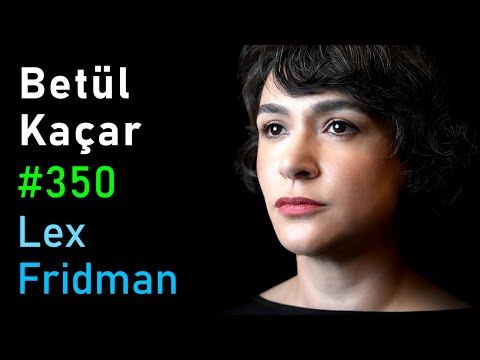
Betül Kaçar: Origin of Life, Ancient DNA, Panspermia, and Aliens | Lex Fridman Podcast #350
Betül Kaçar (guest), Lex Fridman (host), Narrator
In this episode of Lex Fridman Podcast, featuring Betül Kaçar and Lex Fridman, Betül Kaçar: Origin of Life, Ancient DNA, Panspermia, and Aliens | Lex Fridman Podcast #350 explores ancient Chemistry to Alien Life: Betül Kaçar Rethinks Origins Betül Kaçar, an astrobiologist, explores how life emerged from chemistry, focusing on the translation machinery that turns genetic information into functional proteins as a foundational, quasi-computational system. She explains how phylogenetic trees and resurrected ancient genes let us reconstruct deep evolutionary history, probing key singular innovations like nitrogen fixation, photosynthesis, and eukaryotes. The conversation contrasts geology’s fragmentary rock record with biology’s overwritten genomic record, showing how both constrain our stories about early life and possible life elsewhere. Kaçar also wrestles with panspermia, the ethics of seeding other planets with ‘protospermia,’ and what it means for humans to be a late, fragile, but profoundly meaningful product of planetary chemistry.
Ancient Chemistry to Alien Life: Betül Kaçar Rethinks Origins
Betül Kaçar, an astrobiologist, explores how life emerged from chemistry, focusing on the translation machinery that turns genetic information into functional proteins as a foundational, quasi-computational system. She explains how phylogenetic trees and resurrected ancient genes let us reconstruct deep evolutionary history, probing key singular innovations like nitrogen fixation, photosynthesis, and eukaryotes. The conversation contrasts geology’s fragmentary rock record with biology’s overwritten genomic record, showing how both constrain our stories about early life and possible life elsewhere. Kaçar also wrestles with panspermia, the ethics of seeding other planets with ‘protospermia,’ and what it means for humans to be a late, fragile, but profoundly meaningful product of planetary chemistry.
Key Takeaways
Life’s core ‘computer’ is the translation machinery linking information to function.
The ribosome–translation system converts mRNA sequences into proteins and uniquely combines chemistry, physics, informatics, computation, and biology; every known Earth life-form depends on it, and disrupting any of its major steps kills the cell.
Get the full analysis with uListen AI
The genetic code is robust and error-tolerant by design of evolution, not humans.
With 64 codons but only 20 amino acids plus start/stop signals, the code is redundant: many mutations still yield the same or similar amino acids, letting messages survive errors and giving life resilience at the information level.
Get the full analysis with uListen AI
A few singular molecular innovations reshaped the entire planet.
Processes like nitrogen fixation (via nitrogenase), oxygenic photosynthesis in cyanobacteria, and the emergence of eukaryotes and endosymbiosis appear to have arisen once, yet they permanently altered Earth’s atmosphere, ecosystems, and evolutionary potential.
Get the full analysis with uListen AI
Experimental evolution shows evolution ‘focuses’ and often stalls before full optimization.
Kaçar’s lab replaces modern elongation factors with ancestral or distant versions in bacteria, then evolves them; populations tend to improve one module at a time and often stop short of the theoretical optimum before switching to adapt other parts of the cellular network.
Get the full analysis with uListen AI
We study only survivors and fragmentary rocks, so deep-time biology is inherently foggy.
Genomes are four-billion-year products that continuously rewrite their own history, while the rock record is sparse and contingent; reconstructing early life demands integrating limited geological imprints with phylogenetic inference and careful modeling.
Get the full analysis with uListen AI
Origin-of-life chemistry is close to demonstrating self-organizing, evolving systems.
We can now make building blocks like RNA and amino acids under plausible early-Earth conditions and see them interact; Kaçar expects the next major step is lab systems that show basic heredity, environmental responsiveness, and open-ended evolution.
Get the full analysis with uListen AI
Seeding other worlds (protospermia) raises profound ethical and scientific questions.
Rather than shipping whole cells, Kaçar imagines someday adding compatible ‘fertilizer’ chemistry to planets already close to their own chemical tipping point, forcing us to decide whether we have a responsibility to propagate life—or whether we risk spreading suffering.
Get the full analysis with uListen AI
Notable Quotes
“You can study chemistry, you can study physics, you can study geology anywhere in the universe, but this is the only place you can study biology.”
— Betül Kaçar
“This is the oldest computational device of life… more complicated in interesting ways than the computers we have today.”
— Betül Kaçar
“If you don’t like microbes, you are on the wrong planet.”
— Betül Kaçar
“Good planets are hard to find. If we are alone in the universe, that’s huge.”
— Betül Kaçar
“There is no room for arrogance. It should overwhelm you and humiliate you… It’s quite amazing what happened here.”
— Betül Kaçar
Questions Answered in This Episode
If we could experimentally evolve a minimal translation system from simple chemistry, would you consider that a true origin-of-life demonstration, or is there still another missing step?
Betül Kaçar, an astrobiologist, explores how life emerged from chemistry, focusing on the translation machinery that turns genetic information into functional proteins as a foundational, quasi-computational system. ...
Get the full analysis with uListen AI
How might our definition of ‘life’ change if we discover systems elsewhere that compute and evolve without DNA, RNA, or proteins?
Get the full analysis with uListen AI
Do the apparent singularities in evolution—like nitrogen fixation and eukaryotes—reflect historical accidents, deep chemical constraints, or both?
Get the full analysis with uListen AI
What ethical framework should guide any future attempt to ‘fertilize’ another planet’s chemistry and potentially trigger life there?
Get the full analysis with uListen AI
Given how much genomic history has been overwritten, what do you think we will never be able to know about Earth’s earliest life, no matter how good our tools become?
Get the full analysis with uListen AI
Transcript Preview
You can study chemistry, you can study physics, you can study geology anywhere in the universe, but this is the only place you can study biology. This is the only place to be a biologist.
Earth.
That's it.
Yeah.
So, so, definitely something very fundamental happened here, and you cannot take biology out of the equation. If you want to understand how that vast chemistry space, how that general sequence space got narrowed down to what was, what is available or what is used by life, you need to understand the rules of selection. And that's where evolution and biology comes into play.
The following is a conversation with Betul Kacar, an astrobiologist at University of Wisconsin, studying the essential biological attributes of life. This is the Lex Fridman Podcast. To support it, please check out our sponsors in the description, and now, dear friends, here's Betul Kacar. What is the phylogenetic tree, or the evolutionary tree of life, and what can we learn by running it back and studying ancient gene sequences as you have?
I think phylogenetic trees could be one of the most, uh, romantic and, um, beautiful notions that can come out of biology. It shows us a way to depict the connectedness of life and all living beings with one another. It itself is an ever-evolving notion. Biologists like visualizations. They like these graphics, these diagrams, and tree of life is one of them.
So, the tree starts at a common ancestor.
It's actually the other way around. It starts (laughs) from-
At the end? (laughs)
It starts from the, um, from the branches. It starts from the tip of the branch, actually, and then, uh, you f- do further, d- depending on how, what you collected, uh, to build the tree. So, depending on the branches, depending on what's on the tip of the branch, and I will explain what I mean, the root will be determined by what is really sitting on the tip of the branch of the tree.
So, we could study the leaves of the tree by looking at what we have today and then start to, uh, reverse engineer it, start to move back in time to try to understand what the rest of the tree, what the roots of the tree look like?
Exactly. So, the tree itself, by just taking a few steps back and looking at the entire tree itself, can give you an idea about the connectedness, the relatedness of the organisms, or whatever, again, you use to create your tree. There are different ways. But, I mean, in this case, I'm imagining entire diversity of life today is sitting on the tips of the branches of this tree. And we, um, look at, biologists look at the, the tree itself. We like to think of it as the topology of the tree, to understand when certain organisms or their ancestry may have merged over time. Depending on, uh, the tools you use, you might use this tree to then reconstruct the ancestors as well.
Install uListen to search the full transcript and get AI-powered insights
Get Full TranscriptGet more from every podcast
AI summaries, searchable transcripts, and fact-checking. Free forever.
Add to Chrome