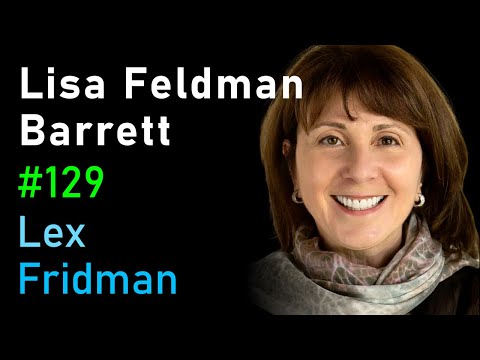
Lisa Feldman Barrett: Counterintuitive Ideas About How the Brain Works | Lex Fridman Podcast #129
Lex Fridman (host), Lisa Feldman Barrett (guest)
In this episode of Lex Fridman Podcast, featuring Lex Fridman and Lisa Feldman Barrett, Lisa Feldman Barrett: Counterintuitive Ideas About How the Brain Works | Lex Fridman Podcast #129 explores neuroscientist Lisa Feldman Barrett Redefines Emotion, Prediction, and Empathy Lisa Feldman Barrett explains the brain as a prediction and body-regulation machine rather than a stimulus–response device, arguing that it constantly uses past experience to anticipate and construct our perceptions, actions, and emotions.
Neuroscientist Lisa Feldman Barrett Redefines Emotion, Prediction, and Empathy
Lisa Feldman Barrett explains the brain as a prediction and body-regulation machine rather than a stimulus–response device, arguing that it constantly uses past experience to anticipate and construct our perceptions, actions, and emotions.
She rejects the popular triune brain and “inner lizard” model, proposing instead that emotions are not hardwired reflexes but concepts our brains construct on the fly to make sense of bodily sensations in context.
This predictive view illuminates free will, social reality, empathy, and political polarization: our internal models are shaped by culture, metabolism, and exposure, which constrain what we can “see” and feel in others.
Barrett emphasizes that humans have socially dependent nervous systems; cultivating curiosity, diverse experiences, and deliberate empathy is both metabolically costly and essential for well-being, democracy, and meaningful relationships.
Key Takeaways
The brain’s primary job is prediction and body regulation, not passive perception.
Barrett argues the brain is trapped in a “dark, silent box” and must infer causes of sensory input using past experience, continuously predicting and adjusting to keep the body’s resources (the “body budget”) in balance.
Get the full analysis with uListen AI
The triune brain and “inner lizard” model are scientifically wrong and misleading.
Modern evolutionary neuroscience shows brains did not evolve as a layered reptile–mammal–rational stack; this myth underpins law and economics, excuses bad behavior, and falsely portrays emotion as an irrational beast to be suppressed.
Get the full analysis with uListen AI
Emotions are constructed concepts, not hardwired circuits or fixed responses.
Emotional categories like anger or fear are assembled on the fly from past experience, bodily sensations, and context; there is no single facial expression, physiological pattern, or brain signature that reliably identifies a given emotion.
Get the full analysis with uListen AI
Empathy depends on your internal model; without the right concepts, you’re experientially blind.
We predict others’ inner states using our own histories and cultural concepts; when someone is too dissimilar or our concepts are narrow, we literally cannot “see” their feelings, which helps explain bias in medicine, policing, and politics.
Get the full analysis with uListen AI
Free will lives in how you curate your experiences and reshape your model.
You are not responsible for the model you were handed as a child, but you can choose what you read, who you spend time with, and what you practice; these choices rewire your predictive model and make different reactions more automatic.
Get the full analysis with uListen AI
Chronic uncertainty and learning demands are metabolically expensive and fuel anxiety and polarization.
Novelty and prediction error cost energy; in times of economic strain, information overload, and social media ambiguity, people’s “body budgets” are depleted, making them less willing or able to invest in curiosity or empathy for opposing views.
Get the full analysis with uListen AI
Human minds are socially dependent; relationships, love, and kindness are physiological necessities.
Brains evolved to co-regulate each other’s body budgets: touch, eye contact, conversation, and stable attachments literally help run our nervous systems, while loneliness and social isolation increase risk for metabolic and mental illness.
Get the full analysis with uListen AI
Notable Quotes
“Your brain doesn’t react to the world; it predicts the world.”
— Lisa Feldman Barrett
“Magic is just a bunch of stuff we don’t really understand how it works yet.”
— Lisa Feldman Barrett
“Emotions are like money. We impose meanings on physical signals and then treat them as real.”
— Lisa Feldman Barrett
“We have the kind of nature that requires nurture.”
— Lisa Feldman Barrett
“You aren’t responsible for the model you were handed, but you are responsible for the one you have now.”
— Lisa Feldman Barrett
Questions Answered in This Episode
If emotions are constructed, how should legal systems rethink responsibility and the use of “crimes of passion” defenses?
Lisa Feldman Barrett explains the brain as a prediction and body-regulation machine rather than a stimulus–response device, arguing that it constantly uses past experience to anticipate and construct our perceptions, actions, and emotions.
Get the full analysis with uListen AI
What practical steps can individuals take to deliberately expand their internal models and reduce experiential blindness toward groups they currently misunderstand or fear?
She rejects the popular triune brain and “inner lizard” model, proposing instead that emotions are not hardwired reflexes but concepts our brains construct on the fly to make sense of bodily sensations in context.
Get the full analysis with uListen AI
How might AI systems inspired by predictive processing and concept construction differ from current stimulus–response machine learning models?
This predictive view illuminates free will, social reality, empathy, and political polarization: our internal models are shaped by culture, metabolism, and exposure, which constrain what we can “see” and feel in others.
Get the full analysis with uListen AI
Given the metabolic costs of novelty and learning, how can societies design media and education to encourage curiosity and empathy without overwhelming people’s body budgets?
Barrett emphasizes that humans have socially dependent nervous systems; cultivating curiosity, diverse experiences, and deliberate empathy is both metabolically costly and essential for well-being, democracy, and meaningful relationships.
Get the full analysis with uListen AI
What does the social, body-budget view of the brain imply about loneliness, remote work, and how we should structure communities after the pandemic?
Get the full analysis with uListen AI
Transcript Preview
The following is a conversation with Lisa Feldman Barrett, a professor of psychology at Northeastern University, and one of the most brilliant and bold thinkers and scientists I've ever had the pleasure of speaking with. She's the author of a book that revolutionized our understanding of emotion in the brain called How Emotions Are Made, and she's coming out with a new book called Seven and a Half Lessons About the Brain that you can and should pre-order now. I got a chance to read it already, and it's one of the best short whirlwind introductions to the human brain I've ever read. It comes out on November 17th, but again, if there's anybody worth supporting, it's Lisa, so please do pre-order the book now. Lisa and I agreed to speak once again around the time of the book release, especially because we felt that this first conversation is good to release now, since we talk about the divisive time we're living through in the United States leading up to the election. And she gives me a whole new way to think about it from a neuroscience perspective that is ultimately inspiring of empathy, compassion, and love. Quick mention of each sponsor, followed by some thoughts related to this episode. First sponsor is Athletic Greens, the all-in-one drink that I start every day with to cover all my nutritional bases that I don't otherwise get through my diet naturally. Second is Magic Spoon, low-carb, keto-friendly, delicious cereal that I reward myself with after a productive day. The cocoa flavor is my favorite. Third sponsor is Cash App, the app I use to send money to friends for food, drinks, and unfortunately, for the many bets I have lost to them. Please check out these sponsors in the description to get a discount and to support this podcast. As a side note, let me say that the bold, first-principles way that Lisa approaches her study of the brain is something that has inspired me ever since I learned about her work. And in fact, I invited her to speak at the AGI series I organized at MIT several years ago. But as a little twist, instead of a lecture, we did a conversation in front of the class. I think that was one of the early moments that led me to start this very podcast. It was scary and gratifying, which is exactly what life is all about. And it's kind of funny how life turns on little moments like these, that at the time don't seem to be anything out of the ordinary. If you enjoy this thing, subscribe on YouTube, review it with five stars on Apple Podcasts, follow on Spotify, support on Patreon, or connect with me on Twitter @lexfridman. And now, here's my conversation with Lisa Feldman Barrett. Since we'll talk a lot about the brain today, do you think ... Let's ask the craziest question. Do you think there is other intelligent life out there in the universe?
Install uListen to search the full transcript and get AI-powered insights
Get Full TranscriptGet more from every podcast
AI summaries, searchable transcripts, and fact-checking. Free forever.
Add to Chrome