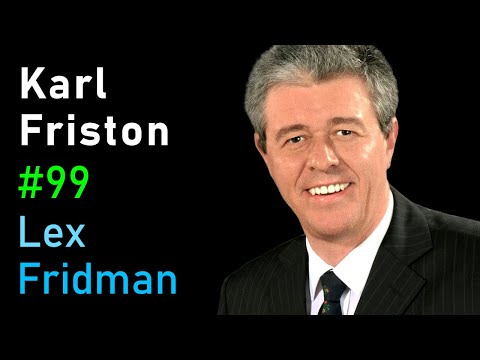
Karl Friston: Neuroscience and the Free Energy Principle | Lex Fridman Podcast #99
Lex Fridman (host), Karl Friston (guest)
In this episode of Lex Fridman Podcast, featuring Lex Fridman and Karl Friston, Karl Friston: Neuroscience and the Free Energy Principle | Lex Fridman Podcast #99 explores karl Friston Explains How Brains Exist By Minimizing Free Energy Lex Fridman interviews neuroscientist Karl Friston about what we understand of the human brain, from microscopic connectivity to large‑scale function and psychiatric phenomena. Friston explains why structure and hierarchy in the brain matter, how modern neuroimaging reveals both functional specialization (blobs) and integration (connectivity), and why we’ve moved beyond the “magic soup” view of the brain.
Karl Friston Explains How Brains Exist By Minimizing Free Energy
Lex Fridman interviews neuroscientist Karl Friston about what we understand of the human brain, from microscopic connectivity to large‑scale function and psychiatric phenomena. Friston explains why structure and hierarchy in the brain matter, how modern neuroimaging reveals both functional specialization (blobs) and integration (connectivity), and why we’ve moved beyond the “magic soup” view of the brain.
He then introduces the free energy principle: a unifying framework in which any system that persists over time can be seen as minimizing a quantity equivalent to variational free energy, tying existence, perception, and action to statistical inference. Using examples from oil droplets to tadpoles, brains, and AI, he explores autonomy, movement, active inference, and the challenges of brain‑computer interfaces.
The conversation extends this framework to questions of life, agency, planning, self‑awareness, and consciousness, arguing that movement, generative models, and social interaction are central. Friston ends on a personal note about life’s “objective function” as fulfilling our internal narratives about who we are, shaped by culture, stories, and science.
Key Takeaways
Brain structure is sparse, hierarchical, and deeply shapes function.
The brain is not a “magic soup”; long‑range connections are relatively rare and organized in layered, onion‑like hierarchies. ...
Get the full analysis with uListen AI
Neuroimaging reveals both specialized regions and integrated networks.
Techniques like fMRI and PET show functionally specialized ‘blobs’ that respond to specific tasks (e. ...
Get the full analysis with uListen AI
Each imaging modality trades off spatial and temporal precision.
Hemodynamic methods (like fMRI) offer millimeter spatial resolution but are slow (seconds), while electromagnetic methods (EEG/MEG) capture millisecond dynamics but blur spatial origin. ...
Get the full analysis with uListen AI
Brain–computer interfaces currently operate at extremely low information bandwidths.
Modern BCIs effectively communicate at “bits per second,” far below the richness of natural brain–body–world interactions. ...
Get the full analysis with uListen AI
The Free Energy Principle frames existence as a kind of inference.
Any system that maintains its boundaries over time (from an oil droplet to an organism) can be mathematically described as minimizing variational free energy, equivalent to maximizing evidence for its own model of the world. ...
Get the full analysis with uListen AI
Movement and active sampling distinguish living from merely existing systems.
An oil droplet can ‘exist’ passively, but a tadpole or animal actively moves to sample and change its environment. ...
Get the full analysis with uListen AI
Self‑awareness may arise from modeling others and oneself in a social world.
In a world populated by similar agents, an organism benefits from a generative model that distinguishes “me” from “you” and anticipates others’ behavior (theory of mind). ...
Get the full analysis with uListen AI
Notable Quotes
“You can think of the brain as, in a rough sense, like an onion.”
— Karl Friston
“It is a characteristic of things that exist that they must look as if they are minimizing a particular quantity, which turns out to be variational free energy.”
— Karl Friston
“You are your own existence proof.”
— Karl Friston
“There is no other way that you can change the universe other than simply moving.”
— Karl Friston
“Current machine learning is much more like the oil drop… exposed to nearly all the data it will ever need, as opposed to the tadpole swimming out to find the right data.”
— Karl Friston
Questions Answered in This Episode
How could the free energy principle practically guide the design of more autonomous, embodied AI systems that move and sample their environments?
Lex Fridman interviews neuroscientist Karl Friston about what we understand of the human brain, from microscopic connectivity to large‑scale function and psychiatric phenomena. ...
Get the full analysis with uListen AI
Are there empirical experiments that could falsify or strongly constrain the free energy principle as a description of living systems?
He then introduces the free energy principle: a unifying framework in which any system that persists over time can be seen as minimizing a quantity equivalent to variational free energy, tying existence, perception, and action to statistical inference. ...
Get the full analysis with uListen AI
What concrete steps would be needed to move brain–computer interfaces beyond ‘bits per second’ communication toward something closer to natural brain–body bandwidth?
The conversation extends this framework to questions of life, agency, planning, self‑awareness, and consciousness, arguing that movement, generative models, and social interaction are central. ...
Get the full analysis with uListen AI
How might we formalize and measure self‑awareness or consciousness within the free energy/active inference framework, especially in artificial agents?
Get the full analysis with uListen AI
If our ‘objective function’ is to self‑evidence the narratives we hold about ourselves, how can individuals or societies intentionally reshape those narratives for better mental health and collective behavior?
Get the full analysis with uListen AI
Transcript Preview
The following is a conversation with Karl Friston, one of the greatest neuroscientists in history, cited over 245,000 times, known for many influential ideas in brain imaging, neuroscience, and theoretical neurobiology, including especially the fascinating idea of the free energy principle for action and perception. Karl's mix of humor, brilliance, and kindness, to me, are inspiring and captivating. This was a huge honor and a pleasure. This is the Artificial Intelligence Podcast. If you enjoy it, subscribe on YouTube, review it with five stars on Apple Podcasts, support on Patreon, or simply connect with me on Twitter @Lex Fridman, spelled F-R-I-D-M-A-N. As usual, I'll do a few minutes of ads now, and never any ads in the middle that can break the flow of a conversation. I hope that works for you and doesn't hurt the listening experience. This show is presented by Cash App, the number one finance app in the App Store. When you get it, use code LEXPODCAST. Cash App lets you send money to friends, buy Bitcoin, and invest in the stock market with as little as $1. Since Cash App allows you to send and receive money digitally, let me mention a surprising fact related to physical money. Of all the currency in the world, roughly 8% of it is actual physical money. The other 92% of money only exists digitally. So again, if you get Cash App from the App Store or Google Play and use the code LEXPODCAST, you get $10 and Cash App will also donate $10 to FIRST, an organization that is helping to advance robotics and STEM education for young people around the world. And now here's my conversation with Karl Friston. How much of the human brain do we understand from the low level of neuronal communication, to the functional level, to the, uh, to the highest level, maybe the, the psychiatric disorder level?
Well, we're certainly in a better position than we were last century. (laughs) How far we've got to go, I think is almost an unanswerable question. So you'd have to set the parameters, you know, what constitutes understanding, what level of understanding do you want? I think we've made enormous progress in terms of broad-brush principles. Um, whether that affords a detailed cartography of the functional anatomy of the brain and what it does, and right down to the microcircuitry in the neurons, tha- tha- that's probably, um, out of reach at the present time.
So the cartography, so mapping the brain, do you think mapping of the brain, the detailed perfect imaging of it, does that get us closer to understanding of the mind, o- of the brain? So how far does it get us if we have that perfect cartography of the brain?
I think there are lower bounds on that. It's a really interesting question. Um, you, i- and it would determine the sort of scientific career you'd pursue. If you believe that, uh, knowing every dendritic connection, every sort of microscopic synaptic structure right down to the molecular level was gonna give you the right kind of information to understand the computational anatomy, then you'd choose to be a microscopist and you would, um, uh, study little, you know, cubic millimeters of brain for the rest of your life. If, on the other hand, you were interested in holistic functions and, um, a sort of functional anatomy of the sort that a neuropsychologist would understand, you'd study brain lesions and strokes, you know, just looking at the whole person. So again, it comes back to, uh, what level do you want understanding? I think there are principled reasons not to go too far. Um, if you commit to a view of the brain as a machine that's performing a form of inference and representing things, um, there are th- that understanding, that level of understanding is necessarily cast in terms of probability densities and ensemble densities, distributions. And what that tells you is that you don't really want to look at the atoms to understand the thermodynamics of, of probabilistic descriptions for how the brain works. So I personally wouldn't look at the molecules, or indeed the single neurons. In the same way, if I wanted to u- understand the thermodynamics of some non-equilibrium steady state of a gas or an active material, I wouldn't spend my life looking at the, the individual molecules that constitute that ensemble. I'd look at their collective behavior. On the other hand, if you go too coarse-grain, you're gonna miss some basic canonical principles of connectivity and architectures. I'm thinking here, um, it's a bit colloquial, but there's current excitement about high-field magnetic resonance imaging at seven tesla. Why? Well, it gives us, for the first time, the opportunity to look at the brain in action at the level of a few millimeters that distinguish between different layers of the cortex that may be very important in terms of, um, uh, evincing generic principles of co- canonical microcircuitry that are replicated, uh, throughout the brain, that may tell us something fundamental about message passing in the brain and these density dynamics of, or neuronal ensemble population dynamics, uh, that underwrite our, you know, our brain function. So somewhere between a millimeter and a meter.
Install uListen to search the full transcript and get AI-powered insights
Get Full TranscriptGet more from every podcast
AI summaries, searchable transcripts, and fact-checking. Free forever.
Add to Chrome