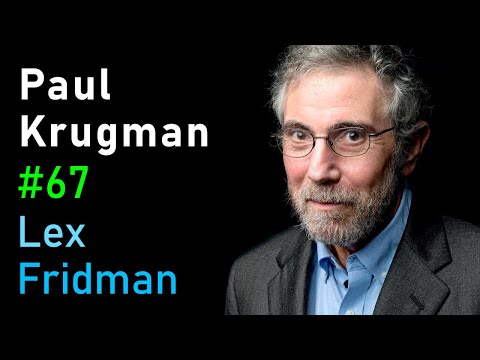
Paul Krugman: Economics of Innovation, Automation, Safety Nets & UBI | Lex Fridman Podcast #67
Lex Fridman (host), Paul Krugman (guest), Lex Fridman (host), Narrator
In this episode of Lex Fridman Podcast, featuring Lex Fridman and Paul Krugman, Paul Krugman: Economics of Innovation, Automation, Safety Nets & UBI | Lex Fridman Podcast #67 explores paul Krugman Dissects Markets, Safety Nets, Robots, and Justice Paul Krugman and Lex Fridman explore what a just, functional economic system looks like, emphasizing strong social safety nets, universal healthcare, and broadly shared prosperity rather than perfect equality. Krugman argues markets and the ‘invisible hand’ work brilliantly in many domains but fail in areas like healthcare, education, and some tech sectors where information and incentives are distorted. He is skeptical of current alarmism about automation and universal basic income, stressing that recent technological change isn’t historically exceptional and that politics, not robots, largely explains wage stagnation and inequality. Throughout, they connect economics to political choices, media fragmentation, public discourse, and the moral questions underlying welfare states, trade, and regulation.
Paul Krugman Dissects Markets, Safety Nets, Robots, and Justice
Paul Krugman and Lex Fridman explore what a just, functional economic system looks like, emphasizing strong social safety nets, universal healthcare, and broadly shared prosperity rather than perfect equality. Krugman argues markets and the ‘invisible hand’ work brilliantly in many domains but fail in areas like healthcare, education, and some tech sectors where information and incentives are distorted. He is skeptical of current alarmism about automation and universal basic income, stressing that recent technological change isn’t historically exceptional and that politics, not robots, largely explains wage stagnation and inequality. Throughout, they connect economics to political choices, media fragmentation, public discourse, and the moral questions underlying welfare states, trade, and regulation.
Key Takeaways
A just economy emphasizes security and shared reality, not perfect equality.
Krugman’s ideal society resembles a “slightly imaginary Sweden”: strong safety nets, environmental regulation, and a distribution where no one is destitute and the very rich still inhabit the same basic material world as everyone else.
Get the full analysis with uListen AI
Markets work well under specific conditions and fail predictably in others.
Drawing on Arrow, Krugman notes that effective competition requires informed, rational participants and good information—conditions that don’t hold in healthcare and often not in health insurance or education, making regulation and public provision necessary complements to markets.
Get the full analysis with uListen AI
The US is unusually harsh for a rich country due to policy choices, not constraints.
Unlike other advanced economies, the US lacks universal healthcare and has weak support for children and long-term care; Krugman argues this cruelty not only violates justice but also undermines long-run economic potential by harming health, development, and productivity.
Get the full analysis with uListen AI
Current automation fears are overstated; productivity data don’t show a jobless revolution.
Krugman points out that overall productivity growth has been modest, not explosive; while some occupations shrink (like longshoremen or translators), this kind of sectoral churn is historically normal, and there’s no evidence yet of a qualitatively new automation era justifying panic or UBI.
Get the full analysis with uListen AI
Wage stagnation and inequality are largely political, not technological inevitabilities.
He emphasizes that choices about unions, labor policy, and the welfare state explain much of the income distribution—e. ...
Get the full analysis with uListen AI
Universal basic income is less effective than targeted, robust safety nets in today’s context.
Krugman sees a trade-off: a meaningful UBI would be extremely expensive or too small to live on; given current realities, he argues it’s more practical to expand existing tools like unemployment insurance, family support, food stamps, and tax credits rather than implement UBI based on speculative automation scenarios.
Get the full analysis with uListen AI
Government can be highly competent in certain domains and underused in others.
He notes that public programs like Medicare and public schooling generally outperform many private or for-profit alternatives, yet ideological hostility to “big government” blocks even obviously valuable investments in infrastructure and research that would boost long-term growth.
Get the full analysis with uListen AI
Notable Quotes
“We have somehow managed to produce a crueler society than almost any other wealthy country, for no good reason.”
— Paul Krugman
“Having a society which is kind of three quarters invisible hand and one quarter visible hand seems to be the balance that works best.”
— Paul Krugman
“The idea that we’re living through greater technological change than ever before is really an illusion.”
— Paul Krugman
“Doing the right thing in terms of justice is also the right thing in terms of economics.”
— Paul Krugman
“Write what you think is right… don’t let yourself get intimidated by the fact that some people are going to say nasty things.”
— Paul Krugman
Questions Answered in This Episode
If the US adopted a Scandinavian-style welfare state, which specific policies would most effectively reduce its ‘harshness’ without significantly harming innovation or growth?
Paul Krugman and Lex Fridman explore what a just, functional economic system looks like, emphasizing strong social safety nets, universal healthcare, and broadly shared prosperity rather than perfect equality. ...
Get the full analysis with uListen AI
How should policymakers decide where markets should dominate and where government should directly provide services, especially in emerging tech sectors like AI and social media?
Get the full analysis with uListen AI
What concrete policy steps could reverse the political erosion of labor’s bargaining power while preserving flexibility and competitiveness in a globalized economy?
Get the full analysis with uListen AI
Given current evidence on productivity and automation, what early warning signs would indicate that a more radical response like UBI has become necessary?
Get the full analysis with uListen AI
How can democratic societies improve the quality of public discourse and economic literacy in an information environment fragmented by partisan media and social networks?
Get the full analysis with uListen AI
Transcript Preview
The following is a conversation with Paul Krugman, Nobel Prize winner in economics, professor at CUNY, and columnist at the New York Times. His academic work centers around international economics, economic geography, liquidity traps, and currency crises. But he also is an outspoken writer and commentator on the intersection of modern-day politics and economics, which places him in the middle of the tense, divisive, modern-day political discourse. If you have clicked dislike on this video and started writing a comment of derision before listening to the conversation, I humbly ask that you please unsubscribe from this channel and from this podcast. Not because you're conservative, a libertarian, a liberal, a socialist, an anarchist, but because you're not open to new ideas, at least in this case, especially at its most difficult, from people with whom you largely disagree. I do my best to stay away from politics of the day, because political discourse is filled with a degree of emotion and self-assured certainty that to me is not conducive to exploring questions that nobody knows the definitive right answer to. The role of government, the impact of automation, the regulation of tech, the medical system, guns, war, trade, foreign policy, are not easy topics and have no clear answers, despite the certainty of the so-called experts, the pundits, the trolls, the media personalities, and the conspiracy theorists. Please listen, empathize, and allow yourself to explore ideas with curiosity and without judgment, and without derision. I will speak with many more economists and political thinkers, trying to stay away from the political battles of the day, and instead look at the long arc of history and the lessons it reveals. In this, I appreciate your patience and support. This is the Artificial Intelligence Podcast. If you enjoy it, subscribe on YouTube, give it five stars on Apple Podcast, follow on Spotify, support it on Patreon, or simply connect with me on Twitter, @LexFridman, spelled F-R-I-D-M-A-N. I recently started doing ads at the end of the introduction. I'll do one or two minutes after introducing the episode, and never any ads in the middle that can break the flow of the conversation. I hope that works for you and doesn't hurt the listening experience. This show is presented by Cash App, the number one finance app in the App Store. Cash App lets you send money to friends, buy Bitcoin, and invest in the stock market with fractional share trading, allowing you to buy $1's worth of a stock no matter what the stock price is. Broker services are provided by Cash App Investing, a subsidiary of Square and member SIPC. Get Cash App from the App Store and Google Play and use the code LEXPODCAST. You'll get $10 and Cash App will also donate $10 to FIRST, one of my favorite organizations that is helping to advance robotics and STEM education for young people around the world. Since Cash App does fractional share trading, let me say that to me, it's a fascinating concept. The order execution algorithm that works behind the scenes to create the abstraction of fractional orders for the investor is an algorithmic marvel. So big props to the Cash App engineers for that. I like it when tech teams solve complicated problems to provide, in the end, a simple, effortless interface that abstracts away all the details of the underlying algorithm. And now here's my conversation with Paul Krugman. What does a perfect world, a utopia, from an economics perspective look like?
Install uListen to search the full transcript and get AI-powered insights
Get Full TranscriptGet more from every podcast
AI summaries, searchable transcripts, and fact-checking. Free forever.
Add to Chrome