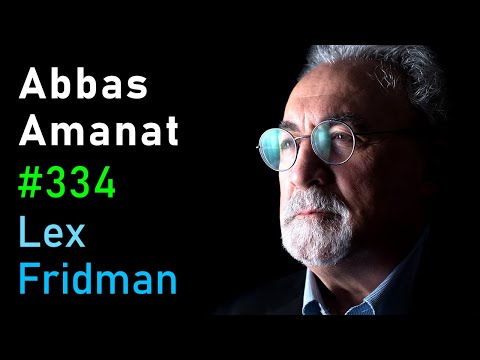
Abbas Amanat: Iran Protests, Mahsa Amini, History, CIA & Nuclear Weapons | Lex Fridman Podcast #334
Abbas Amanat (guest), Lex Fridman (host), Lex Fridman (host), Lex Fridman (host), Lex Fridman (host), Lex Fridman (host), Lex Fridman (host)
In this episode of Lex Fridman Podcast, featuring Abbas Amanat and Lex Fridman, Abbas Amanat: Iran Protests, Mahsa Amini, History, CIA & Nuclear Weapons | Lex Fridman Podcast #334 explores iran’s Past and Present Collide: Women, Power, Revolution, and Hope Lex Fridman and historian Abbas Amanat discuss the 2022–23 Iran protests sparked by Mahsa Amini’s death, framing them as a youth-led revolt against patriarchal authoritarianism symbolized by compulsory hijab. Amanat places the movement in a century-long struggle for constitutionalism, freedom, and modernization, tracing Iran’s trajectory from the 1906 Constitutional Revolution through the Shah, the 1979 Islamic Revolution, and the rise of theocratic rule. They examine the structure and behavior of the Islamic Republic, including the Revolutionary Guards, its fascistic tendencies, and its foreign policy toward the U.S., Israel, Russia, and the nuclear issue. Despite a grim record of repression, Amanat argues Iran’s educated, connected younger generation and deep national culture create real grounds for a hopeful, more open future.
Iran’s Past and Present Collide: Women, Power, Revolution, and Hope
Lex Fridman and historian Abbas Amanat discuss the 2022–23 Iran protests sparked by Mahsa Amini’s death, framing them as a youth-led revolt against patriarchal authoritarianism symbolized by compulsory hijab. Amanat places the movement in a century-long struggle for constitutionalism, freedom, and modernization, tracing Iran’s trajectory from the 1906 Constitutional Revolution through the Shah, the 1979 Islamic Revolution, and the rise of theocratic rule. They examine the structure and behavior of the Islamic Republic, including the Revolutionary Guards, its fascistic tendencies, and its foreign policy toward the U.S., Israel, Russia, and the nuclear issue. Despite a grim record of repression, Amanat argues Iran’s educated, connected younger generation and deep national culture create real grounds for a hopeful, more open future.
Key Takeaways
The current protests are fundamentally about autonomy, not just hijab.
The slogan “Women, Life, Freedom” encapsulates demands for bodily autonomy, civil rights, joy in everyday life, and political liberty, with hijab serving as a visible symbol of much deeper legal and social discrimination.
Get the full analysis with uListen AI
A new, digitally savvy generation is rejecting both state and traditional authority.
Iran’s Gen Z equivalent, raised with social media and higher education, challenges not only the state but also patriarchal family structures, seeing themselves as a distinct, freer generation from their parents and grandparents.
Get the full analysis with uListen AI
The Islamic Republic’s social engineering has backfired.
Attempts to create an ideologically ‘Islamic’ society produced a large, urban, literate middle class—especially educated women—who now overwhelmingly demand choice, openness, and normal engagement with the world.
Get the full analysis with uListen AI
The regime exhibits clear authoritarian and fascistic traits.
Amanat highlights systematic propaganda, intrusion into private life, violent suppression of dissent, privileged ‘insider’ classes, security organs like the Revolutionary Guards and Basij, and extreme brutality against protesters as signs of a fascist-style state.
Get the full analysis with uListen AI
Iran’s theocratic model—clerics directly ruling the state—is historically unprecedented.
For centuries, religious authorities and the state in Iran were separate, often tense but distinct pillars; the 1979 revolution’s fusion of Shi’i clerical power with state sovereignty created a unique and unstable political-theological hybrid.
Get the full analysis with uListen AI
Long-term structural factors made an Islamic revolution more likely.
Shi’i messianic traditions, the politicization of clergy under the Shah, the closure of secular political space, and grievances over foreign interference (e. ...
Get the full analysis with uListen AI
Iran’s geopolitical posture may shift but remains risky and contradictory.
While the regime seeks security and leverage via a nuclear program and alignment with Russia and China, this both intensifies sanctions and isolation and contradicts deep historical Iranian fears of Russian influence and popular desires for Western engagement.
Get the full analysis with uListen AI
Notable Quotes
““This is not a nice, Islamic, fatherly regime. This is a regime that I would see easily in it clear signs of fascism.””
— Abbas Amanat
““Women, Life, Freedom… sums up what this movement is all about.””
— Abbas Amanat
““Iran has never before had a regime where the religious establishment took over the power of the state.””
— Abbas Amanat
““The Islamic Republic’s act of social engineering has failed.””
— Abbas Amanat
““There are moments of despair… but then again, something triggers them. You see 100,000 people in the streets of Berlin hoping for a better future for Iran.””
— Abbas Amanat
Questions Answered in This Episode
How likely is it that the current protest movement can achieve meaningful change without a centralized leadership or devolving into a violent revolution?
Lex Fridman and historian Abbas Amanat discuss the 2022–23 Iran protests sparked by Mahsa Amini’s death, framing them as a youth-led revolt against patriarchal authoritarianism symbolized by compulsory hijab. ...
Get the full analysis with uListen AI
What concrete constitutional or institutional reforms would be necessary to unwind the Guardian Jurist system and separate religion from the state in Iran?
Get the full analysis with uListen AI
In what ways can the large Iranian diaspora constructively support protesters inside Iran without inadvertently strengthening the regime’s ‘foreign conspiracy’ narrative?
Get the full analysis with uListen AI
Given Iran’s history with Russia and current alignment with Moscow, how might this relationship reshape Iran’s regional role and internal politics over the next decade?
Get the full analysis with uListen AI
What lessons can other societies—especially those with strong religious traditions—draw from Iran’s experience with a theocratic state and the subsequent backlash from younger generations?
Get the full analysis with uListen AI
Transcript Preview
This is not a nice, Islamic, fatherly regime. Clear signs of fascism. Clear signs of the state control and pay any price to stay in power.
So, even violence?
Extreme violence.
The following is a conversation with Abbas Amanat, a historian at Yale University specializing in the modern history of Iran. My love and my heart goes out to the Iranian people in their current struggle for freedom. I hope that this conversation helps folks who listen understand the nature and the importance of this struggle. This is the Lex Fridman podcast. To support it, please check out our sponsors in the description and now, dear friends, here's Abbas Amanat. Let's start with the current situation in Iran. On September 16th, protests broke out in Tehran and quickly spread over the death of a 22-year-old Mahsa Amini. Eyewitnesses saw her beaten to death by the morality police. This is a heavy topic, but it's a really important topic. What... Can you explain what happened?
The protests are now in their, uh, sixth week. The death of that young woman occurred, who was visiting Tehran as a tourist, sparked, uh, something very deep, uh, that particularly concerned the younger generations. That is what you would call the equivalent of the Z generation in this country.
(laughs) Yes.
They call themselves دحه هشتدي in Persian, because Iran follows the solar calendar of its own. It's an ancient solar calendar. And this... The, the, the time that they were born, they were in the 1380s. That's what they call themselves, هشتدي.
Mm-hmm.
80s, هشتده, for the '80s. And, uh, the... Well, the circumstances that surrounds the, uh, unfortunate death of this young, beautiful, uh, Kurdish woman, uh, is, uh, really tragic. Uh, she was arrested by the, what is referred to as the morality police, morality patrol, called گشت ارشاد, a guidance police, that is. Presumably, there were two women fully clad that is officers serving on that force, and two men. And, mm, nobody exactly knows what had happened. She had been beaten up, and apparently there was no, uh, uh, uh, sign of any wrongdoing on her side. She was fully covered. Uh, it seems that, uh, uh, there was some altercation in the process and, uh, the, the outcome was that she was unconscious. Uh, not necessarily when she was arrested, but in the course of the detention when they take them to a center, presumably to re-educate them.
Yeah.
And, um, and she apparently collapsed, and maybe my sense is that she must have had some kind of a problem because of the skull being broken or something had happened, and she died in the hospital the next day. And that, through the social media, was widely spread throughout Iran and almost the next day, surprisingly, you could see this outburst of sympathy for her. People are in the streets, uh, weeping because she was seen as such an innocent young woman, 22 years old. And the family, the mother and the father, also mourning for her. Uh, and being a Kurd visiting Tehran, uh, this all added up to really turn her into some kind of a martyr of this cause, and that's what it is. And her, uh, picture, um, uh, uh, graphics that were artistically produced based on her portrait has now dominates basically as the symbol of this protest movement, and the protest movement goes on. Everybody was thinking, or at least the authorities were thinking, that it's going to die out in a matter of a few days. But it became more, uh, intense first in the streets of Tehran by young women, mostly probably between I would say 17, 18, teenagers to 22, 23 or thereabout, and then to university campuses all around the country, and then even to high schools. And that also made it a very remarkable protest movement because first of all it involves the youth and not necessarily the older generations. You see them around, but not as many. Also, you see men and women together, young, uh, uh, girls and boys, and, uh, um, they are adamant, they are desperate in a sense of the tone of their protests, and they are extremely courageous because they stand against the, uh, security forces that were immediately, uh, were sent after to the streets, so... And in full gear, that is.
Install uListen to search the full transcript and get AI-powered insights
Get Full TranscriptGet more from every podcast
AI summaries, searchable transcripts, and fact-checking. Free forever.
Add to Chrome