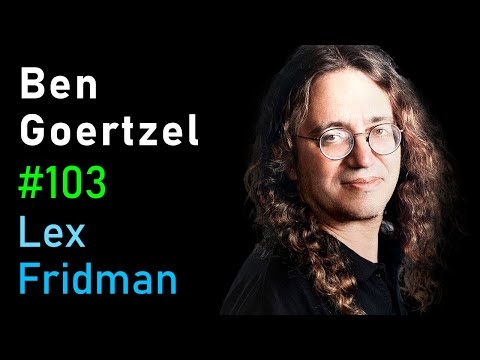
Ben Goertzel: Artificial General Intelligence | Lex Fridman Podcast #103
Lex Fridman (host), Ben Goertzel (guest), Lex Fridman (host), Lex Fridman (host), Lex Fridman (host), Lex Fridman (host), Lex Fridman (host)
In this episode of Lex Fridman Podcast, featuring Lex Fridman and Ben Goertzel, Ben Goertzel: Artificial General Intelligence | Lex Fridman Podcast #103 explores ben Goertzel on AGI, robot compassion, and transcending human limits Ben Goertzel discusses his lifelong motivation to build artificial general intelligence (AGI), tracing influences from science fiction, philosophy, and early AI research to his current projects OpenCog and SingularityNET.
Ben Goertzel on AGI, robot compassion, and transcending human limits
Ben Goertzel discusses his lifelong motivation to build artificial general intelligence (AGI), tracing influences from science fiction, philosophy, and early AI research to his current projects OpenCog and SingularityNET.
He contrasts narrow AI and deep learning with more cognitively inspired architectures, arguing for symbolic–sub-symbolic hybrids and decentralized networks of cooperating AIs as the most promising route to beneficial AGI.
The conversation covers social robots like Sophia as both art and experimental platforms, ethical concerns about corporate control of AI and data, and how decentralized, open systems could counterbalance government and corporate power.
Goertzel closes by connecting AGI, radical life extension, and transhumanism to his core values of joy, growth, and choice, arguing we should abolish involuntary death and use advanced intelligence to explore new modes of being.
Key Takeaways
AGI requires more than scaling deep learning; it needs rich symbolic–sub-symbolic integration.
Goertzel argues current deep neural networks (e. ...
Get the full analysis with uListen AI
Common representations are critical so different cognitive processes can help each other.
By representing logic, neural activations, procedures, and knowledge in one weighted hypergraph, pattern recognition, reasoning, and evolution-like learning can share intermediate state and resolve each other’s bottlenecks, analogous to different brain subsystems co-evolving.
Get the full analysis with uListen AI
Decentralized AI networks could counterbalance corporate and state monopolies on intelligence.
SingularityNET is designed as a blockchain-based “society of AIs” where heterogeneous agents outsource work to each other without a central controller. ...
Get the full analysis with uListen AI
Social robots can be used to teach AGI compassion by embedding it in loving, helpful roles.
Hanson Robotics’ Sophia is intentionally anthropomorphic to elicit empathy; Goertzel thinks early AGIs should learn in contexts like caregiving and education so human values of love and compassion are ingrained experientially, not just specified abstractly.
Get the full analysis with uListen AI
Public perception of robots often ignores technical details and embraces theatrical illusion.
Even when people are told a robot is teleoperated or largely scripted, they still project agency and consciousness onto it. ...
Get the full analysis with uListen AI
Open, shared biomedical data plus advanced AI could accelerate cures and longevity dramatically.
He criticizes the siloing of clinical and genomic data in hospitals and pharma, arguing that a global, privacy-preserving bio-knowledge graph analyzed by hybrid AI systems could rapidly advance personalized medicine, anti-aging, and even COVID treatment optimization.
Get the full analysis with uListen AI
The long-term goal is to abolish involuntary death and expand human and post-human possibilities.
Goertzel advocates “super longevity” with optional death, sees current human motivation structures (including attachment to suffering) as potentially outgrown, and frames the meaning of life in terms of maximizing joy, growth, and choice—possibly through multiple, divergent future versions of oneself.
Get the full analysis with uListen AI
Notable Quotes
“Death is bad. It’s baffling we should have to say that.”
— Ben Goertzel
“GPT-3 understands nothing. It’s a very intelligent idiot.”
— Ben Goertzel
“If you’re making something ten times as smart as you, how can you know what it’s going to do?”
— Ben Goertzel
“Corporations are psychopathic even if the people are not.”
— Ben Goertzel
“Our language for describing emotions is very crude. That’s what music is for.”
— Ben Goertzel
Questions Answered in This Episode
If deep learning alone can’t yield AGI, what concrete hybrid architectures or milestones would convince skeptics that symbolic components are essential?
Ben Goertzel discusses his lifelong motivation to build artificial general intelligence (AGI), tracing influences from science fiction, philosophy, and early AI research to his current projects OpenCog and SingularityNET.
Get the full analysis with uListen AI
How can we realistically build and sustain open, decentralized AI and biomedical data infrastructures in a world dominated by powerful nation-states and tech giants?
He contrasts narrow AI and deep learning with more cognitively inspired architectures, arguing for symbolic–sub-symbolic hybrids and decentralized networks of cooperating AIs as the most promising route to beneficial AGI.
Get the full analysis with uListen AI
Where is the ethical line between using anthropomorphic robots as beneficial ‘theater’ versus misleading the public about the true capabilities of AI systems?
The conversation covers social robots like Sophia as both art and experimental platforms, ethical concerns about corporate control of AI and data, and how decentralized, open systems could counterbalance government and corporate power.
Get the full analysis with uListen AI
What kinds of early tasks and environments are most likely to instill robust compassion and alignment in emerging AGI systems?
Goertzel closes by connecting AGI, radical life extension, and transhumanism to his core values of joy, growth, and choice, arguing we should abolish involuntary death and use advanced intelligence to explore new modes of being.
Get the full analysis with uListen AI
If humans abolish involuntary death and radically increase intelligence, how might our current concepts of identity, meaning, and morality need to change?
Get the full analysis with uListen AI
Transcript Preview
The following is a conversation with Ben Goertzel, one of the most interesting minds in the artificial intelligence community. He's the founder of SingularityNET, designer of OpenCog AI framework, formerly a director of research at the Machine Intelligence Research Institute, and chief scientist of Hanson Robotics, the company that created the Sophia robot. He has been a central figure in the AGI community for many years, including in his organizing and contributing to the Conference on Artificial General Intelligence, the 2020 version of which is actually happening this week, Wednesday, Thursday, and Friday. It's virtual and free. I encourage you to check out the talks, including by Joscha Bach, uh, from episode 101 of this podcast. Quick summary of the ads. Two sponsors, The Jordan Harbinger Show and Masterclass. Please consider supporting this podcast by going to jordanharbinger.com/lex and signing up on masterclass.com/lex. Click the links, buy all the stuff. It's the best way to support this podcast and the journey I'm on in my research and startup. This is the Artificial Intelligence Podcast. If you enjoy it, subscribe on YouTube, review it with five stars on Apple Podcasts, support it on Patreon, or connect with me on Twitter @LexFridman, spelled without the E, just F-R-I-D-M-A-N. As usual, I'll do a few minutes of ads now and never any ads in the middle that can break the flow of the conversation. This episode is supported by The Jordan Harbinger Show. Go to jordanharbinger.com/lex. It's how he knows I sent you. On that page, there's links to subscribe to it on Apple Podcasts, Spotify, and everywhere else. I've been binging on his podcast. Jordan is great. He gets the best out of his guests, dives deep, calls them out when it's needed, and makes the whole thing fun to listen to. He's interviewed Kobe Bryant, Mark Cuban, Neil deGrasse Tyson, Garry Kasparov, and many more. His conversation with Kobe is a reminder of how much focus and hard work is required for greatness in sport, business, and life. I highly recommend the episode if you want to be inspired. Again, go to jordanharbinger.com/lex. It's how Jordan knows I sent you. This show, sponsored by Masterclass. Sign up at masterclass.com/lex to get a discount and to support this podcast. When I first heard about Masterclass, I thought it was too good to be true. For 180 bucks a year, you get an all-access pass to watch courses from, to list some of my favorites, Chris Hadfield on space exploration, Neil deGrasse Tyson on scientific thinking and communication, Will Wright, creator of the greatest city-building game ever, SimCity and Sims, on game design, Carlos Santana on guitar, Garry Kasparov, the greatest chess player ever, on chess, Daniel Negreanu on poker, and many more. Chris Hadfield explaining how rockets work and the experience of being launched into space alone is worth the money. Once again, sign up on masterclass.com/lex to get a discount and to support this podcast. And now, here's my conversation with Ben Goertzel. What books, authors, ideas had a lot of impact on you, um, in your life in the early days?
Install uListen to search the full transcript and get AI-powered insights
Get Full TranscriptGet more from every podcast
AI summaries, searchable transcripts, and fact-checking. Free forever.
Add to Chrome