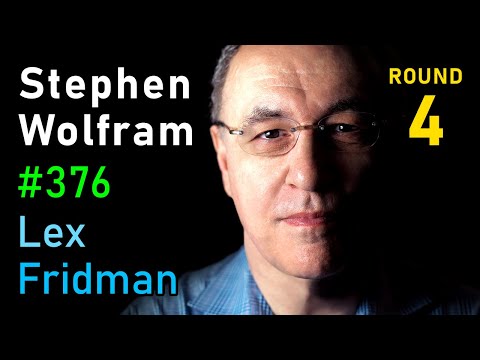
Stephen Wolfram: ChatGPT and the Nature of Truth, Reality & Computation | Lex Fridman Podcast #376
Stephen Wolfram (guest), Lex Fridman (host), Narrator, Narrator
In this episode of Lex Fridman Podcast, featuring Stephen Wolfram and Lex Fridman, Stephen Wolfram: ChatGPT and the Nature of Truth, Reality & Computation | Lex Fridman Podcast #376 explores stephen Wolfram Explores AI, Computation, Truth, and Our Finite Minds Stephen Wolfram and Lex Fridman discuss how large language models like ChatGPT differ from Wolfram’s lifelong project of deep, symbolic computation, and why combining the two creates a powerful new computational interface for the world.
Stephen Wolfram Explores AI, Computation, Truth, and Our Finite Minds
Stephen Wolfram and Lex Fridman discuss how large language models like ChatGPT differ from Wolfram’s lifelong project of deep, symbolic computation, and why combining the two creates a powerful new computational interface for the world.
Wolfram explains core ideas from his work: the computational universe, cellular automata, computational irreducibility, the ruliad, and how these underpin our notions of physics, intelligence, and the second law of thermodynamics.
They explore the nature of truth, models, and abstraction, arguing that human observers are computationally bounded and only ever see coarse-grained, symbolic slices of a vastly more complex underlying reality.
The conversation closes with reflections on AI risk, future education, consciousness, and the bittersweet fact that we are finite observers on the verge of understanding immensely larger computational structures that will outlive us.
Key Takeaways
LLMs are ‘wide and shallow’, Wolfram’s stack is ‘deep and formal’—together they’re transformative.
ChatGPT excels at generating humanlike language by statistically continuing text, while Wolfram Language and Wolfram|Alpha perform precise, deep, symbolic computation. ...
Get the full analysis with uListen AI
Computational irreducibility explains why the world can be lawful yet unpredictable.
Even very simple rules (e. ...
Get the full analysis with uListen AI
Human observers are computationally bounded, so we only see coarse-grained ‘pockets of reducibility’.
We can’t track every molecule or every branch of quantum evolution; instead, we compress reality into symbolic concepts (pressure, temperature, objects, narratives). ...
Get the full analysis with uListen AI
Models are always selective abstractions; the key question is whether they capture what we care about.
No model reproduces every detail of reality. ...
Get the full analysis with uListen AI
There likely exist ‘laws of thought’ or semantic grammars beyond logic that LLMs are implicitly discovering.
Logic was the first abstraction Aristotle and Boole lifted from natural language. ...
Get the full analysis with uListen AI
The nature of truth in AI systems depends on formalization and provenance, not fluent prose.
Wolfram distinguishes between fact-backed, formally grounded outputs (e. ...
Get the full analysis with uListen AI
AI will likely automate boilerplate programming and content, shifting human value toward meta-thinking and choosing goals.
As natural-language-to-code improves, much of routine software engineering and expository writing will be generated by machines. ...
Get the full analysis with uListen AI
Notable Quotes
“I view the ChatGPT thing as being wide and shallow and what we’re trying to do with computation as being deep.”
— Stephen Wolfram
“The only thing that successfully runs the model of the universe is the actual running of the universe.”
— Stephen Wolfram
“No model is correct except the system itself. The question is: does it capture what you care about capturing?”
— Stephen Wolfram
“The great theories of 20th-century physics are the result of an interaction between computationally irreducible systems and computationally bounded observers.”
— Stephen Wolfram
“I think an ordinary computer is already there. A large language model may experience it [consciousness] in a way that is much better aligned with us humans.”
— Stephen Wolfram
Questions Answered in This Episode
If semantic ‘laws of thought’ can be made explicit, how might that change the design of future AI systems and our understanding of human reasoning?
Stephen Wolfram and Lex Fridman discuss how large language models like ChatGPT differ from Wolfram’s lifelong project of deep, symbolic computation, and why combining the two creates a powerful new computational interface for the world.
Get the full analysis with uListen AI
What kinds of human decision-making and creativity remain least susceptible to automation when computation and LLM interfaces become ubiquitous?
Wolfram explains core ideas from his work: the computational universe, cellular automata, computational irreducibility, the ruliad, and how these underpin our notions of physics, intelligence, and the second law of thermodynamics.
Get the full analysis with uListen AI
How should we practically balance the power of AI systems that can generate code and act in the world with the near-impossibility of building perfectly secure sandboxes?
They explore the nature of truth, models, and abstraction, arguing that human observers are computationally bounded and only ever see coarse-grained, symbolic slices of a vastly more complex underlying reality.
Get the full analysis with uListen AI
In what ways does viewing physics as emergent from observer limitations alter our intuitions about free will, causality, and the ‘reality’ of physical laws?
The conversation closes with reflections on AI risk, future education, consciousness, and the bittersweet fact that we are finite observers on the verge of understanding immensely larger computational structures that will outlive us.
Get the full analysis with uListen AI
How might education and university structures need to evolve if ‘computational X’ (formal, computational thinking in every field) becomes as basic as literacy?
Get the full analysis with uListen AI
Transcript Preview
You know, I can tell ChatGPT, "Create a piece of code," and then just run it on my computer. And I'm like, you know, that- that sort of personalizes for me the what could, what could possibly go wrong, so to speak.
Was that exciting or scary, that possibility?
It was a little bit scary actually, because it's kind of like, if you do that, right?
Yeah.
What is the sandboxing that you should have? And that's sort of a, that's a- a version of- of that question for the world. That is, as soon as you put the AIs in charge of things, you know, how much, how many constraints should there be on these systems before you put the AIs in charge of all the weapons and all these, you know, all these different kinds of systems?
Well, here's the fun part about sandboxes, is, uh, the AI knows about them and has the tools to, uh, crack them. The following is a conversation with Stephen Wolfram, his fourth time on this podcast. He's a computer scientist, mathematician, theoretical physicist, and the founder of Wolfram Research, a company behind Mathematica, Wolfram Alpha, Wolfram Language, and the Wolfram Physics & Metamathematics projects. He has been a pioneer in exploring the computational nature of reality. And so, he's the perfect person to explore with together the new quickly evolving landscape of large language models as human civilization journeys towards building super intelligent AGI. This is the Lex Fridman Podcast. To support it, please check out our sponsors in the description. And now, dear friends, here's Stephen Wolfram. You announced the integration of ChatGPT and Wolfram Alpha and Wolfram Language. So, let's talk about that integration. What are the key differences, from the high philosophical level, maybe the technical level, between the capabilities of, broadly speaking, the two kinds of systems, large language models and this computational, gigantic computational system infrastructure that is Wolfram Alpha?
Yeah. So what does something like ChatGPT do? It's- it's mostly focused on make language like the language that humans have made and put on the web and so on.
Yeah.
So, you know, its- its primary sort of underlying technical thing is you've given a prompt, it's trying to continue that prompt in a way that's somehow typical of what it's seen based on a trillion words of text that humans have written on the web. And the way it's doing that is with something which is probably quite similar to the way we humans do the first stages of that, using a neural net and so on, and just saying, "Given these, given this piece of text, let's ripple through the neural net one wo- and- and get one word at a time of output." And, uh, it's kind of a- a shallow computation on a large amount of kind of training data that is what we humans have put on the web. That's a different thing from sort of the computational stack that I spent the last, I don't know, 40 years or so building, which has to do with what can you compute many steps, potentially a very deep computation? It's not sort of taking the statistics of what we humans have produced and trying to continue things based on that statistics. Instead, it's trying to take kind of the formal structure that we've created in our civilization, whether it's from mathematics or whether it's from kind of systematic knowledge of all kinds, and use that to do arbitrarily deep computations to figure out things that- that aren't just, "Let's match what's already been kind of said on the web," but, "Let's potentially be able to compute something new and different that's never been computed before." So as a, as a practical matter, you know, the- the, um, what we're, you know, the- Our goal is to have made as much as possible of the world computable in the sense that if there's a question that in principle is answerable from some sort of expert knowledge that's been accumulated, we can, uh, compute the answer to that question. And we can do it in a sort of reliable way that's- that's the best one can do given what the expertise that our civilization has accumulated. It's a very, it's a- it's a much more sort of labor-intensive on the side of kind of being, creating kind of the- the computational system to do that. Um, obviously the, in- in the, the kind of the ChatGPT world, it's like take things which were produced for quite other purposes, namely the, all the things we've written out on the web and so on, and sort of forage from that things which were, are like what's been written on the web. So I think as, you know, as a practical point of view, I- I view sort of the ChatGPT thing as being wide and shallow and what we're trying to do with sort of building out computation as being this sort of deep, also broad, but- but, uh, most importantly, kind of deep type of thing. I think another way to think about this is if you go back in human history, you know, I don't know, 1,000 years or something, and you say, "What- what can the typical person, what's the typical person going to figure out?" Well, the answer is there are certain kinds of things that we humans can quickly figure out. That's sort of what- what our, uh, you know, at our neural architecture and the kinds of things we learn in our lives let us do. But then there's this whole layer of kind of formalization that got developed in which is, you know, the kind of whole sort of story of intellectual history and whole kind of depth of learning. That formalization turned into things like logic, mathematics, science, and so on. And that's the kind of thing that allows one to kind of build these towers of- of, uh, uh, of- of, uh, sort of towers of things you work out.
Install uListen to search the full transcript and get AI-powered insights
Get Full TranscriptGet more from every podcast
AI summaries, searchable transcripts, and fact-checking. Free forever.
Add to Chrome