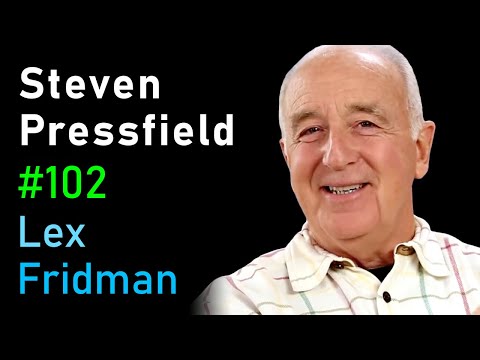
Steven Pressfield: The War of Art | Lex Fridman Podcast #102
Lex Fridman (host), Steven Pressfield (guest), Lex Fridman (host)
In this episode of Lex Fridman Podcast, featuring Lex Fridman and Steven Pressfield, Steven Pressfield: The War of Art | Lex Fridman Podcast #102 explores steven Pressfield on War, Resistance, and Serving the Creative Muse Lex Fridman and Steven Pressfield explore war both as a historical reality and as a metaphor for the inner battles of the creative life. Pressfield argues that humans are still tribal cave-people at heart, making conflict inevitable, but believes outer wars mirror a deeper spiritual war within each person. They dive into his concept of Resistance—the ego-driven force that blocks creative work—and contrast it with the higher self that seeks meaning, love, and service to a “muse.” The conversation also covers Israel’s wars, mortality and reincarnation, the discipline and health of a writer’s daily routine, and what it really means to be a professional and a “warrior” in art.
Steven Pressfield on War, Resistance, and Serving the Creative Muse
Lex Fridman and Steven Pressfield explore war both as a historical reality and as a metaphor for the inner battles of the creative life. Pressfield argues that humans are still tribal cave-people at heart, making conflict inevitable, but believes outer wars mirror a deeper spiritual war within each person. They dive into his concept of Resistance—the ego-driven force that blocks creative work—and contrast it with the higher self that seeks meaning, love, and service to a “muse.” The conversation also covers Israel’s wars, mortality and reincarnation, the discipline and health of a writer’s daily routine, and what it really means to be a professional and a “warrior” in art.
Key Takeaways
War reflects our unchanged tribal nature and drive to conquer.
Pressfield believes humans are psychologically similar to our cave-dwelling ancestors—wired for us-versus-them thinking and conquest—so war is less a historical anomaly than an expression of deep, especially male, impulses that sometimes get sublimated into sports or other contests.
Get the full analysis with uListen AI
Great wars are valuable mainly as metaphors for the inner war.
Despite writing extensively about Spartans, Alexander, and the Six-Day War, Pressfield says he’s not truly interested in war strategy; instead, he uses these stories to illuminate the internal battle against fear, negativity, and spiritual exile that every individual faces.
Get the full analysis with uListen AI
Lasting peace requires mutual respect and balanced fear, not unilateral outreach.
Discussing Israel, he argues that genuine coexistence only becomes possible when both sides respect each other’s strength and simultaneously fear crossing each other’s red lines—only then can they negotiate, mingle, and humanize one another.
Get the full analysis with uListen AI
Resistance is the ego’s fear-driven attempt to keep control.
Pressfield frames Resistance (procrastination, self-sabotage, excuses) as the voice of the ego, which believes in death, separation, and scarcity; it fights to keep us from identifying with the larger Self that operates from love, connection, and creative risk.
Get the full analysis with uListen AI
Professional creatives rely on routine, not inspiration, to overcome Resistance.
His own process is highly disciplined—early rising, gym, set writing hours—and he emphasizes drilling the craft, working daily, and treating writing like a job rather than waiting for moods or epiphanies.
Get the full analysis with uListen AI
Editing and external feedback are crucial to making work actually function.
Pressfield stresses that a great editor sees structure, genre conventions, and what’s broken in a story in ways the writer, who is too close to the work, cannot; he treats editing as a separate, analytical phase as important as drafting.
Get the full analysis with uListen AI
Mortality and a sense of destiny drive the urge to create.
He thinks constant awareness of death both terrifies and motivates us to leave a mark, and he leans toward a reincarnation-like view where people arrive with distinct personalities and “destined” themes that unfold across their body of work.
Get the full analysis with uListen AI
Notable Quotes
“I’m not really that interested in war per se. I’m more interested in the metaphor… the war against myself and my own resistance.”
— Steven Pressfield
“To me, a human being—we are spiritual beings in a physical envelope. And there’s an automatic terrible tension within that which creates a war inside ourselves.”
— Steven Pressfield
“The only way two warring sides can ever really come together is when there’s mutual respect and mutual fear.”
— Steven Pressfield
“Resistance is the voice of the ego trying to keep control of us.”
— Steven Pressfield
“Fear is good. Like self-doubt, fear is an indicator. The more scared we are of a work or a calling, the more sure we can be that we have to do it.”
— Steven Pressfield (quoted by Lex Fridman at the end)
Questions Answered in This Episode
If war is rooted in our tribal nature, what concrete mechanisms—cultural, technological, or spiritual—could realistically sublimate that impulse at scale?
Lex Fridman and Steven Pressfield explore war both as a historical reality and as a metaphor for the inner battles of the creative life. ...
Get the full analysis with uListen AI
How can an individual distinguish between Resistance (ego fear) and a genuine signal that a particular project or path is wrong for them?
Get the full analysis with uListen AI
In creative work, where is the line between healthy professional discipline and unhealthy self-sacrifice that damages long-term effectiveness and well-being?
Get the full analysis with uListen AI
If each person carries a ‘destined’ body of work or set of themes, how much freedom do we truly have to reinvent ourselves creatively?
Get the full analysis with uListen AI
What practical steps can someone take to shift their identity from the ego’s fear-based viewpoint to the larger Self that acts from love and service?
Get the full analysis with uListen AI
Transcript Preview
The following is a conversation with Steven Pressfield, author of several powerful non-fiction and historical fiction books, including The War of Art, a book that had a big impact on my life and the life of millions of people whose passion is to create in art, science, business, sport, and everywhere else. I highly recommend it and others of his books on this topic, including Turning Pro, Do The Work, Nobody Wants To Read Your Shit, and The Warrior Ethos. Also, his book Gates Of Fire, about the Spartans and the Battle of Thermopylae, The Lion's Gate, Tides of War, and others are some of the best historical fiction novels ever written. As some of you know, I don't shy away from taking on a big difficult challenge. One of the hardest for me and for millions of others is the discipline of staring at an empty page every day, pushing on to think deeply, to create, despite the millions of excuses that fill the head. In his work, Steven has articulated this struggle better than anyone I've ever read. Quick summary of the ads. Two sponsors, The Jordan Harbinger Show and Cash App. Please consider supporting the podcast by going to jordanharbinger.com/lex and subscribing to it everywhere after that. And downloading Cash App and using code LEXPODCAST. Click on the links, buy all of the stuff, it really is the best way to support this podcast. This is the Artificial Intelligence Podcast. I recently considered renaming this podcast, but decided against it. AI is my passion, and in some sense, this podcast is not as much about AI but more about a journey of an AI researcher struggling to explore the human mind, the physics of our universe, and the nature of human behavior, intelligence, consciousness, love, and power. I will continue to return home to the technical, computer science, machine learning, engineering, math, programming, but also venture out to talk to people who had a big impact on my life outside the technical fields. Writers like Steven Pressfield and Stephen King. Musicians like Tom Waits. Political leaders like, well, you know who. And even athletes. I hope you join me on this journey. As usual, I'll do a few minutes of ads now, and no ads in the middle that can break the flow of the conversation. Click on the links, buy all of the stuff. It's the best way to support this podcast. This episode is supported by The Jordan Harbinger Show. Go to jordanharbinger.com/lex. It's how he knows I sent you. On that page, there's links to subscribe to it on Apple Podcasts, Spotify, and everywhere else. I've been binging on this podcast. Jordan is a great human being. He gets the best out of his guests, dives deep, calls them out when it's needed, and makes the whole thing fun to listen to. He's interviewed Kobe Bryant, Mark Cuban, Neil deGrasse Tyson, Garry Kasparov, and many more. I just finished listening to his recent conversation with Mick West about debunking conspiracy theories. This topic can be both fascinating and frustrating on both sides. But in this conversation, Jordan thread the needle beautifully, and so it turned out to be a great listen. I highly recommend it. Again, go to jordanharbinger.com/lex. It's how he knows I sent you. On that page, there's links to subscribe to this show on Apple Podcasts, Spotify, and everywhere else. This show is presented by Cash App, the number one finance app in the App Store. When you get it, use code LEXPODCAST. Cash App lets you send money to friends, buy Bitcoin, and invest in the stock market with as little as $1. Since Cash App allows you to buy Bitcoin, let me mention that cryptocurrency in the context of the history of money is fascinating. I recommend A Cent Of Money as a great book on this history. Debits and credits on ledgers started around 30,000 years ago. The US dollar, created over 200 years ago, and the first decentralized cryptocurrency released just over 10 years ago. So given that history, cryptocurrency's still very much in its early days of development, but it's still aiming to and just might redefine the nature of money. So again, if you get Cash App from the App Store or Google Play and use the code LEXPODCAST, you get $10 and Cash App will also donate $10 to FIRST, an organization that is helping advance robotics and STEM education for young people around the world. And now here's my conversation with Steven Pressfield. Modern society in many ways dreams of creating universal peace, and yet war has molded civilization as we know it throughout its history. So, let's start at the high philosophical level. If you could imagine a world without war, how would that world be different? Perhaps put another way, what purpose has war served? Why do we fight?
Install uListen to search the full transcript and get AI-powered insights
Get Full TranscriptGet more from every podcast
AI summaries, searchable transcripts, and fact-checking. Free forever.
Add to Chrome