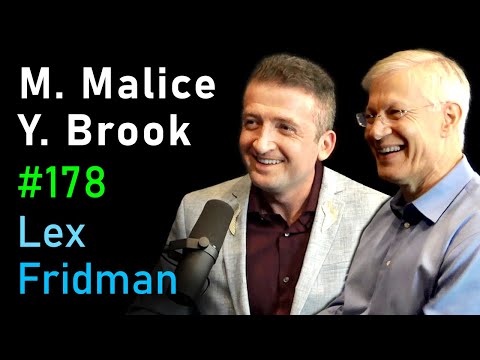
Michael Malice and Yaron Brook: Ayn Rand, Human Nature, and Anarchy | Lex Fridman Podcast #178
Lex Fridman (host), Michael Malice (guest), Yaron Brook (guest), Michael Malice (guest), Yaron Brook (guest), Lex Fridman (host), Lex Fridman (host), Lex Fridman (host), Lex Fridman (host), Lex Fridman (host)
In this episode of Lex Fridman Podcast, featuring Lex Fridman and Michael Malice, Michael Malice and Yaron Brook: Ayn Rand, Human Nature, and Anarchy | Lex Fridman Podcast #178 explores ayn Rand, anarchy, and the state: freedom, power, and human nature Lex Fridman hosts Michael Malice (anarchist) and Yaron Brook (Objectivist) for a long-form debate on human nature, Ayn Rand’s ideas, and whether government is necessary or inherently dangerous.
Ayn Rand, anarchy, and the state: freedom, power, and human nature
Lex Fridman hosts Michael Malice (anarchist) and Yaron Brook (Objectivist) for a long-form debate on human nature, Ayn Rand’s ideas, and whether government is necessary or inherently dangerous.
They begin with thought experiments about cooperation on a desert island, then move into Rand’s ethics of rational self-interest, critiques of Kant, Marx, communism, fascism, and the role of ideology in mass evil.
A central clash is between Brook’s view that a limited rights-protecting state is morally essential and Malice’s view that all monopolistic government power structurally leads to abuse and should be replaced by competing, voluntary institutions.
They also discuss technology (Bitcoin, the internet) as a check on state power, the function of art and myth, the dangers of humility and guilt cultures, the importance of pride and self-made character, and how to live with integrity, love, and ambition.
Key Takeaways
Human beings are naturally cooperative when goals are clear and stakes are high.
Using the desert island thought experiment and real-world examples, both guests argue that small groups of semi-rational individuals tend to cooperate for survival and flourishing; large-scale violence usually emerges when bad ideas and power structures (tribes, states, ideologies) are layered on top of that nature.
Get the full analysis with uListen AI
Ideas and intellectuals are morally responsible for political horrors.
Brook insists Marx, Kant, and similar thinkers are not ‘just writers’ but architects of frameworks that inevitably lead to Lenin, Stalin, and totalitarianism; he argues this responsibility is as real as that of political leaders who operationalize the ideas.
Get the full analysis with uListen AI
Objectivism sees rational self-interest and pride as virtues, not vices.
Rand’s ‘selfishness’ means living by your own rational values and taking your life seriously; Brook argues that pride in one’s achievements is a moral duty, while culturally praised ‘humility’ and guilt often serve to undermine self-esteem and make people more compliant to authority.
Get the full analysis with uListen AI
Anarchism and minarchism hinge on whether force can be ‘marketized’.
Malice argues that security, arbitration, and law can be provided competitively like any other service (analogous to eBay, PayPal, or private arbitration), while Brook counters that law is the precondition for markets, not a market good itself, and that competing armed agencies inevitably consolidate into authoritarian power.
Get the full analysis with uListen AI
Communism and fascism share a core: the individual is expendable.
Despite surface differences (proletariat vs. ...
Get the full analysis with uListen AI
Technology expands freedom but cannot replace good philosophy.
They praise the internet and potential of Bitcoin/crypto for undermining censorship and monetary control, yet Brook warns that states can still regulate physical interfaces (banks, merchants, shipping) and that without pro-freedom ideas, tech can as easily enable surveillance and control (e. ...
Get the full analysis with uListen AI
Living a good life requires conscious value-clarity and integrity.
Both guests emphasize that young people should identify what they truly value (work, relationships, place), read deeply, seek mentors, and refuse small moral compromises; Rand’s heroes (Roark, Rearden, Galt) function as literary models of people who organize their lives around chosen values and accept the cost of consistency.
Get the full analysis with uListen AI
Notable Quotes
“Anytime you say reality doesn’t exist, or that you can’t know it, nothing you say after that means anything.”
— Yaron Brook
“Humility is a vice, not a virtue. If you’ve achieved something in life, you are a big deal, and you should take credit for it.”
— Yaron Brook
“The problem with having any kind of government monopoly is that at the very least it’s going to be expensive, inefficient, and often means mass death.”
— Michael Malice
“All anarchy is, is legalized violence constrained for a while until somebody with more force takes over.”
— Yaron Brook
“To say ‘I love you,’ you first have to be able to say the ‘I.’”
— Yaron Brook (paraphrasing Ayn Rand)
Questions Answered in This Episode
Is it realistically possible to design a limited government that protects individual rights without inevitably expanding its own power?
Lex Fridman hosts Michael Malice (anarchist) and Yaron Brook (Objectivist) for a long-form debate on human nature, Ayn Rand’s ideas, and whether government is necessary or inherently dangerous.
Get the full analysis with uListen AI
Could a mature anarchic order with private law and security ever avoid drifting into the kind of cartelized, state-like monopolies Brook predicts?
They begin with thought experiments about cooperation on a desert island, then move into Rand’s ethics of rational self-interest, critiques of Kant, Marx, communism, fascism, and the role of ideology in mass evil.
Get the full analysis with uListen AI
How much moral blame should be placed on philosophers like Kant or Marx for the political regimes that later use their ideas?
A central clash is between Brook’s view that a limited rights-protecting state is morally essential and Malice’s view that all monopolistic government power structurally leads to abuse and should be replaced by competing, voluntary institutions.
Get the full analysis with uListen AI
Can technologies like Bitcoin genuinely constrain state monetary power, or will governments always be able to reassert control at the physical edges?
They also discuss technology (Bitcoin, the internet) as a check on state power, the function of art and myth, the dangers of humility and guilt cultures, the importance of pride and self-made character, and how to live with integrity, love, and ambition.
Get the full analysis with uListen AI
What does it look like in practice to live a ‘self-made soul’—and how should someone in their 20s concretely start doing that today?
Get the full analysis with uListen AI
Transcript Preview
The following is a conversation with Michael Malice and Yaron Brook. Michael's third time on this podcast, and Yaron's second, but together for the first time. Michael is an anarchist, political thinker, host of a podcast called You're Welcome, and author of Dear Reader: The New Right, and two upcoming books, Anarchist Handbook and The White Pill. Yaron is an objectivist philosopher, chairman of the Ayn Rand Institute, host of the Yaron Brook Show, and co-author of The Free Market Revolution and Equal is Unfair. Quick mention of our sponsors: Ground News, Public Goods, Athletic Greens, Brave, and Four Sigmatic. Check them out in the description to support this podcast. As a side note, let me say that this conversation is a kind of experiment. Both Michael and Yaron are thoughtful and passionate, united in part by an interest in the history and philosophy of Ayn Rand. But they are also very different in style. Good conversation, like good food, is often made delicious by pairing of contrasting elements. For example, someone suggested I try a peanut butter, bacon, and banana sandwich, which apparently is very good. Among the three of us, I don't know who's the peanut butter, who's the bacon, and who's the banana. I'm guessing it's probably gonna be me. I'm the banana. But I hope the final result, the final dish if you will, is equally delicious. We talk through, I think, a lot of interesting ideas, sometimes disagreeing, sometimes even in rare cases, saying something humorous, including dark humor, especially in Michael's case. All three of us are sensitive to the suffering in the world today, and throughout human history. We think about it, we talk about it, and we deal with it in different ways. Be patient with us. Whether you agree, disagree, enjoy, or dislike the result, I hope if you listen, you're a wiser person on the other end of it. I know I was. Mostly I really enjoyed this conversation because no matter what Michael and Yaron believe, underneath it all, they're genuine, kind human beings that I'm lucky to be able to hang out with and learn from. This is the Lex Fridman Podcast, and here's my conversation with Michael Malice and Yaron Brook. I've been a huge fan-
(laughs)
... of the two of you for the longest time.
Are we just recording now? Is this starting?
(laughs)
Or are you just talking?
I'm not recording at all.
He- he's not gonna compliment us if it's not-
Yes he does-
... part of the show.
... all the time. He's very-
(laughs)
... speaks very highly of me. You, I don't know.
(laughs)
Maybe he's being charitable. (laughs)
I'm not sure. He only does this to me on the show.
R- objectivists don't like charity so don't compliment him. He won't f-
(laughs)
... he won't think it's sincere.
There you go.
Install uListen to search the full transcript and get AI-powered insights
Get Full TranscriptGet more from every podcast
AI summaries, searchable transcripts, and fact-checking. Free forever.
Add to Chrome