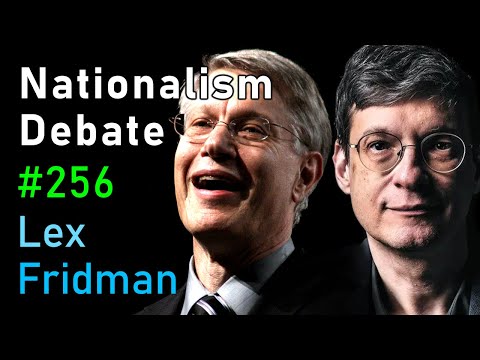
Nationalism Debate: Yaron Brook and Yoram Hazony | Lex Fridman Podcast #256
Lex Fridman (host), Yoram Hazony (guest), Yaron Brook (guest), Narrator, Yoram Hazony (guest), Narrator
In this episode of Lex Fridman Podcast, featuring Lex Fridman and Yoram Hazony, Nationalism Debate: Yaron Brook and Yoram Hazony | Lex Fridman Podcast #256 explores nationalism vs. Individualism: Can Nations Thrive Without Sacrificing Freedom? Lex Fridman moderates a long-form discussion between Yaron Brook, an Objectivist individualist, and Yoram Hazony, a leading national conservative, about conservatism, nationalism, and individual rights.
Nationalism vs. Individualism: Can Nations Thrive Without Sacrificing Freedom?
Lex Fridman moderates a long-form discussion between Yaron Brook, an Objectivist individualist, and Yoram Hazony, a leading national conservative, about conservatism, nationalism, and individual rights.
They debate the philosophical roots of conservatism versus Enlightenment rationalism, the role of tradition and history in politics, and whether universal principles of freedom can be derived from experience.
Using case studies like communism, Bismarck’s welfare state, the French and American revolutions, and modern Japan, they clash over whether politics should prioritize cohesive nations or sovereign individuals.
The conversation ends with reflections on human nature, the meaning of life, and cautious optimism that good ideas and truth eventually prevail despite current cultural and political decline.
Key Takeaways
Conservatism centers on preserving and refining inherited traditions to sustain a nation over time.
Hazony defines political conservatism as recovering, elaborating, and restoring tradition, stressing that each nation’s history and customs shape its specific conservative values rather than a single universal blueprint.
Get the full analysis with uListen AI
Objectivist individualism seeks universal political principles derived from history but grounded in reason and individual rights.
Brook rejects both pure rationalism and blind traditionalism, arguing that we should study historical successes and failures, abstract general principles (like the primacy of individual freedom), and use them universally to guide political systems.
Get the full analysis with uListen AI
Empirical history suggests that placing any collective above the individual leads to oppression.
Brook claims that communism, fascism, and statist welfare regimes all share a core error—elevating class, race, state, or nation above the individual—which repeatedly results in mass suffering and the destruction of human flourishing.
Get the full analysis with uListen AI
Conservative nationalism sees nations as natural, ‘sticky’ human groupings essential for meaning and stability.
Hazony argues humans spontaneously form hierarchical loyalty groups—families, tribes, nations—and that healthy identity and mental stability depend on belonging to such structures; denying or dissolving them produces aimlessness and social breakdown.
Get the full analysis with uListen AI
There is deep disagreement over whether the American founding was primarily nationalist‑conservative or individualist‑liberal.
Hazony sees the 1787 Constitution as a conservative, nation‑building counter‑revolution rooted in English tradition, while Brook sees Declaration and Constitution as a unified, radical affirmation of inalienable individual rights and limited government.
Get the full analysis with uListen AI
Tradition can guide but must be judged by a standard—human flourishing vs. mere inheritance.
Both acknowledge that traditions embody trial and error, but Brook insists they must be evaluated by whether they advance human well‑being, while Hazony emphasizes that discarding inherited norms without robust alternatives leads to anomie and collapse.
Get the full analysis with uListen AI
Both speakers ground hope in a long historical arc where truth and better ideas eventually assert themselves.
Despite pessimism about current trends (low birth rates, cultural decay, ideological extremism), Hazony draws hope from Biblical ideas of divine judgment and renewal, while Brook cites human creativity and the historical tendency for good ideas to win in the long run.
Get the full analysis with uListen AI
Notable Quotes
““All of history now converges on one lesson: what we need to do is build systems that protect individual freedom.””
— Yaron Brook
““Human beings are sticky; they clump. They turn into groups, and those groups are always structured as hierarchies.””
— Yoram Hazony
““The greatest political document in all of human history is the Declaration of Independence.””
— Yaron Brook
““The world is governed best when many nations are able to be independent and chart their own course.””
— Yoram Hazony
““The meaning of life is to be a partner with God in creating the world so that it is moving that much more in the right direction.””
— Yoram Hazony
Questions Answered in This Episode
Can a society meaningfully protect individual rights without a strong shared national identity and cultural cohesion?
Lex Fridman moderates a long-form discussion between Yaron Brook, an Objectivist individualist, and Yoram Hazony, a leading national conservative, about conservatism, nationalism, and individual rights.
Get the full analysis with uListen AI
How do we distinguish between valuable traditions worth preserving and harmful customs that should be discarded, in practice rather than in theory?
They debate the philosophical roots of conservatism versus Enlightenment rationalism, the role of tradition and history in politics, and whether universal principles of freedom can be derived from experience.
Get the full analysis with uListen AI
Is it realistic to expect most people to critically choose their moral framework, or do most humans unavoidably live by inherited norms?
Using case studies like communism, Bismarck’s welfare state, the French and American revolutions, and modern Japan, they clash over whether politics should prioritize cohesive nations or sovereign individuals.
Get the full analysis with uListen AI
Could a world of many nation‑states, each committed to robust individual rights, actually remain peaceful, or would cultural and value clashes still push toward empire or conflict?
The conversation ends with reflections on human nature, the meaning of life, and cautious optimism that good ideas and truth eventually prevail despite current cultural and political decline.
Get the full analysis with uListen AI
What concrete steps—educational, cultural, or political—could reconcile Hazony’s emphasis on loyalty and cohesion with Brook’s insistence on the primacy of the individual?
Get the full analysis with uListen AI
Transcript Preview
The following is a conversation with Yaron Brook and Yoram Hazony. This is Yaron's third time on this podcast, and Yoram's first time. Yaron Brook is an objectivist philosopher, chairman of the Ayn Rand Institute, host of the Yaron Brook Show, and the co-author of Free Market Revolution and Equal Is Unfair. Yoram Hazony is a national conservatism thinker, chairman of the Edmund Burke Foundation that hosted the National Conservatism Conference. He's also the host of the NatCon Talk, and author of The Virtue of Nationalism and an upcoming book called Conservatism: A Rediscovery. Allow me to say a few words about each part of the, uh, two-word title of this episode, nationalism debate. First, debate. I would like to have a few conversations this year that are a kind of debate with two or three people that hold differing views on a particular topic, but come to the table with respect for each other and a desire to learn and discover something interesting together through the empathetic exploration of the tension between their ideas. This is not strictly a debate, it is simply a conversation. There's no structure, there's no winners, except, of course, just a bit of trash talking to keep it fun. Some of these topics will be very difficult, and I hope you can keep an open mind and have patience with me as kind of moderator who tries to bring out the best in each person and the ideas discussed. Okay, that's my comment on the word debate. Now, onto the word nationalism. This debate could have been called nationalism versus individualism, or national conservatism versus individualism, or just conservatism versus individualism. As we discuss in this episode, these words have slightly different meanings depending on who you ask. This is especially true, I think, for any word that ends in -ism. I personally enjoy the discussion of the meaning of such philosophical words. I don't think it's possible to arrive at a perfect definition that everybody agrees with, but the process of trying to do so for a bit is interesting and productive, at least to me, as long as we don't get stuck there as some folks sometimes do in these conversations. This is the Lex Fridman Podcast. To support it, please check out our sponsors in the description, and now here's my conversation with Yaron Brook and Yoram Hazony. I attended the excellent debate between the two of you yesterday at UT Austin. The debate was between ideas of conservatism, represented by Yoram Hazony, and ideas of individualism, represented by Yaron Brook. Let's start with the topics of the debate. Yoram, how do you define conservatism, maybe in the way you were thinking about it yesterday? What, to you, are some principles of conservatism?
Let me define it and then we can, we can get into principles-
Let's do it.
... i- i- if you want. When I, when I talk about political conservatism, I'm talking about, uh, a political sp- standpoint that regards to the recovery, elaboration, and restoration of tradition as the key to maintaining a nation and strengthening it through time. Okay, so this is something that if you have time to talk about it, like we do on this show, it's worth emphasizing that conservatism, uh, is, is not like liberalism or Marxism. Liberalism and Marxism are both, uh, kind of universal theories, and they claim to be able to tell you what's good for human beings at all times and all places. And conservatism is a little bit different because it's going to carry different values, uh, in every nation, in every tribe. Y- you know, even every family you can say has, uh, somewhat different values and the, the, the, these loyalty groups, they compete with one another. Uh, that's the way human beings work.
Install uListen to search the full transcript and get AI-powered insights
Get Full TranscriptGet more from every podcast
AI summaries, searchable transcripts, and fact-checking. Free forever.
Add to Chrome