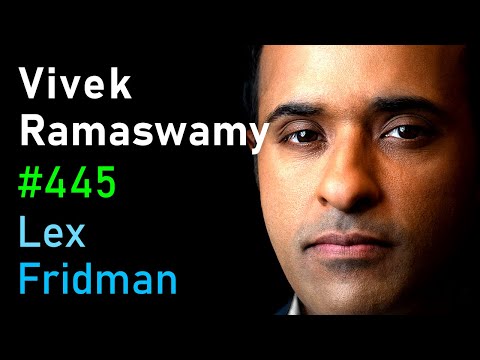
Vivek Ramaswamy: Trump, Conservatism, Nationalism, Immigration, and War | Lex Fridman Podcast #445
Vivek Ramaswamy (guest), Lex Fridman (host), Lex Fridman (host)
In this episode of Lex Fridman Podcast, featuring Vivek Ramaswamy and Lex Fridman, Vivek Ramaswamy: Trump, Conservatism, Nationalism, Immigration, and War | Lex Fridman Podcast #445 explores vivek Ramaswamy Calls To Dismantle America’s Expanding Nanny State Vivek Ramaswamy joins Lex Fridman to outline his ideological project: dismantling what he calls the American “nanny state” across entitlements, regulation, and foreign policy, and reviving a merit-based, sovereignty-focused republic. He argues that modern conservatism has become overly defined by what it opposes and seeks to re-anchor it in 1776 ideals: merit, free speech, self-governance, rule of law, and civic nationalism. The conversation ranges through DEI, bureaucracy, the deep state, immigration and mass deportation, Trump and 2020, the military‑industrial complex, and peace deals in Ukraine and with China. Throughout, Ramaswamy emphasizes aggressive institutional rollback (e.g., 75% federal headcount cuts), paired with a positive vision of national pride and a renewed American identity grounded in shared ideals rather than ethnicity.
Vivek Ramaswamy Calls To Dismantle America’s Expanding Nanny State
Vivek Ramaswamy joins Lex Fridman to outline his ideological project: dismantling what he calls the American “nanny state” across entitlements, regulation, and foreign policy, and reviving a merit-based, sovereignty-focused republic. He argues that modern conservatism has become overly defined by what it opposes and seeks to re-anchor it in 1776 ideals: merit, free speech, self-governance, rule of law, and civic nationalism. The conversation ranges through DEI, bureaucracy, the deep state, immigration and mass deportation, Trump and 2020, the military‑industrial complex, and peace deals in Ukraine and with China. Throughout, Ramaswamy emphasizes aggressive institutional rollback (e.g., 75% federal headcount cuts), paired with a positive vision of national pride and a renewed American identity grounded in shared ideals rather than ethnicity.
Key Takeaways
Conservatism needs a positive, forward-looking vision rooted in 1776 ideals.
Ramaswamy argues that the right has become too focused on fighting ‘wokeism’ and Biden, and not enough on stating what it stands for: meritocracy, free speech, self-governance, rule of law, and a civic identity grounded in truth, individual, family, nation, and God.
Get the full analysis with uListen AI
He proposes a radical rollback of the federal bureaucracy to restore self-governance.
Claiming the administrative state has usurped power from elected officials, he advocates cutting roughly 75% of federal bureaucrats, shutting down obsolete agencies, and rescinding regulations not explicitly passed by Congress, even at the risk of cutting ‘muscle’ along with ‘fat.’
Get the full analysis with uListen AI
DEI and the managerial class are seen as suppressing merit and free thought.
Ramaswamy argues that DEI regimes and bureaucratic committees weaponize virtue signaling to entrench their own power, punish dissenting viewpoints, and undermine true diversity of thought and merit-based advancement in corporations, schools, and government.
Get the full analysis with uListen AI
He wants an honesty-based, selective immigration system and large-scale deportations.
He contends current policy rewards those willing to lie via asylum claims and TPS, and calls for mass deportation of illegal immigrants—starting with criminal offenders and detainees—while redesigning legal immigration to favor those who assimilate, speak English, share civic ideals, and add economic value.
Get the full analysis with uListen AI
Trump is, in his view, the best available vehicle to dismantle the ‘deep state.’
Ramaswamy supports Trump in 2024, citing new Supreme Court precedents (e. ...
Get the full analysis with uListen AI
Foreign policy should prioritize weakening the Russia–China alliance and avoiding World War III.
He advocates a negotiated end to the Ukraine war that trades territorial and NATO assurances plus renewed Western economic ties for Russia’s exit from its military alignment with China and removal of its Western Hemisphere presence, arguing this best serves U. ...
Get the full analysis with uListen AI
Nationalism, properly defined, should be civic, not ethnic.
Rejecting blood-and-soil notions of American identity (including on parts of the right), Ramaswamy says being American hinges on allegiance to the Declaration and Constitution, and that reclaiming national pride and historical myth-making is essential to reversing a ‘lost’ generation’s crisis of meaning.
Get the full analysis with uListen AI
Notable Quotes
“If I was to summarize my ideology in a nutshell, it is to terminate the nanny state in the United States of America in all of its forms: the entitlement state, the regulatory state, and the foreign policy nanny state.”
— Vivek Ramaswamy
“Merit and equity are actually incompatible. Merit and group quotas are incompatible. You can have one or the other. You can’t have both.”
— Vivek Ramaswamy
“What made America itself is we said hell no to that old world vision that we, the people, cannot be trusted to self-govern.”
— Vivek Ramaswamy
“Right now, our immigration system selects for people who are willing to lie.”
— Vivek Ramaswamy
“I don’t want to replace the left-wing nanny state with a right-wing nanny state. I want to get in there and actually dismantle the nanny state.”
— Vivek Ramaswamy
Questions Answered in This Episode
How realistic and socially tolerable would a 75% federal workforce reduction be in practice, and what safeguards would prevent dangerous gaps in essential services?
Vivek Ramaswamy joins Lex Fridman to outline his ideological project: dismantling what he calls the American “nanny state” across entitlements, regulation, and foreign policy, and reviving a merit-based, sovereignty-focused republic. ...
Get the full analysis with uListen AI
Can a meritocratic, selective immigration system be designed that is both brutally honest and still humane toward long-settled families and children?
Get the full analysis with uListen AI
Where is the line between necessary, expert-led administration and the ‘managerial class’ overreach Ramaswamy wants to dismantle?
Get the full analysis with uListen AI
Would Ramaswamy’s proposed Ukraine settlement and Russia–China decoupling be acceptable to Ukrainians themselves, or would it effectively legitimize territorial conquest?
Get the full analysis with uListen AI
How do we foster a shared, civic American nationalism in a deeply polarized society without sliding into exclusionary or ethnonationalist territory?
Get the full analysis with uListen AI
Transcript Preview
The way I would do it, 75% head count reduction across the board in the federal bureaucracy, send them home packing. Shut down agencies that shouldn't exist, rescind every unconstitutional regulation that Congress never passed. In a true self-governing democracy, it should be our elected representatives that make the laws and the rules, not an unelected bureaucrats. Merit and equity are actually incompatible. Merit and group quotas are incompatible. You can have one or the other, you can't have both. It's an assault and a crusade on the nanny state itself. And that nanny state presents itself in several forms. There's the entitlement state, that's the welfare state. It presents itself in the form of the regulatory state, that's what we're talking about. And then there's the foreign nanny state where, effectively, we are subsidizing other countries that aren't paying their fair share of protection or other resources we provide them. If I was to summarize my ideology in a nutshell, it is to terminate the nanny state in the United States of America in all of its forms, the entitlement state, the regulatory state, and the foreign policy nanny state. Once we've done that, we've revived the republic that I think would make George Washington proud.
The following is a conversation with Vivek Ramaswamy about the future of conservatism in America. He has written many books on this topic, including his latest called Truths: The Future of America First. He ran for president this year in the Republican primary and is considered by many to represent the future of the Republican Party. Before all that, he was a successful biotech entrepreneur and investor with a degree in biology from Harvard and a law degree from Yale. As always, when the topic is politics, I will continue talking to people on both the left and the right with empathy, curiosity, and backbone. This is the Lex Fridman Podcast. To support it, please check out our sponsors in the description. And now, dear friends, here's Vivek Ramaswamy. You are one of the great elucidators of conservative ideas so you're the perfect person to ask, uh, what is conservatism?
Yeah.
What's your, let's say, conservative vision for America?
Well, actually, this is one of my criticisms of the modern Republican Party and direction of the conservative movement is that we've gotten so good at describing what we're against. Right, there's a list of things that we could rail against, wokeism, transgender ideology, climate ideology, COVIDism, COVID policies, the radical Biden agenda, the radical Harris agenda, the list goes on. But actually, what's missing in the conservative movement right now is what we actually stand for. What is our vision for the future of the country? And I saw that as a deficit at the time I started my presidential campaign. It was in many ways the purpose of my campaign because I do feel that that's why we didn't have the red wave in 2022. So, uh, they tried to blame Donald Trump, they tried to blame abortion, they blamed a bunch of individual specific issues or factors. I think the real reason we didn't have that red wave was that we got so practiced at criticizing Joe Biden that we forgot to articulate who we are and what we stand for. So what do we stand for as conservatives? I think we stand for the ideals that we fought the American Revolution for in 1776. Ideals like merit, right? That the best person gets the job without regard to their genetics. That you get ahead in this country not on the color of your skin, but on the content of your character. Free speech and open debate, not just as some sort of catchphrase, but the idea that any opinion, no matter how heinous, you get to express it in the United States of America. Self-governance, and this is a big one right now, is that the people we elect to run the government, they're no longer the ones who actually run the government. We in the conservative movement, I believe, should believe in restoring self-governance where it's not bureaucrats running the show, but actually elected representatives. And then the other, the other ideal that the nation was founded on that I think we need to revive and I think is a North Star of the conservative movement is restoring the rule of law in this country. You think about even the abandonment of the rule of law at the southern border. It's particularly personal to me as the kid of legal immigrants to this country. You and I actually share a couple of aspects in, in common in that regard. That also though means your first act of entering this country can't break the law. So there's some policy commitments and principles, merit, free speech, self-governance, rule of law, and then I think culturally what does it mean to be a conservative is it means we believe in the anchors of our identity in truth, the value of the individual, family, nation, and God beat race, gender, sexuality, and climate if we have the courage to actually stand for our own vision. And that's a big part of what's been missing and it's a big part of not just through the campaign but through, you know, a lot of my future advocacy. That's the vacuum I'm aiming to fill.
Install uListen to search the full transcript and get AI-powered insights
Get Full TranscriptGet more from every podcast
AI summaries, searchable transcripts, and fact-checking. Free forever.
Add to Chrome