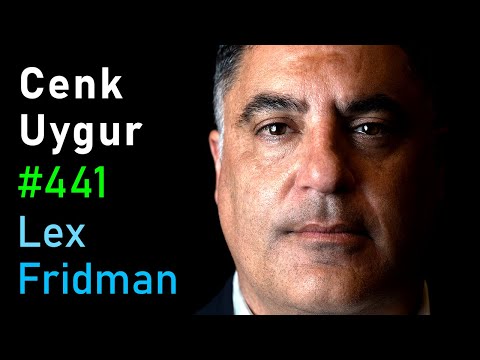
Cenk Uygur: Trump vs Harris, Progressive Politics, Communism & Capitalism | Lex Fridman Podcast #441
Cenk Uygur (guest), Lex Fridman (host), Narrator, Narrator, Narrator
In this episode of Lex Fridman Podcast, featuring Cenk Uygur and Lex Fridman, Cenk Uygur: Trump vs Harris, Progressive Politics, Communism & Capitalism | Lex Fridman Podcast #441 explores cenk Uygur attacks corporatism, defends capitalism, warns on Trump Cenk Uygur joins Lex Fridman to argue that the core problem in American politics is not left vs right but populist vs establishment, with both parties captured by corporate money. He distinguishes capitalism from corporatism, condemning the latter as monopoly‑seeking, anti‑competitive, and enabled by legalized bribery and a complicit media ecosystem. Uygur lays out a reform agenda centered on getting big money out of politics through a constitutional amendment, stronger antitrust enforcement, and “democratic capitalism” that protects markets and people alike. They also dive into Trump vs. Harris 2024, media bias, culture wars, Israel–Palestine, and the limits of progressive leaders like Bernie Sanders and AOC.
Cenk Uygur attacks corporatism, defends capitalism, warns on Trump
Cenk Uygur joins Lex Fridman to argue that the core problem in American politics is not left vs right but populist vs establishment, with both parties captured by corporate money. He distinguishes capitalism from corporatism, condemning the latter as monopoly‑seeking, anti‑competitive, and enabled by legalized bribery and a complicit media ecosystem. Uygur lays out a reform agenda centered on getting big money out of politics through a constitutional amendment, stronger antitrust enforcement, and “democratic capitalism” that protects markets and people alike. They also dive into Trump vs. Harris 2024, media bias, culture wars, Israel–Palestine, and the limits of progressive leaders like Bernie Sanders and AOC.
Key Takeaways
Differentiate capitalism from corporatism if you want real market freedom.
Uygur argues capitalism thrives on competition, while corporatism uses political power to rig rules, create monopolies/oligopolies, and suppress wages. ...
Get the full analysis with uListen AI
Follow the money: campaign finance drives 90%+ of legislative outcomes.
He claims politicians overwhelmingly serve donors, not voters, citing the carried‑interest loophole and the near‑perfect correlation between campaign cash and election wins; without removing big money, other reforms get blocked or watered down.
Get the full analysis with uListen AI
Structural reform requires a constitutional amendment, not just new laws.
Because Supreme Court rulings like Buckley, Bellotti, and Citizens United equate money with speech and grant corporations personhood, Uygur says only an amendment—likely via an Article V convention driven by states—can re‑limit money in politics.
Get the full analysis with uListen AI
Use public financing and small‑donor thresholds to realign incentives.
He proposes ending private financing of elections, replacing it with public funds accessed once candidates show real grassroots support, so politicians are rewarded for serving voters instead of large donors, PACs, and corporations.
Get the full analysis with uListen AI
Media’s biggest bias is pro‑corporate, not left or right.
Uygur contends mainstream outlets protect advertisers and political clients—soft‑pedaling stories about money in politics and policy capture—while reserving their harshest attacks for true populist outsiders on left and right.
Get the full analysis with uListen AI
Culture wars and extreme DEI fights are used to divide and distract.
He sees both far‑left excesses and right‑wing “woke mind virus” panic as tools that keep voters fixated on symbolic social battles instead of uniting around shared economic interests like higher wages, healthcare, and anti‑corruption.
Get the full analysis with uListen AI
Trump is a genuine systemic risk with a small chance of systemic reform.
Uygur says Trump’s fake‑elector plot and affection for strongmen are disqualifying and dangerous for democracy, yet acknowledges that precisely because he’s a wild card, there’s a non‑zero chance he could accidentally disrupt entrenched corruption.
Get the full analysis with uListen AI
Notable Quotes
“Communism makes no sense at all, totally opposed to human nature. It never works. It always devolves into dictatorship.”
— Cenk Uygur
“Corporatism hates competition. It wants monopoly and oligopoly power, whereas capitalism loves competition and wants the free markets.”
— Cenk Uygur
“Mainstream media, in my opinion, is The Matrix. Its job is to delude you into thinking corporate rule is great for you and we should never change it.”
— Cenk Uygur
“If somebody signs your check, that’s the person you work for. If private interests are funding politicians, the politicians will serve private interests.”
— Cenk Uygur
“Hope is the most dangerous thing in the world for the elites.”
— Cenk Uygur
Questions Answered in This Episode
If money in politics is as dominant as Uygur claims, what realistic steps—short of a constitutional amendment—could begin to reduce its influence in the next 5–10 years?
Cenk Uygur joins Lex Fridman to argue that the core problem in American politics is not left vs right but populist vs establishment, with both parties captured by corporate money. ...
Get the full analysis with uListen AI
How can we meaningfully distinguish and measure corporatism vs healthy capitalism in specific industries like tech, pharma, or finance?
Get the full analysis with uListen AI
Are there examples of media outlets that have successfully resisted corporate capture, and what business models make that possible at scale?
Get the full analysis with uListen AI
Is it possible to build a broad populist coalition across left and right without it being captured by charismatic but anti‑democratic leaders?
Get the full analysis with uListen AI
On issues like Israel–Palestine and Ukraine, how should a ‘democratic capitalist’ foreign policy balance anti‑war instincts with deterrence and alliance commitments?
Get the full analysis with uListen AI
Transcript Preview
Communism makes no sense at all, totally opposed to human nature. It never works. It always devolves into dictatorship. It creates a power vacuum. When you say, "Hey, there's no structure of power here," right, "We're all equal, it's a flat line," one guy usually gets up, because that's human nature, and goes, "Uh, I don't think so. I think if you're gonna leave a power vacuum, I'm gonna take that power vacuum." Corporatism hates competition. It wants monopoly and oligopoly power, whereas capitalism loves competition and wants the free markets. When mainstream media has you hooked, you got no hope, because you don't have the right information. You have propaganda. You have marketing. You don't have real news. When you're in the online world, it's chaotic. And don't get me wrong, it's got plenty of downsides, right? But within that chaos, the truth begins to emerge. Trump is a massive risk because of all the things we talked about earlier, but there is a percentage chance that he's such a wild card that he overturns the whole system, and that is why the establishment is a little scared of him.
The following is a conversation with Cenk Uygur, a progressive political commentator and host of The Young Turks. As I've said before, I will speak with everyone, including on the left and the right of the political spectrum, always in good faith, with empathy, rigor, and backbone. Sometimes I fail. Sometimes I say stupid, inaccurate, ineloquent things, and I frequently change my mind as I'm learning and thinking about the world. For all this, I often get attacked, sometimes fairly, sometimes not. But just know that I'm aware when I fall short and I will keep trying to do better. I love you all. This is the Lex Fridman Podcast. To support it, please check out our sponsors in the description. And now, dear friends, here's Cenk Uygur. You wrote a book-
Yeah.
... a manifesto that outlines the progressive vision for America. So, the big question, what are some defining ideas of progressivism?
Yeah. So in order to do that, Lex, we gotta, uh, talk about where we are in the political spectrum. And, uh, in fact, there's two different, uh, spectrums now. People often think of left-right, uh, and that's true. That exists. But layered on top of that is now populist versus establishment. So I'm center-left on the left-right spectrum, um, but I'm all the way on the populist end of, of the second spectrum.
Mm-hmm.
So where does progressivism lie within that? Well, uh, I would argue that it's exactly in those places. It's populist, uh, and it's on the left, but it is not far left. So far left is a different animal, uh, and we could talk about that i- in a little bit. So in terms of what makes a progressive, so expand the circle of liberty and, uh, justice for all and equality of opportunity. Now, people will say, "Well, that seems pretty broad and all American," but is it? Think about it. So expand the circle of liberty. Uh, everybody's in favor of that, right? No, absolutely not. So, uh, certainly the king of England was not in favor of expanding the circle of liberty, and the Founding Fathers said, "We're gonna expand it." And they expanded it to propertied white men, and then progressives have been inc- They are progressives because they expanded the circle of liberty. They then, from then on, as we were perfecting the union, progressives always say expand it further, include women, include people without property, include all races, and at every turn, conservatives fight against it. So that doesn't mean if you're a conservative today, you don't wanna include women or, uh, minorities, et cetera. But, but today, you would say, for example, "Well, I don't wanna expand the circle of liberty to, for example, undocumented immigrants." And maybe you're right about that and we could have that d- discussion in terms of a specific philosophy. And I don't believe that undocumented immigrants should immediately be citizens or anything along those lines, but I do believe in expanding liberty overall, and the contours of that are what's interesting. And then you say justice for all, everybody's for just- No. Right now, marijuana possession is still illegal in a lot of parts of the, uh, country. Now a lot of right-wingers and left-wingers agree that it should be legal, but for my entire lifetime, uh, Black people have been arrested at about 3.7 times the rate of white people, and the entire country has been fine with it. So does that justice? No. They smoke... White people, Black people smoke marijuana at the same rate. Black people get arrested about four times the rate. That is an injustice that an enormous percentage of the country was comfortable with, while progressives aren't comfortable with it. We want justice for all. So the equality of opportunity is an interesting one because the far left will say, s- at least some portions of them will say equality of results, right? So progressives just want a fair chance, so free college education, but afterwards, you don't get to have exact same results as the, either the wealthiest person or we're not all going to be equal. We don't have equal talents, skills, abilities, et cetera.
Install uListen to search the full transcript and get AI-powered insights
Get Full TranscriptGet more from every podcast
AI summaries, searchable transcripts, and fact-checking. Free forever.
Add to Chrome