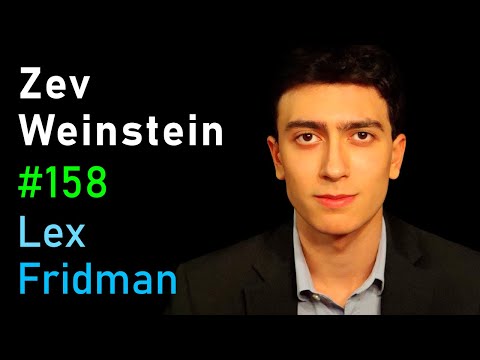
Zev Weinstein: The Next Generation of Big Ideas and Brave Minds | Lex Fridman Podcast #158
Lex Fridman (host), Zev Weinstein (guest)
In this episode of Lex Fridman Podcast, featuring Lex Fridman and Zev Weinstein, Zev Weinstein: The Next Generation of Big Ideas and Brave Minds | Lex Fridman Podcast #158 explores young philosopher confronts stagnation, danger of ideas, and meaning Lex Fridman speaks with young thinker Zev Weinstein about the power and danger of deep thought in times of societal stagnation, arguing that “philosophy” in the broad sense—radical, first-principles thinking and innovation—is both risky and necessary when systems are failing.
Young philosopher confronts stagnation, danger of ideas, and meaning
Lex Fridman speaks with young thinker Zev Weinstein about the power and danger of deep thought in times of societal stagnation, arguing that “philosophy” in the broad sense—radical, first-principles thinking and innovation—is both risky and necessary when systems are failing.
Zev explores topics such as growth versus stagnation, the intolerance of public change, the distortion of language and labels, and the role of free will, truth, and morality in stabilizing civilizations.
He reflects on communication mediums (books, podcasts, social media), the beauty and universality of math and physics, the pursuit of a theory of everything, and the potential role of AGI and radical individuals in breaking current frameworks.
The conversation becomes personal as Zev discusses his relationship with his father, Eric Weinstein, his fear and obligation to think publicly, his approach to music and self-teaching, and his views on mortality and the meaning of life as contributing to truths that transcend humanity.
Key Takeaways
In stagnant times, deep thinking becomes both more essential and more dangerous.
When nothing is growing, power shifts from creators to protectors of existing resources; radical ideas threaten entrenched interests but are also the only way out of eventual conflict or collapse.
Get the full analysis with uListen AI
Philosophy should be understood broadly as first-principles thinking, not just academic debate.
Zev uses “philosophy” to include moral reasoning, political re-framing, and technological innovation—any deep ideation that can restructure how societies work and who succeeds within them.
Get the full analysis with uListen AI
Public intolerance of changing one’s mind stifles genuine intellectual growth.
Zev accepts that his views will evolve but fears the internet’s hostility to inconsistency, arguing that openly revising beliefs should be normalized—especially for his generation—if society wants real thinkers instead of brand-managed personas.
Get the full analysis with uListen AI
Labels and degraded language corrupt abstraction and constrain new political and philosophical spectra.
Attaching simplistic labels (left/right, radical/extremist) compresses nuanced ideas into pre-packaged categories, making it easier to straw-man and suppress novel frameworks; Zev sees this as partly deliberate and deeply Orwellian.
Get the full analysis with uListen AI
Morality, truth, and science serve as stabilizing structures for civilization.
He defines “good” as a proxy for a civilization’s stability and fitness, argues that convergent moral norms are not purely subjective, and sees objective truth and science as shared ground that should, in principle, reduce conflict.
Get the full analysis with uListen AI
Math and physics are discovered universals; human notation is just a messy interface.
Zev believes the deep structures of math and physics are fundamental features of reality that any intelligent species would uncover; what we invent are the symbols and language, which inevitably “smudge” the underlying beauty.
Get the full analysis with uListen AI
A meaningful life involves contributing to truths and structures that transcend the human condition.
Pleasure and many joys are evolutionarily programmed; Zev sees the highest meaning in observing, understanding, and adding to the abstract, universal truths—especially in math, physics, and deep theory—that outlast individual lives and local circumstances.
Get the full analysis with uListen AI
Notable Quotes
“Good is a proxy for the stability and fitness of a civilization.”
— Zev Weinstein
“It becomes much more dangerous for a person to think deeply and question during a time when the important people are those concerned with making sure no one rocks the boat.”
— Zev Weinstein
“We’re making legitimate decisions within a system that has no freedom.”
— Zev Weinstein
“The things which shallows our thought can be the incorporation of circumstance and coincidence.”
— Zev Weinstein
“If we have a culture which cares very deeply about science, that’s a culture which is not necessarily bound to injure unwarranted internal conflict.”
— Zev Weinstein
Questions Answered in This Episode
If philosophy and radical thinking are both necessary and dangerous in stagnant times, how can societies protect and cultivate such thinkers without triggering destructive upheaval?
Lex Fridman speaks with young thinker Zev Weinstein about the power and danger of deep thought in times of societal stagnation, arguing that “philosophy” in the broad sense—radical, first-principles thinking and innovation—is both risky and necessary when systems are failing.
Get the full analysis with uListen AI
What practical steps could individuals and institutions take to make public mind-changing and intellectual evolution socially acceptable rather than punishable?
Zev explores topics such as growth versus stagnation, the intolerance of public change, the distortion of language and labels, and the role of free will, truth, and morality in stabilizing civilizations.
Get the full analysis with uListen AI
How can we design new political “spectrums” or frameworks that escape current left/right labeling while still allowing for clear communication and democratic accountability?
He reflects on communication mediums (books, podcasts, social media), the beauty and universality of math and physics, the pursuit of a theory of everything, and the potential role of AGI and radical individuals in breaking current frameworks.
Get the full analysis with uListen AI
Do you agree with Zev’s definition of morality as a proxy for civilizational stability—and what would that imply for judging controversial moral norms across cultures and eras?
The conversation becomes personal as Zev discusses his relationship with his father, Eric Weinstein, his fear and obligation to think publicly, his approach to music and self-teaching, and his views on mortality and the meaning of life as contributing to truths that transcend humanity.
Get the full analysis with uListen AI
If math and physics are universal but our symbols are smudges, what would a less “smudged,” more direct way of grasping and sharing these truths look like—for humans or for AI?
Get the full analysis with uListen AI
Transcript Preview
The following is a conversation with Zev Weinstein, a young man with a brilliant, bold, and hopeful mind that I had the great fortune of talking to on a recent afternoon. He happens to be Eric Weinstein's son, but I invited Zev not because of that, but because I got a chance to listen to him speak on a few occasions and was captivated by how deeply he thought about this world at such a young age, and I thought that it might be fun to explore this world of ours together with him for a time through this conversation. Quick mention of our sponsors: ExpressVPN, Grammarly grammar assistant, SimpliSafe home security, and Magic Spoon low-carb cereal. So the choice is privacy, grammar, safety, or health. Choose wisely, my friends, and if you wish, click the sponsor links below to get a discount and to support this podcast. As a side note, let me say that Zev acknowledges the fear associated with participating in public discourse and is brave enough to join in at a young age, to push forward, to change his mind publicly, to learn, to articulate difficult, nuanced ideas, and grow from the conversations that follow. In this, I hope he leads the next generation of minds that is joining and steering the collective intelligence of this big ant colony we think of as our human civilization. If you enjoy this thing, subscribe on YouTube, review it on Apple Podcasts, follow on Spotify, support on Patreon, or connect with me on Twitter @lexfriedman. And now, here's my conversation with Zev Weinstein. You've said that philosophy becomes more dangerous in difficult times. What do you mean by that?
Interestingly, I think I mean two things by that, and I think firstly I should clarify, when I say philosophy, I sort of mean in a- a very traditional sense, just thinking, ideation, and that could be reconsidering our notions of self in a very traditional sense which we consider philosophy, or that could be, like, technological, uh, innovation. I think it's important to recognize all of these as philosophy so that we can not question whether it's important to promote thought. I think the other thing I should clarify is when I say difficult times, I mean times when nothing is growing and so the risk for real conflict is much greater because people are incentivized to fight over the things which already exist. I think when times are not difficult, the people with the greatest power are usually the people who are very creative, generating a lot, and that really requires ideation or philosophy of some sort. I think when times become stagnant, the important successful people become the people who are very good at protecting their own pieces of the pie and taking others. Um, I think that those people have to be very opposed to any sort of thinking that could restructure society or conventions about who s- should succeed. And so firstly, I mean by that, that it becomes much more dangerous- dangerous for a person to think deeply and question during a time when the important people are those concerned with making sure no one rocks the boat. You know, one example of this would be, like, Socrates and his execution, because everyone was happy enough to sit through his questions before, uh, there was war and poverty and distress, and afterwards, it just became too dangerous. The other thing I mean by that is that the consequences of thinking deeply carry much greater potential for real catastrophe when everyone is desperate. So, like, for example, you know, the Communist Manifesto was probably much more dangerous, uh, during early 1900s Russia than it was during the 1848 revolutions because I think people were in much worse shape, uh, and desperate people are very willing to dive into anything new that might bring the future without fully calculating whatever the consequences or risks might be. So it is both more dangerous for a person to have creative ideas, and those ideas are more dangerous when t- when times are tough.
Install uListen to search the full transcript and get AI-powered insights
Get Full TranscriptGet more from every podcast
AI summaries, searchable transcripts, and fact-checking. Free forever.
Add to Chrome