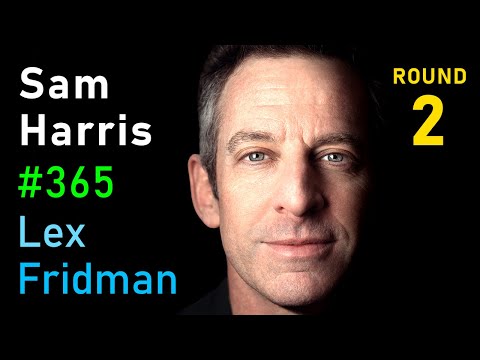
Sam Harris: Trump, Pandemic, Twitter, Elon, Bret, IDW, Kanye, AI & UFOs | Lex Fridman Podcast #365
Lex Fridman (host), Sam Harris (guest), Narrator, Narrator
In this episode of Lex Fridman Podcast, featuring Lex Fridman and Sam Harris, Sam Harris: Trump, Pandemic, Twitter, Elon, Bret, IDW, Kanye, AI & UFOs | Lex Fridman Podcast #365 explores sam Harris, Trump, COVID, Free Speech, AI, and Fractured Friendships Lex Fridman and Sam Harris explore the tension between empathy and reason, arguing that while empathy is vital interpersonally, rational analysis must guide large‑scale ethics and policy.
Sam Harris, Trump, COVID, Free Speech, AI, and Fractured Friendships
Lex Fridman and Sam Harris explore the tension between empathy and reason, arguing that while empathy is vital interpersonally, rational analysis must guide large‑scale ethics and policy.
They dissect Trump, January 6th, COVID, vaccines, the Hunter Biden laptop, and institutional failure, while examining how social media, audience capture, and misinformation have deranged public discourse.
Sam reflects on strained relationships with figures like Elon Musk, Bret Weinstein, and Joe Rogan, and on the ethics of platforming controversial voices such as Kanye West and Trump.
The conversation closes with concerns about AI safety, nuclear risk, free will, and the possibility of building healthier information ecosystems and institutions despite current chaos.
Key Takeaways
Reason must lead large‑scale ethics; empathy should be constrained.
Sam distinguishes cognitive empathy (understanding others) from emotional contagion, arguing the latter misguides moral judgment (e. ...
Get the full analysis with uListen AI
Some partiality toward loved ones is ethically acceptable and even stabilizing.
Against a purely impartial ‘Dalai Lama’ ethic, Sam suggests it's likely better for society if people prioritize their children and close relations, provided public systems (courts, hospitals) remain impartial and fair.
Get the full analysis with uListen AI
Trump’s main danger was institutional norm‑breaking, not ideological genius.
Sam sees Trump as an incompetent, pathological narcissist whose refusal to commit to peaceful transfer of power revealed how fragile U. ...
Get the full analysis with uListen AI
Expertise is real and necessary, even though experts often fail and incentives are corrupting.
He emphasizes that while truths don't depend on credentials, in emergencies (pandemics, nuclear risk), deferring to genuine domain experts is usually rational; simultaneously, he acknowledges institutional capture, bad incentives, and the need for reform.
Get the full analysis with uListen AI
Social media, especially Twitter, distorts character and reality perception.
Sam argues Twitter incentivizes snideness, audience capture, and sociopathic behavior in otherwise decent people, including himself; deleting his account improved his attention, mood, and trust in ordinary human decency.
Get the full analysis with uListen AI
Audience capture is warping public intellectuals and podcasters.
He worries that creators who monetize outrage or one topic (e. ...
Get the full analysis with uListen AI
AI and information tech pose existential coordination and epistemic threats.
Sam fears we’re failing the ‘dress rehearsal’ of COVID and social media, heading into an era of deepfakes and powerful AI where truth is hard to establish; he doubts we know how to align superintelligent systems with human values and sees this as a genuine existential risk.
Get the full analysis with uListen AI
Notable Quotes
“We have basically enrolled all of human society into a psychological experiment that is deranging us and making it virtually impossible to solve coordination problems.”
— Sam Harris
“I think the truly depressing and genuinely scary thing was that we have a country that didn't see anything wrong with bringing someone like Trump, who obviously doesn't know what he should know to be president, into that role.”
— Sam Harris
“Even if ivermectin turned out to be a panacea and mRNA vaccines killed millions, Bret would still have been wrong at the time, because his reasoning and confidence were unjustified then.”
— Sam Harris
“The reason I deleted my Twitter account in the end was that it was obviously making me a worse person.”
— Sam Harris
“We are going to design the aliens. That’s what building superintelligent AI really is.”
— Sam Harris
Questions Answered in This Episode
How should individuals balance deference to experts with healthy skepticism when institutions have clearly failed or been politicized?
Lex Fridman and Sam Harris explore the tension between empathy and reason, arguing that while empathy is vital interpersonally, rational analysis must guide large‑scale ethics and policy.
Get the full analysis with uListen AI
What concrete reforms could rebuild trust in public health, media, and scientific institutions after COVID and the social media era?
They dissect Trump, January 6th, COVID, vaccines, the Hunter Biden laptop, and institutional failure, while examining how social media, audience capture, and misinformation have deranged public discourse.
Get the full analysis with uListen AI
Where exactly is the ethical line between ‘platforming’ harmful ideas for illumination and irresponsibly amplifying them?
Sam reflects on strained relationships with figures like Elon Musk, Bret Weinstein, and Joe Rogan, and on the ethics of platforming controversial voices such as Kanye West and Trump.
Get the full analysis with uListen AI
How can public thinkers and creators practically resist audience capture while still sustaining large platforms and livelihoods?
The conversation closes with concerns about AI safety, nuclear risk, free will, and the possibility of building healthier information ecosystems and institutions despite current chaos.
Get the full analysis with uListen AI
Given Sam’s view on free will and possibility, how should we rethink blame, punishment, and moral responsibility in legal and personal contexts?
Get the full analysis with uListen AI
Transcript Preview
The following is a conversation with Sam Harris, his second time on the podcast. As I said two years ago when I first met and spoke with Sam, he's one of the most influential pioneering thinkers of our time. As the host of the Making Sense podcast, creator of the Waking Up app, and the author of many seminal books on human nature and the human mind, including The End of Faith, The Moral Landscape, Lying, Free Will, and Waking Up. In this conversation, besides our mutual fascination with AGI and free will, we do also go deep into controversial challenging topics of Donald Trump, Hunter Biden, January 6th, vaccines, lab leak, Kanye West, and several key figures at the center of public discourse, including Joe Rogan and Elon Musk, both of whom have been friends of Sam and have become friends of mine, somehow in an amazing life trajectory that I do not deserve in any way, and in fact believe is probably a figment of my imagination. And if it's all right, please allow me to say a few words about this personal aspect of the conversation of discussing Joe, Elon, and others. What's been weighing heavy on my heart since the beginning of the pandemic now three years ago, is that many people I look to for wisdom and public discourse stopped talking to each other as often with respect, humility, and love when the world needed those kinds of conversations the most. My hope is that they start talking again, they start being friends again, they start noticing the humanity that connects them that is much deeper than the disagreements that divide them. So let me take this moment to say, with humility and honesty, why I look up to and am inspired by Joe, Elon, and Sam. I think Joe Rogan is important to the world as a voice of compassionate curiosity and open-mindedness to ideas both radical and mainstream, sometimes with humor, sometimes with brutal honesty, always pushing for more kindness in the world. I think Elon Musk is important to the world as an engineer, leader, entrepreneur and human being who takes on the hardest problems that face humanity and refuses to accept the constraints of conventional thinking that made the solutions to these problems seem impossible. I think Sam Harris is important to the world as a fearless voice who fights for the pursuit of truth against growing forces of echo chambers and audience capture, taking unpopular perspectives and defending them with rigor and resilience. I both celebrate and criticize all three privately, and they criticize me, usually more effectively, from which I always learn a lot and always appreciate. Most importantly, there is respect and love for each other as human beings, the very thing that I think the world needs most now in a time of division and chaos. I will continue to try to mend divisions, to try to understand, not deride, to turn the other cheek if needed, to return hate with love. Sometimes people criticize me for being naive, cheesy, simplistic, all of that. I know, I agree, but I really am speaking from the heart, and I'm trying. This world is too fucking beautiful not to try in whatever way I know how. I love you all. This is the Lex Fridman Podcast. To support it, please check out our sponsors in the description. And now, dear friends, here's Sam Harris. What is more effective at making a net positive impact on the world, empathy or reason?
Install uListen to search the full transcript and get AI-powered insights
Get Full TranscriptGet more from every podcast
AI summaries, searchable transcripts, and fact-checking. Free forever.
Add to Chrome