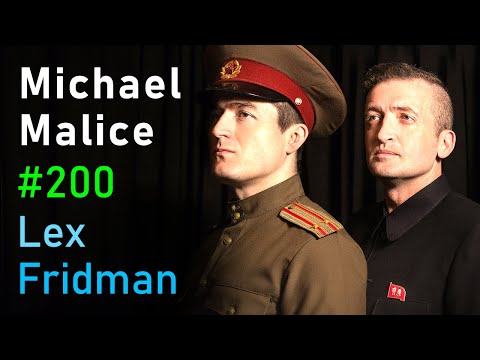
Michael Malice: Totalitarianism and Anarchy | Lex Fridman Podcast #200
Michael Malice (guest), Lex Fridman (host), Narrator, Narrator, Narrator, Narrator, Lex Fridman (host), Narrator
In this episode of Lex Fridman Podcast, featuring Michael Malice and Lex Fridman, Michael Malice: Totalitarianism and Anarchy | Lex Fridman Podcast #200 explores michael Malice and Lex Fridman Confront Power, Suffering, Freedom, Hope Lex Fridman and Michael Malice explore totalitarianism, anarchism, and human nature through history, literature, and personal experience, centering on Orwell, Camus, Emma Goldman, and the Soviet and North Korean regimes.
Michael Malice and Lex Fridman Confront Power, Suffering, Freedom, Hope
Lex Fridman and Michael Malice explore totalitarianism, anarchism, and human nature through history, literature, and personal experience, centering on Orwell, Camus, Emma Goldman, and the Soviet and North Korean regimes.
They debate what heroism and conscience look like under oppressive systems, contrasting public martyrdom with small, quiet acts of moral courage in everyday life.
Malice lays out his anarchist critique of the state—especially war, policing, and taxation—while Lex pushes back with questions about hierarchy, governance, and whether better versions of government are possible.
Throughout, they weave in deeply emotional reflections on Jewish family histories in World War II, contemporary North Korea, the temptation of cynicism, and their shared commitment to kindness, joy, and individual responsibility.
Key Takeaways
Heroism is often quiet, local, and costly—but not always martyrdom.
Malice argues that real heroism is doing the right thing when it has real risk or cost—like the Nazi guard quietly saving a child at Auschwitz or someone refusing to participate in cruelty—not just grand public gestures with no personal consequence.
Get the full analysis with uListen AI
Some of the fiercest critics of totalitarianism came from the left.
Figures like Emma Goldman, George Orwell, and Albert Camus were committed leftists who turned against Soviet and fascist totalitarianism from within their own ideological camp, showing that courage often means opposing your “own side.”
Get the full analysis with uListen AI
Totalitarian regimes weaponize family bonds to crush dissent.
From Stalin’s USSR to Kim Il-sung’s North Korea, the state punishes entire families—often across three generations—using children and relatives as hostages to force confessions and obedience, making individual bravery far harder than Westerners imagine.
Get the full analysis with uListen AI
Cynicism is a trap; hope and innocence can be a disciplined choice.
Both see cynicism as a form of hopelessness that projects itself onto the world; Lex defends what others call naivety as a deliberate stance of seeing the possibility of goodness and joy, while Malice sides with Camus in rejecting nihilism and championing conscience.
Get the full analysis with uListen AI
Anarchism reframes the state as just another coercive actor, not a moral authority.
Malice contends that the core of anarchism is: “You do not speak for me. ...
Get the full analysis with uListen AI
War reveals the state at its moral worst and should truly be a last resort.
They argue that modern politics and media treat war as a first-line policy tool, ignoring the immense, often invisible human cost to civilians abroad, and that any legitimate system should treat war as an absolute last resort, if at all.
Get the full analysis with uListen AI
Everyday kindness and small rebellions against mediocrity matter enormously.
From taking a lonely person out for their birthday to quietly ignoring petty rules or online cruelty, they argue these seemingly minor acts move humanity forward, model better behavior, and are available to almost everyone at low cost.
Get the full analysis with uListen AI
Notable Quotes
“Anarchism can be summed up in one sentence: you do not speak for me.”
— Michael Malice
“Cynicism is the lie that happiness is not possible on this earth.”
— Michael Malice
“I’d rather be naive than a cynic, because a cynic is a hopeless man who projects his hopelessness to the world at large.”
— Michael Malice
“Real heroism might be quietly, privately in your own life living the virtues you want the rest of the world to live by.”
— Lex Fridman
“Be kind to yourself, because a lot of you deserve it.”
— Michael Malice
Questions Answered in This Episode
Is it realistic to expect most people to engage in quiet moral rebellion, or are Malice and Lex overestimating human capacity for conscience?
Lex Fridman and Michael Malice explore totalitarianism, anarchism, and human nature through history, literature, and personal experience, centering on Orwell, Camus, Emma Goldman, and the Soviet and North Korean regimes.
Get the full analysis with uListen AI
Can an anarchist vision of voluntary security, courts, and welfare actually scale without morphing into something that looks like a state?
They debate what heroism and conscience look like under oppressive systems, contrasting public martyrdom with small, quiet acts of moral courage in everyday life.
Get the full analysis with uListen AI
How should we balance the moral appeal of pacifism and turning the other cheek with the need to resist real, violent evil in the world?
Malice lays out his anarchist critique of the state—especially war, policing, and taxation—while Lex pushes back with questions about hierarchy, governance, and whether better versions of government are possible.
Get the full analysis with uListen AI
What practical steps can individuals in free societies take today to meaningfully oppose totalitarian regimes like North Korea without fueling harmful interventions?
Throughout, they weave in deeply emotional reflections on Jewish family histories in World War II, contemporary North Korea, the temptation of cynicism, and their shared commitment to kindness, joy, and individual responsibility.
Get the full analysis with uListen AI
Where is the line between a healthy distrust of power (conspiracy realism) and a destructive worldview where all institutions are assumed corrupt by default?
Get the full analysis with uListen AI
Transcript Preview
The following is a conversation between me and Michael Malice. Michael is an author, anarchist, and simpleton, and I'm proud to call him my friend. He makes me smile, he makes me think, and he makes me wonder why I sound so sleepy all the time. And now, enjoy this conversation with Michael Malice in the Ədaləc language that I'm increasingly certain I'll never quite able to get the hang of.
Hello, comrade.
(laughs) Ələy gəlmisiniz?
(laughs) So Animal Farm by, uh, George Orwell is, uh, one of my favorite books. It's an allegory about, at least I think, about the Soviet Union and the Russian Revolution of 1917. So for people who haven't read it, it's, uh, animals overthrow the humans and then slowly become as bad or worse than the humans. So comrade, if we lived on this farm in the book Animal Farm, which animal would you most rather be? Uh, would it be the pigs, the horses, the donkey, Benjamin, the raven, Moses, the humans, Mr. and Mrs. Jones, the dogs, or the sheep?
Um, I'm gonna go with the Milton answer, which is it's better to rule in hell than serve in heaven, right?
It's better to rule in hell-
To-
... than serve in heaven.
Yeah, so I would have to go with the pigs. So I guess I'd be a cop. Um-
At the very top, so the leader, the main pig, Napoleon, versus like the-
Snowball and the others.
Yeah.
I, I would say it's not s- it's, uh, sure it's an allegory about the Russian Revolution, but I think, um, Orwell's point was this is broader towards most totalitarian dictatorships.
Yeah.
I mean, it, it, it could very easily be read as an indictment of Mussolini or Hitler or many of these others. Uh, I'm a huge, um, George Orwell fan. One of the things that I think people on the right need to appreciate is the courage of many of these ind- undisputably left-wing voices who were the strongest ones to take on, uh, totalitarianism, totalitarian communism, and the three I could think of off the top of my head who are all in my top 10 heroes of all time are Emma Goldman, uh, Albert Camus, uh, and Orwell being the third. You know, something that, uh, leftists like to throw in the face of people on the right who constantly invoke Orwell is that Orwell said, and I don't have the exact quote off the top of my head, but something to the effect of, "Every word I have written is in, should be taken as a defense of democratic socialism against totalitarianism."
Mm-hmm.
So, uh, people like Truman, you know, was obviously very hardcore, in many ways anti-communist. Uh, we like to parse things out, um, you're gonna laugh, uh, into binary fashions that, you know, left good/right bad or right good/left bad, but historically speaking, it w- does not fall away into these camps as easily as people would like. Um, and I think it is important for those of us... It takes a lot more courage, um, to fight the right from the right or to fight the left from the left because, in a sense, a lot of your countrymen or your fellow travelers are gonna regard you as a traitor to the cause. So I, I, every chance I get, I will sing the praises of these three figures, a- among others, who not onl- even if they hadn't done what they had done, just lived just amazing lives that all of us can, uh, learn from and admire and regard as somewhat a, a role model, so, uh...
Install uListen to search the full transcript and get AI-powered insights
Get Full TranscriptGet more from every podcast
AI summaries, searchable transcripts, and fact-checking. Free forever.
Add to Chrome