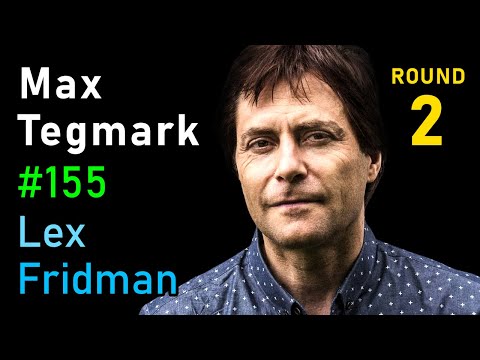
Max Tegmark: AI and Physics | Lex Fridman Podcast #155
Lex Fridman (host), Max Tegmark (guest), Narrator, Narrator
In this episode of Lex Fridman Podcast, featuring Lex Fridman and Max Tegmark, Max Tegmark: AI and Physics | Lex Fridman Podcast #155 explores max Tegmark warns: powerful AI, fragile civilization, and rare life Lex Fridman and Max Tegmark explore how recent advances in AI and machine learning intersect with physics, scientific discovery, and the long‑term future of civilization. Tegmark argues for “intelligible intelligence” – AI systems we deeply understand and can prove safe – instead of ever-larger opaque black boxes. They connect current harms like social-media-driven polarization and autonomous weapons to deeper alignment failures in technology, corporations, and geopolitics. Throughout, Tegmark frames AI, nuclear weapons, pandemics, and the Fermi paradox as parts of one question: whether humanity survives this century and unlocks a vast, potentially unique cosmic future for conscious life.
Max Tegmark warns: powerful AI, fragile civilization, and rare life
Lex Fridman and Max Tegmark explore how recent advances in AI and machine learning intersect with physics, scientific discovery, and the long‑term future of civilization. Tegmark argues for “intelligible intelligence” – AI systems we deeply understand and can prove safe – instead of ever-larger opaque black boxes. They connect current harms like social-media-driven polarization and autonomous weapons to deeper alignment failures in technology, corporations, and geopolitics. Throughout, Tegmark frames AI, nuclear weapons, pandemics, and the Fermi paradox as parts of one question: whether humanity survives this century and unlocks a vast, potentially unique cosmic future for conscious life.
Key Takeaways
AI’s power should come from understanding, not inscrutable complexity.
Tegmark argues we must move from black-box neural nets to “intelligible intelligence” where we can explain and even formally verify critical systems (e. ...
Get the full analysis with uListen AI
Most current AI failures stem from misalignment, not malice.
Incidents like the 737 MAX crashes, Knight Capital’s trading fiasco, and social-media polarization arose from over-trusting systems whose goals (or failure modes) weren’t aligned with human safety and societal well-being, despite no “evil intent” in the code.
Get the full analysis with uListen AI
Media algorithms weaponize our attention; we can also weaponize AI for citizen empowerment.
Engagement-optimizing recommender systems amplified outrage and filter bubbles, but Tegmark’s Improve the News project shows how machine learning can instead help individuals see cross-partisan, establishment vs anti‑establishment coverage and recognize bias techniques.
Get the full analysis with uListen AI
Autonomous weapons risk cheap, scalable destruction and demand early international norms.
Drawing a parallel to bioweapons bans, Tegmark contends that fully autonomous, cheap, mass-producible weapons will proliferate to terrorists and unstable actors; even imperfect treaties and strong stigma can greatly reduce deployment, as with bioweapons.
Get the full analysis with uListen AI
AI alignment must address both technical systems and human power structures.
Even perfectly obedient AI can be catastrophic if serving misaligned human or institutional goals; aligning corporations, governments, and international incentives with humanity’s long-term interests is as important as aligning algorithms themselves.
Get the full analysis with uListen AI
Machine learning can revolutionize physics and mathematics by finding structure we miss.
Projects like AI Feynman, AlphaFold, and work on lattice QCD, black-hole simulations, and cosmology hint that AI can discover equations and efficient computational shortcuts, potentially contributing to fundamental theories and even “the next Kepler or Planck.”
Get the full analysis with uListen AI
Humanity may be cosmically rare, making our century unusually consequential.
Given the abundance of Earth-like planets but no obvious signs of advanced civilizations, Tegmark argues that intelligent life might be extremely rare and short-lived between key transitions, implying that how we handle nukes, pandemics, and AGI this century could determine the entire future of consciousness in our observable universe.
Get the full analysis with uListen AI
Notable Quotes
“The real power of neural networks comes not from inscrutability but from differentiability.”
— Max Tegmark
“The risk is not malice, it's competence — systems that are incredibly good at achieving goals that aren’t aligned with ours.”
— Max Tegmark
“Propaganda is to democracy what violence is to totalitarianism.”
— Max Tegmark (paraphrasing Noam Chomsky)
“We are not doomed to trust machines because some sales rep tells us to; they should earn our trust the way rockets did — through understanding.”
— Max Tegmark
“What we do on our little spinning ball this century could make the difference for the entire future of life in our universe.”
— Max Tegmark
Questions Answered in This Episode
If we insisted on “intelligible intelligence,” what concrete design and verification practices would radically change how current AI systems are built and deployed?
Lex Fridman and Max Tegmark explore how recent advances in AI and machine learning intersect with physics, scientific discovery, and the long‑term future of civilization. ...
Get the full analysis with uListen AI
How can we realistically align the incentives of powerful corporations and governments with global long-term interests, not just technical AI behavior?
Get the full analysis with uListen AI
What specific international mechanisms or treaties could credibly limit autonomous weapons, given the dual-use nature of AI and the difficulty of verification?
Get the full analysis with uListen AI
In practice, how should researchers prioritize between pushing AI capabilities forward and investing in alignment, interpretability, and safety research?
Get the full analysis with uListen AI
If machine learning begins to generate deep new physics or math insights, how will that reshape our notions of scientific creativity, credit, and even what counts as an explanation?
Get the full analysis with uListen AI
Transcript Preview
The following is a conversation with Max Tegmark, his second time on the podcast. In fact, the previous conversation was episode number one of this very podcast. He is a physicist, an artificial intelligence researcher at MIT, co-founder of the Future of Life Institute, and author of Life 3.0: Being Human in the Age of Artificial Intelligence. He's also the head of a bunch of other huge, fascinating projects, and has written a lot of different things that you should definitely check out. He has been one of the key humans who has been outspoken about long-term existential risks of AI, and also its exciting possibilities and solutions to real world problems, most recently at the intersection of AI and physics, and also in re-engineering the algorithms that divide us by controlling the information we see, and thereby creating bubbles and all other kinds of, uh, complex social phenomena that we see today. In general, he's one of the most passionate and brilliant people I have the fortune of knowing. I hope to talk to him many more times on this podcast in the future. Quick mention of our sponsors: The Jordan Harbinger Show, Four Sigmatic Mushroom Coffee, BetterHelp Online Therapy, and ExpressVPN. So the choice is wisdom, caffeine, sanity, or privacy. Choose wisely, my friends. And if you wish, click the sponsor links below to get a discount and to support this podcast. As a side note, let me say that much of the researchers in the machine learning and artificial intelligence communities do not spend much time thinking deeply about existential risks of AI. Because our current algorithms are seen as useful but dumb, it's difficult to imagine how they may become destructive to the fabric of human civilization in the foreseeable future. I understand this mindset, but it's very troublesome. To me, this is both a dangerous and uninspiring perspective, reminiscent of a lobster sitting in a pot of lukewarm water that a minute ago was cold. I feel a kinship with this lobster. I believe that already the algorithms that drive our interaction on social media have an intelligence and power that far outstrip the intelligence and power of any one human being. Now really is the time to think about this, to define the trajectory of the interplay of technology and human beings in our society. I think that the future of human civilization very well may be at stake over this very question of the role of artificial intelligence in our society. If you enjoy this thing, subscribe on YouTube, review it on Apple Podcasts, follow on Spotify, support on Patreon, or connect with me on Twitter @lexfriedman. And now, here's my conversation with Max Tegmark. So people might not know this, but you were actually episode number one of this podcast just a couple of years ago, and now we're back. And it so happens that a lot of exciting things happened in both physics and artificial intelligence, both fields that you're super passionate about. Can we try to catch up to some of the exciting things happening in artificial intelligence, especially in the context of the way it's cracking open the different problems of s- the sciences?
Install uListen to search the full transcript and get AI-powered insights
Get Full TranscriptGet more from every podcast
AI summaries, searchable transcripts, and fact-checking. Free forever.
Add to Chrome