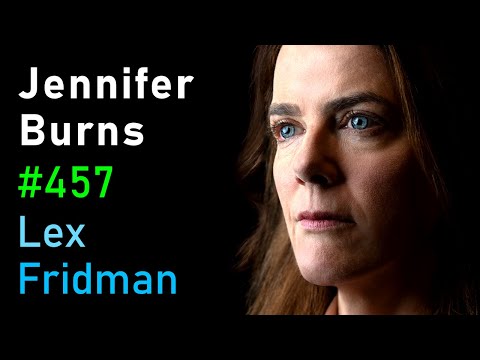
Jennifer Burns: Milton Friedman, Ayn Rand, Economics, Capitalism, Freedom | Lex Fridman Podcast #457
Lex Fridman (host), Jennifer Burns (guest), Narrator, Lex Fridman (host), Narrator, Lex Fridman (host), Narrator
In this episode of Lex Fridman Podcast, featuring Lex Fridman and Jennifer Burns, Jennifer Burns: Milton Friedman, Ayn Rand, Economics, Capitalism, Freedom | Lex Fridman Podcast #457 explores milton Friedman, Ayn Rand, and the Battles Over Freedom and Capitalism Lex Fridman and historian Jennifer Burns explore the lives and ideas of Milton Friedman and Ayn Rand, two towering but very different champions of individualism and capitalism.
Milton Friedman, Ayn Rand, and the Battles Over Freedom and Capitalism
Lex Fridman and historian Jennifer Burns explore the lives and ideas of Milton Friedman and Ayn Rand, two towering but very different champions of individualism and capitalism.
They contrast Friedman’s empirical, policy-focused economics and evolving defense of capitalism through freedom with Rand’s mythic, absolutist philosophy of Objectivism, built around rationality and heroic individualism.
The discussion traces how their ideas shaped U.S. economic policy, conservatism, and popular culture, including monetarism, neoliberalism, and the enduring appeal and danger of ideological purity.
In the outro, Lex reflects on his Zelensky interview, his preparation and neutrality, and his deep personal commitment to pushing for peace in the Ukraine–Russia war despite intense online backlash.
Key Takeaways
Friedman and Rand share an individualist, pro‑capitalist core but diverge sharply in method and temperament.
Both oppose collectivism and defend capitalism, yet Friedman builds arguments from data and is willing to compromise and revise his views, while Rand constructs an axiomatic, all‑or‑nothing philosophy, grows more dogmatic over time, and often breaks with dissenters.
Get the full analysis with uListen AI
Monetarism reframed the Great Depression and reshaped modern central banking.
Friedman and Anna Schwartz’s Monetary History argued the Depression was chiefly a monetary and Federal Reserve failure, not a failure of capitalism; this view now underpins crisis playbooks from 2008 to COVID, where central banks aggressively provide liquidity to avoid another “Great Contraction.”
Get the full analysis with uListen AI
Keynesianism and the Chicago School represent rival visions of how governments should steer the macroeconomy.
Keynesian economics centers fiscal policy and demand management via government spending and taxation, while Friedman’s Chicago School insists money supply and clear rules for monetary policy are paramount, warning that discretionary tinkering breeds inflation and instability.
Get the full analysis with uListen AI
Ayn Rand’s power comes less from philosophical rigor than from mythic storytelling that fuses identity, ethics, and politics.
Through characters like Howard Roark and John Galt, she offers readers a psychologically potent narrative of heroic self‑creation, which for many becomes a totalizing worldview—but it’s grounded in fictional worlds that bypass messy realities of luck, inequality, and human frailty.
Get the full analysis with uListen AI
Friedman’s defense of capitalism ultimately rests on freedom, not moral desert or market outcomes alone.
He explicitly rejects the idea that people always “deserve” what markets give them, instead arguing that capitalism is ethically preferable because it best supports individual and political freedom—while inequality must be managed through targeted policies like a negative income tax.
Get the full analysis with uListen AI
Intellectual movements gain real power when abstract ideas are translated into institutions, stories, and policy battles.
Burns shows how Friedman’s technical work became Newsweek columns, TV series, and Reagan‑era policy, and how Rand’s novels seeded grassroots clubs and helped recruit activists, illustrating the multi‑step journey from dense theory to mass politics.
Get the full analysis with uListen AI
Lex positions himself as fiercely independent and sees dialogue as a tool for peace, not partisanship.
In reflecting on the Zelensky interview, he stresses deep preparation, refusal to join any ideological camp, and a deliberate effort to nudge leaders toward negotiations—even when that means asking seemingly naive but strategically aimed questions that anger online factions.
Get the full analysis with uListen AI
Notable Quotes
“Friedman struggles a bit more with how to justify capitalism, and he'll ultimately come down to freedom as his core value, like his god as he says.”
— Jennifer Burns
“Ayn Rand is a purist. She wants to start with the pure belief. She doesn't want it to be diluted.”
— Jennifer Burns
“The Great Depression is not a failure of capitalism as a system. It becomes then an institutional failure and a political failure, not a failure of capitalism.”
— Jennifer Burns (paraphrasing Friedman & Schwartz’s argument)
“She thought of herself as rational…but she was actually doing a kind of mythopoetic psychological work as well.”
— Jennifer Burns on Ayn Rand
“I may be speaking too long… but I merely want to do my small part in pushing for peace in a moment in history when there's a real chance for that peace to actually be achieved.”
— Lex Fridman
Questions Answered in This Episode
How should policymakers today balance Friedman’s warning about inflation with popular demands for expansive social spending and industrial policy?
Lex Fridman and historian Jennifer Burns explore the lives and ideas of Milton Friedman and Ayn Rand, two towering but very different champions of individualism and capitalism.
Get the full analysis with uListen AI
Does Ayn Rand’s celebration of ‘rational selfishness’ offer a useful corrective to herd conformity, or does it dangerously undercut empathy and social responsibility?
They contrast Friedman’s empirical, policy-focused economics and evolving defense of capitalism through freedom with Rand’s mythic, absolutist philosophy of Objectivism, built around rationality and heroic individualism.
Get the full analysis with uListen AI
In light of China and other hybrid regimes, was Friedman ultimately wrong that economic freedom naturally leads to political freedom?
The discussion traces how their ideas shaped U. ...
Get the full analysis with uListen AI
What mechanisms best prevent powerful economic ideas—Keynesianism, neoliberalism, postmodernism—from mutating into rigid dogmas detached from reality?
In the outro, Lex reflects on his Zelensky interview, his preparation and neutrality, and his deep personal commitment to pushing for peace in the Ukraine–Russia war despite intense online backlash.
Get the full analysis with uListen AI
Given Lex’s emphasis on peace, what concrete concessions and security guarantees would be required from both Ukraine and Russia to achieve a durable settlement now?
Get the full analysis with uListen AI
Transcript Preview
The following is a conversation with Jennifer Burns, a historian of ideas, including the evolution of economic, political, and social ideas in the United States in the 20th century to today. She wrote two biographies, one on Milton Friedman and the other on Ayn Rand, both of which I highly recommend. This was a super technical and super fascinating conversation. At the end, I make a few comments about my previous conversation with President Zelenskyy, for those of you who may be interested. This is the Lex Fridman Podcast. To support it, please check out our sponsors in the description. And now, dear friends, here's Jennifer Burns. You have written two biographies, one on Milton Friedman and one on Ayn Rand. So if we can, we will focus on each one separately. But first, let's talk about the ideas the two of them held in common, the value of individual freedom, skepticism of collectivism, and the ethics of capitalism. Can you talk about the big picture ideas they converge on?
Yeah, so Milton Friedman and Ayn Rand, in the biggest picture, they are both individualists, and they're skeptical of collectivities and collectivism. So their unit of analysis is the individual, what's good for the individual, what works for the individual, and their understanding of society kind of flows from that. They also both use this focus on individualism to justify and to support capitalism as a social and economic system. So we can put them in a similar category. We can call them individualists, we can call them libertarians of a sort, but they're also really different in how they approach capitalism, how they approach thinking. You know, Ayn Rand developed her own moral and philosophical system to justify individualism, and to connect the individual to capitalism, and to support capitalism as a social and economic system. Friedman struggles a bit more with how to justify capitalism, and he'll ultimately come down to freedom as his core value, like his god as he says. And so freedom does connect back to the individual, but he's not justifying capitalism for his own sake. He's justifying it for its ability to underwrite freedom in a social sense and also in the individual sense.
At a high level, are there interesting differences between them? You already mentioned a few, maybe in terms of who they are personally, maybe in terms of how they approach the justification for capitalism, uh, maybe other ways.
Yeah, for sure. So beyond this idea that, that Milton Friedman takes a while to come to his justification of capitalism, whereas Ayn Rand kind of has it from the start. She really focuses on the core quality of rationalism and rationality, and rationality is the defining feature of human beings. And so she works from there, whereas Friedman, uh, Milton Friedman eventually converges on this idea of freedom. So that's one part of it. The other is their intellectual styles are really, really different, and their interpersonal styles are really different. So Friedman has big ideas, big principles that guide him, but he's also deeply empirical. He spends most of his career doing historical research, economic research, pulling data from how people actually make economic decisions and live in the world and using them to test and refine his theories. Where Rand, to some degree we could say she's empirical in that she lives through the Russian Revolution and takes a very big lesson from that, but her style of thinking is really, um, first principles, an axiomatic approach, going from the basic, uh, idea of rationality, and then playing that out in different spheres. And so those are just very different intellectual approaches, and then they lead, in some ways, to really different ways of thinking about how you get things done in the world. Ayn Rand is a purist. She wants to start with the pure belief. She doesn't want it to be diluted. You know, one of her favorite sayings was, you know, "It's earlier than you think," in other words, we're still moving towards a place where we can really hold and express these ideals purely. Friedman, although he didn't use this terminology, was much more half a loaf guy. You know, like, "I'll take what I can get, and then I'll try to move to where I really wanna be." But he is able to compromise, especially when he moves from being an economist into being more of a political thinker. And so that's a really different intellectual style, and then it also plays out in their lives in that R- Ayn Rand is incredibly schismatic. I mean, she wants her friends to believe what she believes and support what she supports, and she's willing to break a relationship if it doesn't match. Milton Friedman, he also does tend to have friends who agree with him, yet he's always willing to debate his opponents, and he's willing to do so with a smile on his face. You know, he's the kind of... He's the happy warrior, and he actually will win a lot of debates simply by his emotional affect and his cheerfulness and his confidence, where Rand will lose debates because she gets so angry in the face of disagreement. So yeah, they have s- they have a lot of similarities and a lot of differences, and, and it's been really fascinating to kind of dive deep into both of them.
Install uListen to search the full transcript and get AI-powered insights
Get Full TranscriptGet more from every podcast
AI summaries, searchable transcripts, and fact-checking. Free forever.
Add to Chrome