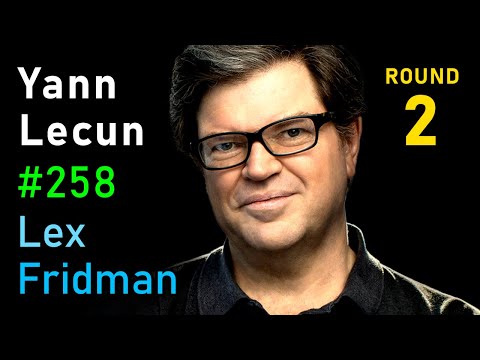
Yann LeCun: Dark Matter of Intelligence and Self-Supervised Learning | Lex Fridman Podcast #258
Lex Fridman (host), Yann LeCun (guest), Narrator
In this episode of Lex Fridman Podcast, featuring Lex Fridman and Yann LeCun, Yann LeCun: Dark Matter of Intelligence and Self-Supervised Learning | Lex Fridman Podcast #258 explores yann LeCun explains dark matter of intelligence: self-supervised learning Yann LeCun argues that today's dominant paradigms—supervised and reinforcement learning—are far too data- and trial-hungry compared to how humans and animals actually learn. He frames self-supervised learning as the 'dark matter of intelligence': the largely unexplored mechanism by which brains build rich world models from raw observation. LeCun details why predictive, gap-filling learning from video and multimodal data is likely our best path toward common-sense physical understanding and eventually human-level AI, stressing differentiable, gradient-based systems over symbolic logic. He also ranges into topics like emotions in AI, consciousness, complexity, the future of conferences and peer review, Meta/FAIR’s role, and the societal impact of social platforms.
Yann LeCun explains dark matter of intelligence: self-supervised learning
Yann LeCun argues that today's dominant paradigms—supervised and reinforcement learning—are far too data- and trial-hungry compared to how humans and animals actually learn. He frames self-supervised learning as the 'dark matter of intelligence': the largely unexplored mechanism by which brains build rich world models from raw observation. LeCun details why predictive, gap-filling learning from video and multimodal data is likely our best path toward common-sense physical understanding and eventually human-level AI, stressing differentiable, gradient-based systems over symbolic logic. He also ranges into topics like emotions in AI, consciousness, complexity, the future of conferences and peer review, Meta/FAIR’s role, and the societal impact of social platforms.
Key Takeaways
Self-supervised learning is likely the main driver of animal and human intelligence.
Most of our 'background knowledge'—intuitive physics, object permanence, common sense—is learned by passively observing the world and predicting missing or future information, not by labels or explicit rewards. ...
Get the full analysis with uListen AI
Current supervised and reinforcement learning are far too inefficient to reach general intelligence.
Supervised learning needs huge labeled datasets and reinforcement learning needs astronomically many trials; a tabula rasa RL agent would literally fall off the cliff thousands of times to learn a basic driving rule that humans infer instantly from prior world knowledge. ...
Get the full analysis with uListen AI
Powerful AI will require differentiable world models and gradient-based reasoning and planning.
LeCun emphasizes that deep learning’s strength is efficient gradient-based optimization. ...
Get the full analysis with uListen AI
Handling uncertainty and multimodal futures is the crux of learning from video and complex data.
Predicting the next video frame is hard because there are infinitely many plausible continuations. ...
Get the full analysis with uListen AI
Non-contrastive joint-embedding methods may be a key breakthrough for representation learning.
LeCun is particularly excited about non-contrastive methods like Barlow Twins and VicReg, which learn invariant yet informative representations from different views of the same data without requiring negative examples. ...
Get the full analysis with uListen AI
Real intelligence must be grounded in perception and interaction, not just trained on text.
LeCun argues that no amount of text (GPT-style training, Cyc-like knowledge bases) can capture basic physical truths that are never written down, such as how objects move when pushed on a table. ...
Get the full analysis with uListen AI
Autonomous intelligent machines will almost inevitably have emotions in a functional sense.
Given intrinsic objectives and critic networks that predict future outcomes, intelligent agents will experience analogues of fear (anticipating bad outcomes) and elation (anticipating good ones). ...
Get the full analysis with uListen AI
Notable Quotes
“There is obviously a kind of learning that humans and animals are doing that we currently are not reproducing properly with machines.”
— Yann LeCun
“Self-supervised learning is the dark matter of intelligence.”
— Yann LeCun
“The essence of intelligence is the ability to predict.”
— Yann LeCun
“I don’t think we can train a machine to be intelligent purely from text, because the amount of information about the world that’s contained in text is tiny.”
— Yann LeCun
“There’s no question in my mind that machines at some point will become more intelligent than humans in all domains where humans are intelligent.”
— Yann LeCun
Questions Answered in This Episode
What concrete research steps are needed to make self-supervised video learning truly work for building robust world models?
Yann LeCun argues that today's dominant paradigms—supervised and reinforcement learning—are far too data- and trial-hungry compared to how humans and animals actually learn. ...
Get the full analysis with uListen AI
How might non-contrastive joint-embedding methods like VicReg scale from images to full multimodal, embodied agents?
Get the full analysis with uListen AI
In practice, how can we design intrinsic motivation and 'emotion-like' critics for AI systems without creating dangerous incentives?
Get the full analysis with uListen AI
What would a realistic roadmap look like from today’s large language models to a grounded, physically knowledgeable artificial 'cat-brain'?
Get the full analysis with uListen AI
How could the peer review and publication ecosystem be redesigned to better surface genuinely new ideas rather than only incremental benchmark gains?
Get the full analysis with uListen AI
Transcript Preview
The following is a conversation with Yann LeCun, his second time on the podcast. He is the chief AI scientist at Meta, formerly Facebook, professor at NYU, Turing Award winner, one of the seminal figures in the history of machine learning and artificial intelligence, and someone who is brilliant and opinionated in the best kind of way, and so is always fun to talk to. This is a Lex Fridman podcast. To support it, please check out our sponsors in the description, and now here's my conversation with Yann LeCun. You co-wrote the article "Self-Supervised Learning: The Dark Matter of Intelligence," great title by the way, with Ishaan Misra. So let me ask, what is self-supervised learning and why is it the dark matter of intelligence?
I'll start by the dark matter part.
(laughs)
Uh, there is obviously a kind of learning that humans and animals are, uh, are doing that we currently are not reproducing properly with machines or with AI, right? So the most popular approaches to machine learning today are, or paradigms I should say, are supervised learning and reinforcement learning and they're extremely inefficient. Supervised learning requires many samples for learning anything, and reinforcement learning requires a ridiculously large number of trial and errors to, for, you know, a system to learn anything. Um, and that's why we don't have self-driving cars.
(laughs) That was a big leap from one to the other. Okay. So that to solve difficult problems, you have to have a lot of, uh, human annotation for supervised learning to work, and to solve those difficult problems with reinforcement learning, you have to have some way to maybe simulate that problem such that you can do that large scale kind of learning that reinforcement learning requires.
Right. So how is it that, you know, most teenagers can learn to drive a car in about 20 hours of, uh, practice, whereas, uh, even with millions of hours of simulated practice-
Mm-hmm.
... a self-driving car can't actually learn to drive itself properly? Um, and so obviously we're missing something, right? And, and it's quite obvious for a lot of people that, you know, the immediate response you get from many people is, "Well, you know, humans use their background knowledge to learn faster." And they're right. Now, how was that background knowledge acquired? And that's the big question. So now you have to ask, you know, how do babies in their first few months of life learn how the world works? Mostly by observation because they can hardly act in the world. Um, and they learn an enormous amount of background knowledge about the world that may be the, the basis of what we call common sense. Uh, this type of learning is not learning a task, it's not being reinforced for anything, it's just observing the world and figuring out how it, how it works. Building world models, learning world models. Um, how do we do this and how do we reproduce this in, in machines? So self-supervised learning is, you know, one instance or one attempt at trying to reproduce this kind of learning.
Install uListen to search the full transcript and get AI-powered insights
Get Full TranscriptGet more from every podcast
AI summaries, searchable transcripts, and fact-checking. Free forever.
Add to Chrome