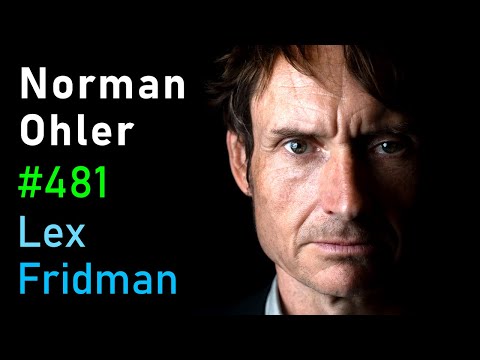
Norman Ohler: Hitler, Nazis, Drugs, WW2, Blitzkrieg, LSD, MKUltra & CIA | Lex Fridman Podcast #481
Norman Ohler (guest), Lex Fridman (host), Lex Fridman (host), Lex Fridman (host), Lex Fridman (host), Lex Fridman (host)
In this episode of Lex Fridman Podcast, featuring Norman Ohler and Lex Fridman, Norman Ohler: Hitler, Nazis, Drugs, WW2, Blitzkrieg, LSD, MKUltra & CIA | Lex Fridman Podcast #481 explores drugs, Dictators, and Dissent: How Chemistry Shaped Nazi Germany Lex Fridman interviews author Norman Ohler about his archival research on drug use in Nazi Germany, focusing on methamphetamine in the Wehrmacht and opioids in Hitler’s inner circle. They detail how Pervitin (meth) enabled sleepless blitzkrieg tactics in France and the Soviet Union, while Hitler’s personal doctor Morell gradually turned him into a heavily medicated opioid addict. The conversation also explores Ohler’s work on CIA LSD experiments, the cultural history of drugs in Berlin and beyond, and his new project viewing human civilization as “stoned sapiens.” Finally, they discuss a little-known German resistance network and broader questions about consciousness, psychedelics, and the meaning of life.
Drugs, Dictators, and Dissent: How Chemistry Shaped Nazi Germany
Lex Fridman interviews author Norman Ohler about his archival research on drug use in Nazi Germany, focusing on methamphetamine in the Wehrmacht and opioids in Hitler’s inner circle. They detail how Pervitin (meth) enabled sleepless blitzkrieg tactics in France and the Soviet Union, while Hitler’s personal doctor Morell gradually turned him into a heavily medicated opioid addict. The conversation also explores Ohler’s work on CIA LSD experiments, the cultural history of drugs in Berlin and beyond, and his new project viewing human civilization as “stoned sapiens.” Finally, they discuss a little-known German resistance network and broader questions about consciousness, psychedelics, and the meaning of life.
Key Takeaways
Methamphetamine was systematically used to power blitzkrieg operations.
The Wehrmacht distributed tens of millions of Pervitin tablets, especially to tank crews, enabling three days and nights of continuous advance through the Ardennes in 1940—a key factor in the rapid collapse of France, though not the sole cause.
Get the full analysis with uListen AI
Hitler’s leadership degraded in parallel with escalating opioid use.
Initially a teetotal health purist, Hitler evolved into a poly-drug patient of Dr. ...
Get the full analysis with uListen AI
Archives still contain overlooked evidence that can rewrite major narratives.
Ohler’s work shows how reading primary documents—war diaries, medical decrees, pharmaceutical records—can surface unexamined factors such as military drug programs, challenging long-established historical interpretations.
Get the full analysis with uListen AI
Drug use in Nazi Germany was ideologically selective, not absent.
While the regime loudly criminalized ‘degenerate’ drugs and projected an image of purity, it simultaneously sanctioned and industrialized performance-enhancing substances in the military and leadership when they served its goals.
Get the full analysis with uListen AI
There was serious, organized resistance inside Nazi Germany.
Harro and Libertas Schulze-Boysen built a diverse urban resistance network in Berlin that spread anti-Nazi messaging and leaked military intelligence to Allies and the USSR, demonstrating that internal opposition existed despite extreme risks.
Get the full analysis with uListen AI
LSD’s modern image as a counterculture drug obscures its darker institutional history.
Developed by Sandoz and initially explored as a psychiatric tool, LSD was quickly co‑opted by U. ...
Get the full analysis with uListen AI
Psychoactive substances may have played a deep role in human evolution and religion.
Ohler’s upcoming ‘Stoned Sapients’ project advances the idea that compounds like iboga, psilocybin, opium, and ritual beers influenced early cognition, social structures, and religious experiences from Göbekli Tepe to Moses and beyond.
Get the full analysis with uListen AI
Notable Quotes
““Hitler was really an opioid guy, while the army was really meth‑ed up.””
— Norman Ohler
““We historians, we never do drugs. We don’t understand drugs. We missed this.””
— Norman Ohler, quoting historian Hans Mommsen’s reaction
““Even Hitler was a person, you know, and if you understand, for example, the substance abuse of a person, of course you understand more about that person.””
— Norman Ohler
““History defines the future… If we don’t know where we come from, we cannot know where we go.””
— Norman Ohler
““Nazi ideology and genocidal policies have nothing to do with drugs… You can’t use intoxication to excuse those crimes.””
— Norman Ohler (paraphrasing his response to critics)
Questions Answered in This Episode
To what extent should psychoactive substances be treated as core explanatory variables in military and political history, rather than marginal footnotes?
Lex Fridman interviews author Norman Ohler about his archival research on drug use in Nazi Germany, focusing on methamphetamine in the Wehrmacht and opioids in Hitler’s inner circle. ...
Get the full analysis with uListen AI
How do we draw a clear moral line between explaining historical actors’ behavior (e.g., via drug use) and appearing to excuse or diminish their responsibility?
Get the full analysis with uListen AI
What other major events or eras might look very different if we systematically examined archival evidence for widespread drug use and its effects?
Get the full analysis with uListen AI
If psychedelics and other substances helped shape early human cognition and religion, how should that influence today’s debates about their legality and role in society?
Get the full analysis with uListen AI
What personal or societal risks are justified in pursuing altered states of consciousness to gain insight, creativity, or healing—as in Ohler’s use of psychedelics and his mother’s microdosing experiments?
Get the full analysis with uListen AI
Transcript Preview
Hitler invited three young tank generals to his office, and they had a plan, which was the plan to go through the Ardenne Mountains. That was the victorious idea. So it's not the drugs, actually that idea to go through the Ardenne Mountain. If you, if you think monocausal, you would say that's the reason. That idea was genius, and Hitler immediately understood it, because before, the plan was to attack in the north of Belgium, which is the same as World War I. You... It, it becomes a stalemate, and they fight for months, and no one really moves, and it's bloody, and it's... Nothing's happening. It's bad. But that was the only plan that they had. That's why the high command said, "No, we're not going to do it. It's stupid." But these three tank generals, they said, "Look, if we go with the whole army through the Ardenne Mountains..." And then Hitler, "Eh, this is not possible. This is like a mountain range. How can the whole German army fit through this eye of a needle basically?" And they said, "No, we can do it, because everyone misunderstands what tanks can do. Tanks are not slow machines in the back that wait for the action to happen and then support this somehow. We're going to use tanks in the front as race cars, basically. We're going to overpower the enemy. We're going to be in France... Before they know it, we are already behind them." But it would only work if you would reach Sedan, the border city of France within three days and three nights, and that was only possible if you don't stop. Suddenly, Ranke realized that his moment had come, because he had the recipe how people could stay awake for three days and three nights. Before that, he was kind of an outsider, like the freak with the drug idea. Suddenly, he became like-
Mm-hmm.
... "Okay, tell us, how does it work?" And he gave, like, lectures in front of the officers, and he wrote a stimulant decree where, like, a whole army is prescribed a drug, in this case methamphetamine, how much should be taken, at what intervals. This became a very big thing, and then Temmler had to deliver 35 million dosages to the front lines, and then on May 10th, they took their methamphetamine, and they started the surprise attack through the Ardenne Mountains.
The following is a conversation with Norman Ohler, author of Blitzed: Drugs in the Third Reich, a book that investigates what role psychoactive drugs, particularly stimulants such as methamphetamine, played in the military history of World War II. It is a book that two legendary historians, Ian Kershaw and Antony Beevor, give very high praise to. Ian Kershaw describes it as very well researched, serious piece of scholarship, and Antony Beevor describes it as remarkable work of research, and it is indeed a remarkable work of research. Norman went deep into the archives, using primary sources to uncover perspective on Hitler and the Third Reich that has before this been mostly ignored by historians. He also wrote Tripped: Nazi Germany, the CIA, and the Dawn of the Psychedelic Age, and he's now working on a new book with the possible title of Stoned Sapients, great title, looking at the history of human civilization through the lens of drugs. This is the Lex Fridman Podcast. To support it, please check out our sponsors in the description and consider subscribing to this channel, and now, dear friends, here's Norman Ohler. Tell me the origin story of meth, methamphetamine, and Pervitin, its brand name drug version, in the context of Nazi Germany in the late 1930s. Let's start there.
Install uListen to search the full transcript and get AI-powered insights
Get Full TranscriptGet more from every podcast
AI summaries, searchable transcripts, and fact-checking. Free forever.
Add to Chrome