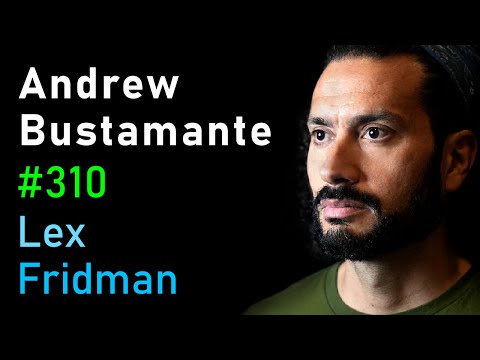
Andrew Bustamante: CIA Spy | Lex Fridman Podcast #310
Andrew Bustamante (guest), Lex Fridman (host)
In this episode of Lex Fridman Podcast, featuring Andrew Bustamante and Lex Fridman, Andrew Bustamante: CIA Spy | Lex Fridman Podcast #310 explores ex-CIA spy reveals intelligence power, propaganda, and human nature Lex Fridman interviews former CIA covert officer Andrew Bustamante about how the U.S. and foreign intelligence communities actually work, from the CIA’s mission and structure to the President’s Daily Brief and interagency politics.
Ex-CIA spy reveals intelligence power, propaganda, and human nature
Lex Fridman interviews former CIA covert officer Andrew Bustamante about how the U.S. and foreign intelligence communities actually work, from the CIA’s mission and structure to the President’s Daily Brief and interagency politics.
They dive deeply into the Ukraine–Russia war, arguing that Russia is strategically winning while Ukraine serves as a geopolitical pawn and testbed for Western weapons, amid a massive global information war.
Bustamante compares major intelligence agencies—CIA, MSS, Mossad, DGSE—on reach, resources, and ruthlessness, and explains tradecraft: disguise, cover, recruitment, manipulating perceptions, and the psychology of spying.
Across the conversation they wrestle with ethics: politicized intelligence, mass surveillance, Snowden, CIA myths, private intelligence, and what all of this reveals about predictable human nature, loneliness, power, and self‑respect.
Key Takeaways
Presidents heavily shape what intelligence gets prioritized, creating systemic bias.
The President dictates what appears on the front of the President’s Daily Brief and appoints the CIA Director, which means short-term political interests can override long-term national-security priorities and incentivize cronyism over merit.
Get the full analysis with uListen AI
The Ukraine war is also an economic and information war in which Ukraine is largely a pawn.
Bustamante argues Russia is winning strategically by controlling resources and logistics in Ukraine while NATO bears economic pain, and Ukraine functions as a battleground for testing weapons and gauging Russian capabilities more than as a true geopolitical player.
Get the full analysis with uListen AI
Different intelligence agencies have different ‘superpowers’ and ethical lines.
China’s MSS excels in global reach via cultural integration, the CIA in budget and technical capability, France’s DGSE in economic espionage, and Mossad in willingness to cross violent red lines to protect Israeli citizens—each reflecting its nation’s priorities.
Get the full analysis with uListen AI
Human nature is both predictable and deeply social, which spies routinely exploit.
Espionage tradecraft is built on predictable cognitive biases, emotional needs, and the powerful human longing for connection; officers systematically create artificial relationships by manipulating feelings and perceptions rather than relying on authentic bonds.
Get the full analysis with uListen AI
Mass surveillance can enhance security but erodes trust and is widely misunderstood.
Bustamante defends NSA bulk metadata collection as focused on detecting terrorist threats rather than private vices, arguing Snowden’s leaks made America less safe, while acknowledging that most citizens misjudge both the value and the actual use of such programs.
Get the full analysis with uListen AI
Private intelligence operates under market incentives, not public oversight.
Post‑9/11 growth in contractors created a large, wealthy private intel ecosystem around Washington whose primary constraint is economic performance rather than democratic accountability, raising new ethical and power concerns.
Get the full analysis with uListen AI
Perspective—stepping outside your own viewpoint—is a powerful ‘spy skill’ for life.
Bustamante says shifting from your own perception to another person’s perspective gives you informational and relational advantage, improving negotiations, relationships, and leadership far more than arguing from your own point of view.
Get the full analysis with uListen AI
Notable Quotes
“Mossad will do anything. Mossad has no qualms doing what it takes to ensure the survival of every Israeli citizen around the world.”
— Andrew Bustamante
“If the president doesn’t care what you have to say, he’s going to take your funding and attention away. For four years under Trump, basically everybody at CIA had their career put on pause.”
— Andrew Bustamante
“Ukraine is a pawn on a table for superpowers to calculate each other’s capacities.”
— Andrew Bustamante
“The thing that’s surprising about human nature is that human beings long, like in their soul, there’s a painful longing to be with other people.”
— Andrew Bustamante
“What’s the meaning of life? Self‑respect. If you don’t respect yourself, how can you do anything else?”
— Andrew Bustamante
Questions Answered in This Episode
How should intelligence agencies be insulated from short‑term political pressures without becoming unaccountable ‘deep state’ actors?
Lex Fridman interviews former CIA covert officer Andrew Bustamante about how the U. ...
Get the full analysis with uListen AI
Is Bustamante’s assessment that Russia is ‘winning’ in Ukraine still valid as conditions on the ground and alliances evolve?
They dive deeply into the Ukraine–Russia war, arguing that Russia is strategically winning while Ukraine serves as a geopolitical pawn and testbed for Western weapons, amid a massive global information war.
Get the full analysis with uListen AI
Where is the ethical line between legitimate information operations and dangerous propaganda that distorts leaders’ worldviews?
Bustamante compares major intelligence agencies—CIA, MSS, Mossad, DGSE—on reach, resources, and ruthlessness, and explains tradecraft: disguise, cover, recruitment, manipulating perceptions, and the psychology of spying.
Get the full analysis with uListen AI
Does the rise of powerful private intelligence firms pose a greater long‑term risk to democracy than traditional state intelligence agencies?
Across the conversation they wrestle with ethics: politicized intelligence, mass surveillance, Snowden, CIA myths, private intelligence, and what all of this reveals about predictable human nature, loneliness, power, and self‑respect.
Get the full analysis with uListen AI
How can societies balance the security benefits of surveillance with citizens’ demand for privacy and distrust of government power?
Get the full analysis with uListen AI
Transcript Preview
Mossad will do anything. Mossad has no qualms doing what it takes to ensure the survival of every Israeli citizen around the world. Most other countries will stop at some point, but Mossad doesn't do that.
The following is a conversation with Andrew Bustamante, former CIA covert intelligence officer and US Air Force combat veteran, including the job of operational targeting, encrypted communications, and launch operations for 200 nuclear intercontinental ballistic missiles. Andrew's over seven years as a CIA spy have given him a skill set and a perspective on the world that is fascinating to explore. This is the Lex Fridman podcast. To support it, please check out our sponsors in the description. And now, dear friends, here's Andrew Bustamante. The Central Intelligence Agency was formed almost 75 years ago. What is the mission of the CIA? How does it work?
The mission of the CIA is to collect intelligence from around the world that supports a national security mission and be the central repository for all other intelligence agencies so that it's one collective source where all intelligence can be synthesized and then passed forward to the decision-makers.
That doesn't include domestic intelligence. It's primarily looking outward, outside the United States.
Correct. CIA is the foreign intelligence, uh, collection, uh, kingspoke, if you will. FBI does domestic and then Department of Homeland Security does domestic. Law enforcement essentially handles all things domestic. Uh, intelligence is not law enforcement, so we technically cannot work inside the United States.
Is there clear lines to be drawn between, like you just said, the FBI... CIA, FBI, and the other US intelligence agencies like the DIA, Defense Intelligence Agency, Department of Homeland Security, NSA, National Security Ag- Agency, and, and there's a list, there's a list of-
There's a list of about 33 different intelligence organizations. Yeah, you're exactly right.
So like the Army, the Navy has a, all, all the different organizations have their own intelligence groups. So is there, is there clear lines here to be drawn? Or is the CIA the, the giant integrator of all of these?
Uh, it's a little bit of both, to be honest. So yes, there are absolutely lines, and more so than the lines, there are lines that divide what our primary mission is. Everything's gotta be prioritized. That's one of the benefits and the s- and the super powers of the United States, is we prioritize everything. So different intelligence organizations are prioritized to collect certain types of intelligence. And then within the confines of how they collect, they're also given unique authorities. Authorities are a term that's directed by the executive branch. Different agencies have different authorities to execute missions in different ways. FBI can't execute the same way CIA executes, and CIA can't execute the same way NGA, uh, ex- executes. But then at the end, (clears throat) excuse me, when it's all collected, then yes, CIA still acts as a final synthesizing repository to create what's known as the President's Daily Brief, the PDB. The only way CIA can create the PDB is by being the single s- source of all source intelligence from around the IC, the inter- the intelligence community, which are those 30 some odd and always changing, uh, organizations that are sponsored for intelligence operations.
Install uListen to search the full transcript and get AI-powered insights
Get Full TranscriptGet more from every podcast
AI summaries, searchable transcripts, and fact-checking. Free forever.
Add to Chrome