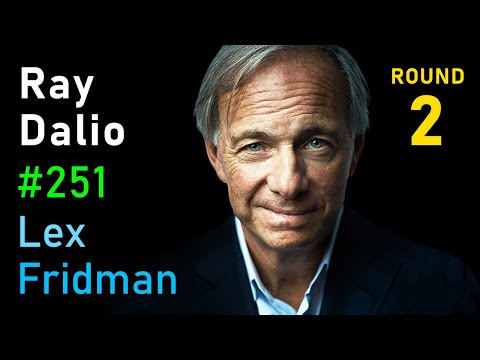
Ray Dalio: Money, Power, and the Collapse of Empires | Lex Fridman Podcast #251
Lex Fridman (host), Ray Dalio (guest), Narrator
In this episode of Lex Fridman Podcast, featuring Lex Fridman and Ray Dalio, Ray Dalio: Money, Power, and the Collapse of Empires | Lex Fridman Podcast #251 explores ray Dalio on Empires, China, Democracy’s Risks, and Bitcoin’s Future Ray Dalio outlines his “Big Cycle” model for the rise and fall of empires, driven by long‑term debt cycles, internal order vs. disorder, and external geopolitical competition. Using data over 500 years, he compares the Dutch, British, American, and emerging Chinese empires, emphasizing education, innovation, and fiscal soundness as leading indicators of strength.
Ray Dalio on Empires, China, Democracy’s Risks, and Bitcoin’s Future
Ray Dalio outlines his “Big Cycle” model for the rise and fall of empires, driven by long‑term debt cycles, internal order vs. disorder, and external geopolitical competition. Using data over 500 years, he compares the Dutch, British, American, and emerging Chinese empires, emphasizing education, innovation, and fiscal soundness as leading indicators of strength.
He argues the United States faces serious challenges: rising debt and money printing, worsening internal polarization, and deteriorating broad-based education, while China is rapidly improving on many of those metrics under a more centralized, autocratic model. Both democracy and autocracy have distinct vulnerabilities—democracy to internal chaos and autocracy to rigidity and eventual breakage.
Dalio discusses the growing rivalry between the U.S. and China—including trade, technology, capital, and potential military conflict over Taiwan—and stresses the importance of mutual understanding over ideological crusades. On money, he sees Bitcoin as an interesting, proven alternative asset in an emerging “competition of monies,” but still prefers gold as a store of wealth.
He closes with personal principles for decision‑making and advice for young people: know your goals, embrace pain plus reflection as progress, write down your principles, and align your work with your passion while collaborating with people whose strengths complement your weaknesses.
Key Takeaways
Empires follow predictable long-term cycles driven by debt, internal cohesion, and external power balance.
Dalio’s data-driven model shows dominant powers rising on education, innovation, competitiveness, and sound finances, then declining as they become indebted, unequal, complacent, and internally divided, often ending in internal or external conflict and a new world order.
Get the full analysis with uListen AI
Education and civility are the strongest leading indicators of a nation’s future strength.
Broad-based, meritocratic education—combined with social skills to work together productively—precedes waves of innovation, technological leadership, and export competitiveness, while also reinforcing social stability and perceived fairness.
Get the full analysis with uListen AI
The United States’ main threat is internal conflict and fiscal imprudence, not external enemies.
Rising debt, money printing, intense political polarization, and deteriorating average public education put the U. ...
Get the full analysis with uListen AI
China’s autocratic, meritocratic-capitalist hybrid is gaining ground but carries its own risks.
China has rapidly grown wealth, reduced poverty, and built strong trade and tech capabilities by combining markets with centralized control and a ‘common good over individualism’ ethos, yet its vulnerability is inflexibility if popular discontent grows and the system cannot bend.
Get the full analysis with uListen AI
U.S.–China conflict is multi-dimensional; avoiding a hot war over Taiwan is crucial.
Dalio identifies five overlapping “wars” (trade, technology, geopolitical influence, capital, and military), with Taiwan as the main flashpoint for possible military confrontation—something he views as catastrophic in a world of nuclear, cyber, and advanced warfare.
Get the full analysis with uListen AI
We are entering a competition of monies, but gold still has structural advantages over Bitcoin.
Bitcoin has proven resilient and gained widespread “imputed value,” yet Dalio sees its realistic ceiling as a minority share of the “gold-equivalent” store-of-wealth pool; he prefers gold for its untraceability, long history, and central bank acceptance, while recognizing crypto and NFTs as real emerging assets.
Get the full analysis with uListen AI
Writing down principles and looping through pain plus reflection drives personal evolution.
Dalio recommends codifying decision rules from repeated experiences, using a five-step process (set goals, identify problems, diagnose root causes, design solutions, execute) and viewing painful setbacks as essential data for growth, especially when paired with self-knowledge and complementary partnerships.
Get the full analysis with uListen AI
Notable Quotes
“The United States’ war is with itself. That’s the main war.”
— Ray Dalio
“Pain plus reflection equals progress.”
— Ray Dalio
“Human nature has not changed over the thousands of years. It’s like watching the same movie over and over again.”
— Ray Dalio
“Democracy’s vulnerability is internal conflict that produces itself as anarchy; autocracy’s vulnerability is that, rather than bending, it breaks.”
— Ray Dalio
“If you want to out-compete somebody, it still pays to understand what they’re thinking.”
— Ray Dalio
Questions Answered in This Episode
How might policymakers in the U.S. practically reverse the negative trends in debt, polarization, and public education that Dalio highlights?
Ray Dalio outlines his “Big Cycle” model for the rise and fall of empires, driven by long‑term debt cycles, internal order vs. ...
Get the full analysis with uListen AI
What specific indicators from Dalio’s 18-measure “scorecard” should an informed citizen track to gauge whether their country’s trajectory is improving or deteriorating?
He argues the United States faces serious challenges: rising debt and money printing, worsening internal polarization, and deteriorating broad-based education, while China is rapidly improving on many of those metrics under a more centralized, autocratic model. ...
Get the full analysis with uListen AI
In what ways could the U.S. and China deliberately structure their competition to avoid a military clash over Taiwan while still pursuing their interests?
Dalio discusses the growing rivalry between the U. ...
Get the full analysis with uListen AI
How should an individual investor think about allocating between fiat currencies, gold, Bitcoin, and other emerging digital assets in the “competition of monies” Dalio describes?
He closes with personal principles for decision‑making and advice for young people: know your goals, embrace pain plus reflection as progress, write down your principles, and align your work with your passion while collaborating with people whose strengths complement your weaknesses.
Get the full analysis with uListen AI
What personal principles or decision rules might be most valuable to write down and refine for someone just starting their career in a volatile, geopolitically tense world?
Get the full analysis with uListen AI
Transcript Preview
The following is a conversation with Ray Dalio. It's his second time on the podcast. He is a legendary investor, founder of Bridgewater Associates, author of a book I highly recommend called Principles, and also a new book called Principles for Dealing With the Changing World Order that looks at the geopolitics of today, especially US and China, through the lens of history, providing a fascinating model for the rise and fall of empires that can be applied to the analysis of our world today. This is the Lex Fridman podcast. To support it, please check out our sponsors in the description, and now here's my conversation with Ray Dalio. When you look at the history of the world, as you have done in your new book, Principles for Dealing With the Changing World Order, what is more important, more impactful, money or power?
They go hand-in-hand. They support each other and they, um, compete with each other. Those who have money have power, a certain type of power. Um, that power has to do with all that they can buy, but it also has the ability to influence those with political power. So, um, and, and so you see this throughout history, this symbiotic relationship. You know, um, for example, between, um, the royal families, um, the nobility, and the church. So you see that group of people supporting each other in various ways, and then wrestling around with each other for the money and power among that group. So the dynamic that's quite classic is you could look at the parties in power back in, you know, the 16th, 17th centuries, you would look at, uh, royal families, nobles, and th- um, and the church, if you were in Europe, and then you would look at, um, agricultural land, and there was a certain dynamic. And that varies over time. It changes. Um, a- as those people get thrown out and technology changes, so when we evolved, when the society evolved, so that it would produce goods and services, and you have something like the Industrial Revolution, the first industrial revolution, and you have machines, and you have the talent of people that are off the farms, um, and then you have a struggling for power, um, you see that power mix change. And so we don't see that same power mix anymore, but you still see the same dynamic. You see those with money, um, dealing with those who have, uh, political power around those assets that are considered most valuable, t- particularly the productive assets that produce money.
And, uh, political power is usually centered around nation-state? So the major locust is its power is the nations?
Yes. In 1668, uh, after 30 years of war, uh, there was the development of nation-states. Before then, we had, uh, it was really the development of, uh, countries as we know it. That there were borders, and that within those borders, uh, those w- who had control got to control it, and there were not to be intrusions in those borders, and that's how we established the nation-state. And then of course, within each country, there is levels. There is a central level, and then there is a, typically a province or state l- level down below, and then there's a municipal level, so they each have different levels of power, and it's the coordination of those, um, that determines how the country is run.
Install uListen to search the full transcript and get AI-powered insights
Get Full TranscriptGet more from every podcast
AI summaries, searchable transcripts, and fact-checking. Free forever.
Add to Chrome