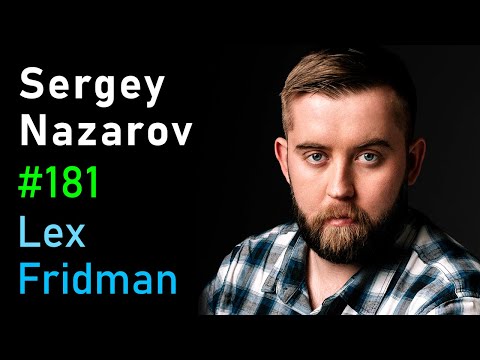
Sergey Nazarov: Chainlink, Smart Contracts, and Oracle Networks | Lex Fridman Podcast #181
Lex Fridman (host), Sergey Nazarov (guest)
In this episode of Lex Fridman Podcast, featuring Lex Fridman and Sergey Nazarov, Sergey Nazarov: Chainlink, Smart Contracts, and Oracle Networks | Lex Fridman Podcast #181 explores sergey Nazarov Envisions Trustless Smart Contracts Reshaping Global Institutions Lex Fridman and Chainlink co-founder Sergey Nazarov explore how hybrid smart contracts and decentralized oracle networks can move society from brand-based trust in institutions to mathematically guaranteed agreements. They discuss ‘definitive truth’ as consensus-based, data-driven facts that smart contracts can rely on, enabling transparent, automated systems in finance, insurance, supply chains, governance, and beyond. Nazarov explains Chainlink’s role as a decentralized service layer that feeds trustworthy external data and computations into blockchains, unlocking use cases like DeFi, crop insurance in emerging markets, privacy-preserving data markets, and cross-chain applications. The conversation also ranges into simulation theory, AI control via cryptographic constraints, social media reform, the future of Bitcoin and Ethereum, personal philosophy, and life advice about using youth to build a meaningful body of work.
Sergey Nazarov Envisions Trustless Smart Contracts Reshaping Global Institutions
Lex Fridman and Chainlink co-founder Sergey Nazarov explore how hybrid smart contracts and decentralized oracle networks can move society from brand-based trust in institutions to mathematically guaranteed agreements. They discuss ‘definitive truth’ as consensus-based, data-driven facts that smart contracts can rely on, enabling transparent, automated systems in finance, insurance, supply chains, governance, and beyond. Nazarov explains Chainlink’s role as a decentralized service layer that feeds trustworthy external data and computations into blockchains, unlocking use cases like DeFi, crop insurance in emerging markets, privacy-preserving data markets, and cross-chain applications. The conversation also ranges into simulation theory, AI control via cryptographic constraints, social media reform, the future of Bitcoin and Ethereum, personal philosophy, and life advice about using youth to build a meaningful body of work.
Key Takeaways
Shift from brand-based trust to math-based, cryptographic guarantees.
Traditional institutions rely on logos, buildings, and paper contracts; Nazarov argues that cryptographically enforced smart contracts and decentralized consensus give users stronger assurances about asset control and contractual outcomes, especially under stress (e. ...
Get the full analysis with uListen AI
Hybrid smart contracts unlock most real-world use cases.
On-chain code alone can’t access external data; combining blockchains with decentralized oracle networks allows contracts to react to market prices, weather, IoT data, randomness, and cross-chain messages, enabling DeFi, insurance, gaming, and more.
Get the full analysis with uListen AI
Definitive truth is agreed, data-backed truth sufficient for commerce.
Rather than unattainable philosophical objectivity, ‘definitive truth’ is defined as pre-agreed conditions (e. ...
Get the full analysis with uListen AI
DeFi offers transparency, user control, and often superior yield.
DeFi protocols expose collateral, risk, and logic on-chain, let users directly custody and move their assets across protocols, and currently can deliver higher yields than banks, making the main barrier widespread awareness and understanding, not feature parity.
Get the full analysis with uListen AI
Emerging markets may benefit most from smart contracts.
Use cases like parametric crop insurance via satellite/weather data can bypass weak legal systems and corrupt intermediaries, giving farmers with a $50 Android phone protections comparable or superior to those in developed economies, with potential ripple effects across trade and livelihoods.
Get the full analysis with uListen AI
Privacy and data markets can be rebuilt with impartial code.
Hybrid smart contracts and oracle networks can evaluate user data or ML datasets privately—giving insurers, data buyers, and algorithms what they need without exposing raw data—thus resolving trust issues that currently block better pricing, sharing, and innovation.
Get the full analysis with uListen AI
AI and powerful systems should be constrained by cryptography.
Nazarov suggests using private keys and blockchains as hard guardrails on what advanced AIs can do, defining actions they can never pass; this shifts the core safety question from “Is it smarter than us? ...
Get the full analysis with uListen AI
For young people, use early years for things that get impossible later.
He urges people roughly 18–25 to prioritize what they’d most regret never doing—travel, deep education, starting a company, creative work—because obligations and comparison pressure later will sharply cut discretionary time and risk tolerance.
Get the full analysis with uListen AI
Notable Quotes
“This is about redefining how everyone collaborates with everyone about everything where we can prove something through data.”
— Sergey Nazarov
“DeFi actually gives people the version of the world they think they already have.”
— Sergey Nazarov
“If you’re really smart, you’re going to make it anyway. If you’re not really smart, you’re screwed anyway. So don’t piss away this rare, unique discretionary time.”
— Sergey Nazarov
“The success of someone in this industry is whether they’re able to make a Linux or HTTP or HTTPS‑like system that lives on for a very long time, and is essentially a public good.”
— Sergey Nazarov
“Smart contracts are a picture of how the world could work in so many other ways.”
— Sergey Nazarov
Questions Answered in This Episode
How realistic is it that hybrid smart contracts will be adopted for core government functions like budgeting, welfare distribution, or war powers within the next few decades?
Lex Fridman and Chainlink co-founder Sergey Nazarov explore how hybrid smart contracts and decentralized oracle networks can move society from brand-based trust in institutions to mathematically guaranteed agreements. ...
Get the full analysis with uListen AI
What kinds of new data sources or sensing infrastructures will likely emerge specifically because smart contracts create monetary demand for trustworthy, machine-readable truths?
Get the full analysis with uListen AI
How can ordinary users evaluate the security of a particular oracle network or DeFi protocol without deep technical expertise, and what minimum checks should they perform?
Get the full analysis with uListen AI
In practice, how might cryptographically enforced constraints on advanced AI systems be designed, audited, and updated without introducing new central points of failure?
Get the full analysis with uListen AI
What social or political frictions could most strongly resist a transition from opaque, brand-based institutions to transparent, code-based systems, and how might those frictions be overcome?
Get the full analysis with uListen AI
Transcript Preview
The following is a conversation with Sergey Nazarov, CEO of Chainlink, which is a centralized oracle network that provides data to smart contracts. He and his team have done seminal research in engineering in the space of smart contracts. Check out the Chainlink 2.0 white paper that I found to be a great overview of their technology and vision. It's 136 pages, but very accessible. Quick mention of our sponsors; Wine Access, Athletic Greens, Magic Spoon, Indeed, and BetterHelp. Check them out in the description to support this podcast. As a side note, let me say that externally connected smart contracts that combine the ocean of data out there with the security of the blockchain are fascinating to me, both technically and philosophically. Data is knowledge, and knowledge is power. I think the more reliable data sources we integrate into our decision-making, especially when those decisions are executed by programs, the more efficient and productive our decisions become. There are interactions between humans that should not be formalized digitally, like love, for example. But for all the others, there's no reason for smart contracts not to automate away the menial parts of life, making more room for good conversation over brisket and maybe some vodka with old and new friends. This is the Lex Fridman Podcast, and here is my conversation with Sergey Nazarov.
Is that Yozhik there?
He's... So I gave away everything I own a few times in my life, and he accidentally survived, and I don't like stuffed animals. What I really liked about him... I got him at a thrift store. What I liked about him is 'cause I'd never seen a stuffed animal that looks pissed off at life. Like, they're usually smiling in the dumbest of ways-
(laughs)
... and this guy was just pissed.
(laughs) Yeah, I gotta tell you, that's actually pretty funny. (laughs)
(laughs) I like this guy. If you had to live only in the digital world or the physical world, which would you choose?
So I, I think this is actually a question more about what the fidelity of the digital world would be versus the physical world. I, I think this, this type of question, this whole simulation thing, actually comes from papers about 20, 30 years ago, in, in the philosophical world, where people tried to make this thought experiment of, of would you be comfortable if, if everything that was happening to you happened in a simulation.
Mm-hmm.
What they were trying to do is they were intuitively trying to understand is, is there some kind of intuitive, um, personal connection we have to something being the real world, right?
Yeah.
And then the Matrix movie actually came out of these papers, and then these ideas made its way, made their way into the public consciousness. Um, I personally think that if I had the choice to be in the digital world at the same fidelity as the real world with immortality, I would absolutely go with the digital world.
Install uListen to search the full transcript and get AI-powered insights
Get Full TranscriptGet more from every podcast
AI summaries, searchable transcripts, and fact-checking. Free forever.
Add to Chrome