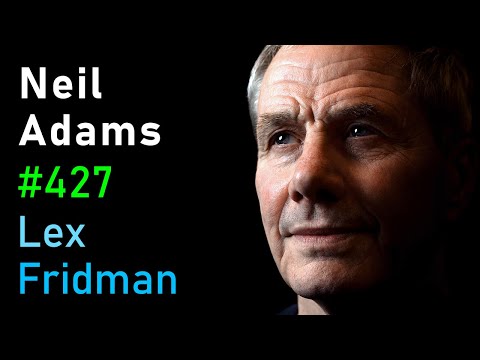
Neil Adams: Judo, Olympics, Winning, Losing, and the Champion Mindset | Lex Fridman Podcast #427
Neil Adams (guest), Lex Fridman (host), Narrator, Narrator, Narrator, Narrator
In this episode of Lex Fridman Podcast, featuring Neil Adams and Lex Fridman, Neil Adams: Judo, Olympics, Winning, Losing, and the Champion Mindset | Lex Fridman Podcast #427 explores neil Adams on Judo, Olympic Heartbreak, and Becoming a True Champion Neil Adams, legendary judoka and commentator, discusses his Olympic journeys, including painful silver medals in 1980 and 1984, and how poor nutrition, mindset shifts, and tactical decisions shaped those outcomes. He explores the evolution of judo’s rules and styles, from classic Japanese throwing to wrestling-influenced leg grabs, and why gripping and transitions on the ground are the sport’s true science. Adams also opens up about his obsessive will to win, the psychological toll of losing on the biggest stage, his battles with alcohol, and how he rebuilt his life, career, and identity after competition. Throughout, he reflects on what makes a “great champion”: not only winning, but how you lose, how you carry yourself, and how you give back to the sport.
Neil Adams on Judo, Olympic Heartbreak, and Becoming a True Champion
Neil Adams, legendary judoka and commentator, discusses his Olympic journeys, including painful silver medals in 1980 and 1984, and how poor nutrition, mindset shifts, and tactical decisions shaped those outcomes. He explores the evolution of judo’s rules and styles, from classic Japanese throwing to wrestling-influenced leg grabs, and why gripping and transitions on the ground are the sport’s true science. Adams also opens up about his obsessive will to win, the psychological toll of losing on the biggest stage, his battles with alcohol, and how he rebuilt his life, career, and identity after competition. Throughout, he reflects on what makes a “great champion”: not only winning, but how you lose, how you carry yourself, and how you give back to the sport.
Key Takeaways
Technical foundation and correct repetition matter more than sheer volume of training.
Adams criticizes mindless uchikomi and emphasizes that repetitions of flawed technique only make bad habits permanent; athletes need high-quality partners and coaching to ingrain proper movement, balance, gripping, and reactions.
Get the full analysis with uListen AI
Transition speed from standing to ground is the real engine of effective newaza.
In judo’s short ground windows, submissions and pins must be built into the throw or its failure; Adams, Kashiwazaki, and others succeed by chaining plan A–B–C in one seamless movement rather than “settling” into groundwork.
Get the full analysis with uListen AI
Mindset shifts from “trying to win” to “trying not to lose” are often fatal.
Adams notes that when athletes get ahead and start protecting a lead, they become passive, draw penalties, or get scored on late; the champions he admires maintain positive, attacking judo for the full duration.
Get the full analysis with uListen AI
Losses, especially on the biggest stage, can fuel technical evolution—or lifelong demons.
His Olympic defeats led him to overhaul his ground game (“never lose on the ground again”) and later to write about ‘lessons in losing,’ but they also triggered recurring nightmares, drinking, and a prolonged identity crisis once competition ended.
Get the full analysis with uListen AI
Rule changes deliberately steer the evolution of the sport’s style and spectacle.
The IOC pressed to distinguish judo from wrestling and reduce ugly stalling; banning leg grabs and encouraging upright posture restored classic throwing judo and shifted heavy wrestlers toward learning “real judo” rather than importing their rules.
Get the full analysis with uListen AI
Great champions are defined less by medals than by how they lose and behave.
Adams points to athletes like Clarisse Agbegnenou and Teddy Riner, who accept losses with grace and perspective, as models of true greatness; arrogance, poor sportsmanship, and lack of humility undermine an athlete’s legacy regardless of titles.
Get the full analysis with uListen AI
Life after elite sport demands re-building purpose, structure, and self-worth.
Losing funding, sponsors, and daily training left Adams adrift; he eventually found a second career in commentary and coaching, choosing to become someone “not forgotten” by contributing deeply to the sport beyond his competitive record.
Get the full analysis with uListen AI
Notable Quotes
““Repetition doesn’t make perfect, repetition makes permanent.””
— Neil Adams
““In the early days, I didn’t think I was gonna lose… I never thought it was possible to lose.””
— Neil Adams
““Great champions for me are the ones who do the right thing when they lose.””
— Neil Adams
““If I’d won that Olympic Games and it changed my life so I didn’t meet my wife and have the family I’ve got now… I wouldn’t swap that for anything.””
— Neil Adams
““Whatever sport you’re doing, you need good instruction and a good club atmosphere. Most people do martial arts for pleasure; winning can’t be the only thing.””
— Neil Adams
Questions Answered in This Episode
How should an ambitious young judoka balance physical conditioning, randori volume, and technical drilling to avoid overtraining while still progressing quickly?
Neil Adams, legendary judoka and commentator, discusses his Olympic journeys, including painful silver medals in 1980 and 1984, and how poor nutrition, mindset shifts, and tactical decisions shaped those outcomes. ...
Get the full analysis with uListen AI
What practical steps can elite athletes take to avoid the psychological trap of becoming more afraid to lose than eager to win as their careers advance?
Get the full analysis with uListen AI
How might judo’s current rules evolve in the next decade, and what changes, if any, would best preserve both the art and the spectacle of the sport?
Get the full analysis with uListen AI
For athletes approaching the end of their competitive careers, what structures or habits can ease the transition into a fulfilling ‘second life’ beyond elite sport?
Get the full analysis with uListen AI
How could Brazilian jiu-jitsu practitioners systematically study and adopt judo-style pins, transitions, and aggression without sacrificing the longer, more exploratory pace of their game?
Get the full analysis with uListen AI
Transcript Preview
When we go to the dojos there, we all get thrown by people that never come out to-
Yeah.
... be world champions. You know, they're, they're just in the mix or they're going through three years of university and then they go. We, we had a guy-
(laughs) Yeah.
(laughs) Y- y- you did-
Yeah.
We had a guy that came in. He was a business guy. He came in-
Yeah.
... with his suitcase and his tie up like that. And he's, he's in his lunch hour. He's in his lunch hour, right?
Yeah.
So he's gotta be quick.
Yeah. (laughs)
(laughs) So he comes in and he goes through ... He's working his way through the whole of the British team.
(laughs)
And we're all lined up, right? 10 minutes later, he's just, just-
Yeah.
... tying his tie up like that, you know?
Yeah.
And off b- back to work like that, you know? Imagine him sitting behind his desk in his computer.
Yeah. Yeah.
Yeah, I'm glad he didn't get out. (laughs)
(laughs) Who do you think wins, Yamashita versus-
I think Yamashita but, but I, you know, I-
Y- w- w- w- w- w- w-
Yeah.
You think Yamashita beats Teddy Riner?
I think so.
Strong words. The following is a conversation with Neil Adams, a legend in the sport of judo. He is a world champion, two-time Olympic silver medalist, five-time European champion, and often referred to as the voice of judo. Commentating all the major events, world championships and Olympic Games, highlighting the drama, the triumph, the artistry of the sport of judo. Making fans like me feel the biggest wins, the biggest losses, the surprise turns of fortune, the dominance of champions coming to an end, and new champions made. Always speaking from the heart. This is the Lex Fridman Podcast. To support it, please check out our sponsors in the description and now, dear friends, here's Neil Adams. You are a five-time European champion, world champion, two-time Olympic silver medalist. Let's first go to the 1980 Olympics. Where was your mind? What was your preparation like? What was your strategy leading into that Olympics?
That was my first Olympic Games, so my preparation was a little bit different to how it was the, uh, '84 and the '88 Olympic Games. And, um, I'd kind of done part of the preparation as well for '76 Olympic Games. I wasn't quite old enough for those, but I was first reserve. So in 1980, I'd had four years build up and I was hungry and I was one of these young athletes, and I see them so often now, that was developing and, you know, full of ... I wouldn't say I was full of myself, but I was, I was certainly confident of my ability and, uh, I wanted to conquer the world. And I'd had a couple of really, uh, tight matches with the current Olympic world champions, so I knew that, uh, there was a possibility that I could get there for the '80 Olympics. So, uh, building up to the '80 Olympics was, um, was quite interesting because I was kind of coming through the weights and I was halfway in between the 71 kilos weight category and the, um, the higher weight category of 78 kilograms. And, um, I'd got third place at the '79 World Championships, the weight below, fought the whole year at the higher weight category. Didn't win a- lose a contest, so I'd beaten everybody in the world and, uh, and then I had to make the decision as to whether to drop to the weight below because I was seeded in the weight below. It was a different seeding then, see, a- and, um ... So I decided to drop into the weight below because I was seeded in the top four and, um, a- a- as it happens, I think it was probably the worst decision I made.
Install uListen to search the full transcript and get AI-powered insights
Get Full TranscriptGet more from every podcast
AI summaries, searchable transcripts, and fact-checking. Free forever.
Add to Chrome