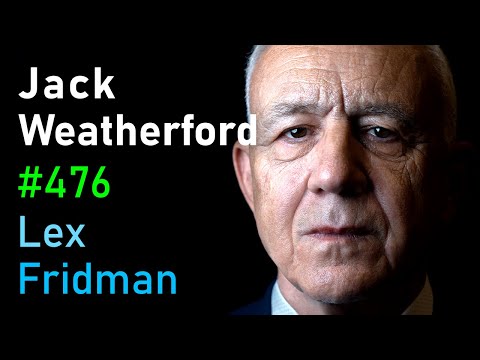
Jack Weatherford: Genghis Khan and the Mongol Empire | Lex Fridman Podcast #476
Lex Fridman (host), Jack Weatherford (guest), Lex Fridman (host), Lex Fridman (host), Lex Fridman (host), Lex Fridman (host)
In this episode of Lex Fridman Podcast, featuring Lex Fridman and Jack Weatherford, Jack Weatherford: Genghis Khan and the Mongol Empire | Lex Fridman Podcast #476 explores from Orphaned Nomad to World-Maker: Genghis Khan Reconsidered Deeply Lex Fridman and historian Jack Weatherford trace Genghis Khan’s life from traumatic childhood on the Mongolian steppe to architect of the largest contiguous empire in history.
From Orphaned Nomad to World-Maker: Genghis Khan Reconsidered Deeply
Lex Fridman and historian Jack Weatherford trace Genghis Khan’s life from traumatic childhood on the Mongolian steppe to architect of the largest contiguous empire in history.
They explore how kidnapping, abandonment, and betrayal shaped his radical break with tribal norms, his love for his wife Börte, and his insistence on loyalty based on merit instead of blood.
The conversation reframes Genghis not just as a conqueror, but as a systemic innovator in warfare, governance, religious freedom, women’s power, trade, and environmental rules.
They also confront the brutality of his campaigns, compare it to modern warfare, examine how history is written about “barbarians,” and reflect on what his vision means for today’s world.
Key Takeaways
Childhood trauma drove Genghis Khan to distrust kinship and reinvent loyalty.
Abandoned by his clan, nearly starved, kidnapped, and betrayed by his father’s brothers, Temujin learned early that blood ties were unreliable, leading him to build a political and military order based on personal loyalty and competence rather than family lineage.
Get the full analysis with uListen AI
The kidnapping of Börte catalyzed his transformation into a military strategist.
His decision to risk everything to rescue his wife required building alliances, organizing a multi-tribal force, and planning a coordinated night assault—his first true campaign and the emotional core of his lifelong commitment to her and to outlawing the kidnapping of women.
Get the full analysis with uListen AI
Mongol military success came from systems thinking, not just ferocity.
Genghis Khan integrated horse mastery, superior archery, the decimal army structure, logistical self-sufficiency, flexible tactics (like feigned retreat), ruthless discipline, and rapid adoption of foreign technologies into a coherent, adaptive war machine.
Get the full analysis with uListen AI
He implemented surprisingly modern reforms on law, religion, and women’s authority.
He outlawed the kidnapping and sale of women, declared individual religious freedom, protected envoys, exempted teachers, doctors, and clergy from taxes, and entrusted major economic and political power to his mother, wives, and daughters as rulers and administrators.
Get the full analysis with uListen AI
The Mongol Empire unified Eurasian trade, accelerating global exchange of ideas.
By securing routes, elevating merchants’ status, standardizing taxation, creating relay-post networks, and protecting caravans, the Mongols turned the Silk Road into a relatively safe, continuous corridor for goods, technologies, crops, and scientific and religious ideas from China to the Mediterranean.
Get the full analysis with uListen AI
The Secret History of the Mongols preserves an unusually intimate view of power.
Compiled just after Genghis’s death by his adopted literate judge, it records not only battles and decrees but private arguments, emotional outbursts, and women’s voices, offering a rare inside account of how an empire-maker thought, doubted, and changed.
Get the full analysis with uListen AI
Judging past conquerors requires confronting our own era’s violence honestly.
Weatherford argues that while Mongol campaigns killed millions, modern states—including the U. ...
Get the full analysis with uListen AI
Notable Quotes
““Let my body go. Let my nation live.””
— Jack Weatherford (attributing Genghis Khan’s wish for an unmarked grave and no monuments)
““If I say he is my son, he is my son. Who are you to say otherwise? You were not there.””
— Jack Weatherford (quoting Genghis Khan defending Börte and their first son Jochi)
““The Mongol, the horse, and the bow were a perfect combination and it was the most lethal weapon known to the world before the modern era.””
— Jack Weatherford
““No other power in the history of the world has conquered Russia and China and Persia and Central Asia and Turkey and Korea. Nobody will ever do it again.””
— Jack Weatherford
““We overlook all of our things that we did. If we can be honest with ourselves and strip away our own lies about ourselves, then perhaps we will be more ethical in our dealings with other people.””
— Jack Weatherford
Questions Answered in This Episode
To what extent did Genghis Khan’s traumatic childhood experiences directly shape his later legal and moral reforms?
Lex Fridman and historian Jack Weatherford trace Genghis Khan’s life from traumatic childhood on the Mongolian steppe to architect of the largest contiguous empire in history.
Get the full analysis with uListen AI
How should we weigh the Mongol Empire’s cultural and institutional innovations against the mass death they caused when evaluating Genghis Khan’s legacy?
They explore how kidnapping, abandonment, and betrayal shaped his radical break with tribal norms, his love for his wife Börte, and his insistence on loyalty based on merit instead of blood.
Get the full analysis with uListen AI
What concrete lessons from Mongol military strategy and statecraft could modern states apply to avoid repeating recent failures in places like Iraq and Afghanistan?
The conversation reframes Genghis not just as a conqueror, but as a systemic innovator in warfare, governance, religious freedom, women’s power, trade, and environmental rules.
Get the full analysis with uListen AI
Why have “barbarian” nomadic empires like the Mongols been so consistently misrepresented in settled civilizations’ histories, and how does that distortion affect geopolitics today?
They also confront the brutality of his campaigns, compare it to modern warfare, examine how history is written about “barbarians,” and reflect on what his vision means for today’s world.
Get the full analysis with uListen AI
Could a leader with Genghis Khan’s combination of vision, discipline, and resistance to personal glorification realistically emerge—and function—in modern democratic societies?
Get the full analysis with uListen AI
Transcript Preview
The following is a conversation with Jack Weatherford, anthropologist and historian specializing in Genghis Khan and the Mongol Empire. He has written a legendary book on this topic titled Genghis Khan and the Making of the Modern World. And he has written many other books, including Emperor of the Seas: Kublai Khan and the Making of China, Genghis Khan and the Quest for God, The Secret History of the Mongol Queens, and other excellent books. I've gotten to know Jack more after this conversation, and I cannot speak highly enough about him. He's a truly brilliant, thoughtful, and kind soul. This was a huge honor and pleasure for me. This is the Lex Fridman Podcast. To support it, please check out our sponsors in the description, and consider subscribing to this channel. And now, dear friends, here's Jack Weatherford. Genghis Khan, born in approximately 1162, became the conqueror of the largest contiguous empire in history. But before that, he was a boy named Temujin, who at nine years old lost everything, his father, his tribe, living in poverty, abandoned to the harshness of the Mongolian steppe. From a boy with nothing to the conqueror of the world. So, tell me about this boy, his childhood and, uh, the Mongolian steppe from which he came from.
The story of Genghis Khan, like the story I think of all of us, it doesn't begin at birth, it begin... That's the beginning of life. The story begins long before birth. And, uh, sometimes it can be many generations before and sometimes only shortly before. But I think with Genghis Khan, a crucial thing is to understand how his parents met and then how he was conceived. And that is that one day a cart was coming across the Mongol territory. And only women drove carts. Men rode horses. Women also rode horses. But women owned the houses which were called gers, the tents. They owned all the household equipment, and so they had to have carts for moving back and forth. And the fact that a cart was moving meant that some woman was moving from one place to another. And in fact her husband was with her. She was a new bride and her husband, uh, was on a horse close to her. So what happened was a man named Yasuke... Yasuke, the future father of Genghis Khan. Yasuke was up on a hill. He was hunting with his falcon. The words of The Secret History of the Mongols were very clear. And he looked down and he saw her, and he could barely glimpse her, but he knew she was young and she was a new bride. And he rode back to camp, he got his two brothers, and they came racing down. And they came and f- first the husband of the woman looked around and he decided to flee. Not because he was a coward, but he figured he would probably pull the men after him. They would chase him. And they did. They chased him. He went far away. He circled around. He came back. He arrived back at the cart where his wife was. Her name was Hoelun. And Hoelun had time to think while he was riding around being chased by the Mongols. And she decided that it's more important for him to live. And she told him when he came back, "You must flee. If you stay here, they will kill you and they will take me. But if you flee, they will take me, but you will have the chance to find another wife. There are many women in the world. You find one and you call her Hoelun after my name, and you remember me when you're with her." It was a very dramatic moment. And he rode away, and he looked back and forth, and it's said that the pigtails or the braids that were hanging down were whipping back and forth from his chest to his back. Uh, he was divided, obviously, in whether he should go or stay. But the three men were approaching again, and they were headed straight for the cart this time. And they came in and they took Hoelun. She didn't say a word until her husband was over the ridge. And when he was over the ridge and she could no longer see him, she began to scream and wail. And one of the brothers said to her, "It doesn't matter if you shake the waters out of the river and if you shake the mountains with your screaming, you will never see this man again." And he was right. That was the moment that Genghis Khan's mother and father met. That's the beginning of his story in this kidnapping. And it's gonna reverberate. Every detail of it will come back again and again, not only throughout the story of the life of Genghis Khan, but it's gonna continue on with the feuds and the issues caused by it all the way into the future. And to some extent, in certain parts of the world, you could say it still exists.
Install uListen to search the full transcript and get AI-powered insights
Get Full TranscriptGet more from every podcast
AI summaries, searchable transcripts, and fact-checking. Free forever.
Add to Chrome