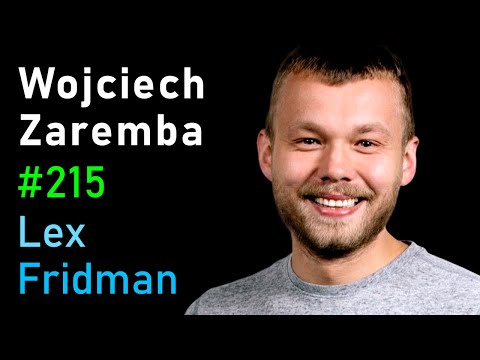
Wojciech Zaremba: OpenAI Codex, GPT-3, Robotics, and the Future of AI | Lex Fridman Podcast #215
Lex Fridman (host), Wojciech Zaremba (guest), Narrator, Narrator
In this episode of Lex Fridman Podcast, featuring Lex Fridman and Wojciech Zaremba, Wojciech Zaremba: OpenAI Codex, GPT-3, Robotics, and the Future of AI | Lex Fridman Podcast #215 explores openAI’s Wojciech Zaremba on consciousness, Codex, and humane AGI futures Wojciech Zaremba, OpenAI co‑founder and head of language/Codex, speaks with Lex Fridman about the nature of intelligence, consciousness, love, and the long‑term trajectory of AI systems like GPT-3 and Codex.
OpenAI’s Wojciech Zaremba on consciousness, Codex, and humane AGI futures
Wojciech Zaremba, OpenAI co‑founder and head of language/Codex, speaks with Lex Fridman about the nature of intelligence, consciousness, love, and the long‑term trajectory of AI systems like GPT-3 and Codex.
They explore philosophical questions (Fermi paradox, meaning of life, death) alongside concrete engineering topics such as deep learning, program synthesis, robotics, and iterative deployment of powerful models.
Zaremba emphasizes intelligence as compression and meta‑compression, views language models as chameleons shaped by context, and argues that future AI tutors, therapists, and companions could dramatically scale human wellbeing.
Throughout, he stresses meditation, empathy, and love as guiding principles for building and deploying AGI, while trusting governance questions largely to OpenAI CEO Sam Altman.
Key Takeaways
Intelligence may fundamentally be compression and meta‑compression.
Zaremba suggests that systems like GPT learn by compressing reality (predicting text), and consciousness/self‑consciousness might emerge when a powerful compressor starts modeling and compressing itself—analogous to Gödelian self‑reference.
Get the full analysis with uListen AI
Context is everything: large language models are chameleons shaped by prompts.
He likens the human “story of self” to a GPT prompt: the narrative we prepend determines how we behave, just as a well‑crafted prefix (“You are Elon Musk…”) steers GPT into different personas and capabilities.
Get the full analysis with uListen AI
Program synthesis via Codex turns natural language into action across software.
By training on code and text, Codex can translate human instructions into working code (e. ...
Get the full analysis with uListen AI
Scaling data and compute has been more impactful than new algorithms—so far.
While architectural innovations (e. ...
Get the full analysis with uListen AI
Robotics is bottlenecked by data, fidelity, and latency, not just algorithms.
Their Rubik’s Cube hand project required massive simulation with domain randomization and still struggled with real‑world latency and hardware maintenance; for a commercial robotics firm today, he’d start with tele‑operation to amass supervised data before autonomy.
Get the full analysis with uListen AI
Future AI therapists and companions could scale empathy—but must optimize for users’ goals, not engagement.
He believes language‑based systems, augmented by multimodal perception and continual learning, can become extraordinarily good at understanding personalities and emotions, but insists they should be tuned to maximize human wellbeing rather than attention or addiction.
Get the full analysis with uListen AI
Meaning and love can be framed as reward functions—but that doesn’t trivialize them.
Zaremba models love as partly “optimizing another’s reward function as your own,” and sees meaning as arising from a structured set of internal rewards (curiosity, connection, creation) that can be understood scientifically yet remain experientially profound.
Get the full analysis with uListen AI
Notable Quotes
“It almost feels that consciousness is a compressor trying to compress itself—meta‑compression.”
— Wojciech Zaremba
“GPT is a chameleon. You can turn it into anything by providing context.”
— Wojciech Zaremba
“Codex is yet another step toward bringing computers closer to humans, so you communicate with a computer in your own language rather than a specialized language.”
— Wojciech Zaremba
“I don’t want to be working because I’m scared. I want to be working out of passion, out of curiosity, out of looking forward to a positive future.”
— Wojciech Zaremba
“We very quickly get used to whatever we possess. Meditation showed me that even a simple object can be incredibly beautiful if you really look at it.”
— Wojciech Zaremba
Questions Answered in This Episode
If intelligence is compression and meta‑compression, what concrete experiments could falsify or support that hypothesis in brains and artificial systems?
Wojciech Zaremba, OpenAI co‑founder and head of language/Codex, speaks with Lex Fridman about the nature of intelligence, consciousness, love, and the long‑term trajectory of AI systems like GPT-3 and Codex.
Get the full analysis with uListen AI
How can we design AI‑driven therapists or companions that robustly optimize for users’ long‑term wellbeing rather than short‑term engagement or dependence?
They explore philosophical questions (Fermi paradox, meaning of life, death) alongside concrete engineering topics such as deep learning, program synthesis, robotics, and iterative deployment of powerful models.
Get the full analysis with uListen AI
What governance structures or technical mechanisms could realistically prevent AGI power from concentrating in the hands of a few organizations or states?
Zaremba emphasizes intelligence as compression and meta‑compression, views language models as chameleons shaped by context, and argues that future AI tutors, therapists, and companions could dramatically scale human wellbeing.
Get the full analysis with uListen AI
To what extent can a purely digital, disembodied AI ever truly understand human experience, and where does embodiment (touch, pain, physical risk) become essential?
Throughout, he stresses meditation, empathy, and love as guiding principles for building and deploying AGI, while trusting governance questions largely to OpenAI CEO Sam Altman.
Get the full analysis with uListen AI
How should we measure and eventually legislate around degrees of machine consciousness without creating perverse incentives or unethical hierarchies of sentience?
Get the full analysis with uListen AI
Transcript Preview
The following is a conversation with Wojciech Zaremba, co-founder of OpenAI, which is one of the top organizations in the world doing artificial intelligence research and development. Wojciech is the head of language and co-generation teams, building and doing research on GitHub Copilot, OpenAI Codex, and GPT-3 and who knows, 4, 5, 6, and, and, n+1, and he also previously led OpenAI's robotic efforts. These are incredibly exciting projects to me that deeply challenge and expand our understanding of the structure and nature of intelligence. The 21st century, I think, may very well be remembered for a handful of revolutionary AI systems and their implementations. GPT, Codex, and applications of language models and transformers in general to the language and visual domains may very well be at the core of these AI systems. To support this podcast, please check out our sponsors. They're listed in the description. This is the Lex Fridman Podcast, and here is my conversation with Wojciech Zaremba. You mentioned that Sam Altman asked about the Fermi paradox, and, uh, the people at OpenAI had really sophisticated, interesting answers, so that's when you knew this is the right team to be working with. So let me ask you about the Fermi paradox about aliens. Why have we not found overwhelming evidence for aliens visiting Earth?
I don't have a conviction in the answer, but rather kind of probabilistic perspective on what might be a, let's say, possible answers. It's also interesting that the question itself even can touch on the, you know, your typical question of what's the meaning of life because like-
Yes.
... if you assume that like we don't see aliens because they destroy themselves, that kind of upweights the, um, focus on making sure that we won't destroy ourselves.
Yeah.
Um, but at the moment, the place where I am actually with my belief, and these things also change over the time, is I think that, uh, we might be alone in the universe, which actually makes life more or let's say consciousness life more kind of valuable, and that means that we should more appreciate it.
Have we always been alone? So y- what's your intuition about our galaxy, our universe? Is it just sprinkled with graveyards of intelligent civilizations, or are we truly... Is, is life, intelligent life truly unique?
At the moment, my belief that it, it is unique, but I would say I could also, uh, you know... There was like some footage, uh, released, uh, with UFO objects-
Mm-hmm.
... which makes me actually doubt my own belief.
Yes.
Uh, yeah, I can tell you one crazy answer that I have heard.
Yes.
Um, so, um, apparently when you look actually at the limits of computation, you can compute more if the temperature of the universe were to drop down. So, one of the things that aliens might want to do if they are truly optimizing to maximize amount of compute which, you know, maybe can lead to more let's say simulations or so, it's instead of wasting current entropy of the universe, because you know, we by living we are actually somewhat wasting entropy.
Install uListen to search the full transcript and get AI-powered insights
Get Full TranscriptGet more from every podcast
AI summaries, searchable transcripts, and fact-checking. Free forever.
Add to Chrome