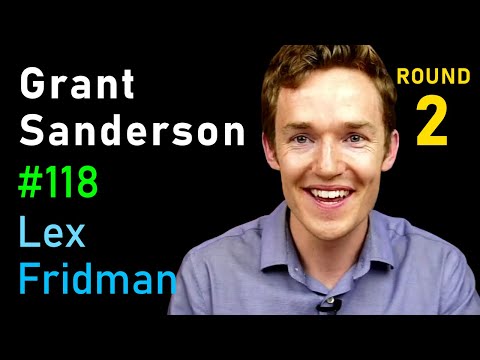
Grant Sanderson: Math, Manim, Neural Networks & Teaching with 3Blue1Brown | Lex Fridman Podcast #118
Lex Fridman (host), Grant Sanderson (guest), Narrator, Narrator
In this episode of Lex Fridman Podcast, featuring Lex Fridman and Grant Sanderson, Grant Sanderson: Math, Manim, Neural Networks & Teaching with 3Blue1Brown | Lex Fridman Podcast #118 explores grant Sanderson on Feynman, math beauty, teaching, and exponential progress Lex Fridman and Grant Sanderson (3Blue1Brown) discuss Richard Feynman’s depth as a scientist and explainer, and how Grant tries to emulate Feynman’s habit of re‑deriving ideas to gain real ownership of concepts.
Grant Sanderson on Feynman, math beauty, teaching, and exponential progress
Lex Fridman and Grant Sanderson (3Blue1Brown) discuss Richard Feynman’s depth as a scientist and explainer, and how Grant tries to emulate Feynman’s habit of re‑deriving ideas to gain real ownership of concepts.
They explore math education, visualization, and interactivity, including why beautifully clear lectures often fail long‑term retention and how tools like Manim and online video can ‘commoditize explanation’ for the benefit of students worldwide.
The conversation ranges through exponential growth, pandemics, Moore’s law, and GPT‑3, using each as a springboard to talk about intuition, abstraction, and what actually counts as understanding in math and science.
They close by reflecting on remote teaching during COVID, the loneliness of solo creative work, the dangers and temptations of social media, and a grounded view of meaning in life centered on human connection and shared curiosity.
Key Takeaways
Deep understanding often comes from re-deriving ideas yourself.
Grant echoes Feynman’s habit of trying to solve problems before reading others’ solutions; although slower and impractical for everything, selectively doing this on core topics builds inarticulable intuitions, counterexamples, and a stronger sense of ownership.
Get the full analysis with uListen AI
Beautiful explanations can be deceptive if not paired with active learning.
Feynman’s lectures (and 3Blue1Brown videos) feel incredibly clear in the moment, but retention is low without problem-solving, spaced repetition, or hands-on play; intellectual “candy” must be followed by deliberate practice to stick.
Get the full analysis with uListen AI
Topology and other advanced fields can be motivated through concrete puzzles.
Grant argues topology is often popularized either too squishily (mugs and donuts) or too axiomatically; starting from specific impossibility puzzles (like embedding a Möbius strip without self-intersection) and only then formalizing concepts like orientability makes the subject much more meaningful.
Get the full analysis with uListen AI
Humans are bad at large-number exponential growth but can learn the intuition.
We may naturally think logarithmically for small numbers, but examples like lily pads doubling on a lake or R₀ dynamics in epidemics show how shockingly fast exponentials explode; exposure to such examples (and seeing where they break down) trains better intuition for pandemics and tech trends.
Get the full analysis with uListen AI
Good online teaching should treat explanations as reusable, public artifacts.
Grant advocates that each great teacher pick a few topics and make the best short explanation they can, publishing it so it can be reused globally; classroom time can then focus on interaction and problem-solving while explanation itself becomes a shared, “canonical” online resource.
Get the full analysis with uListen AI
Solo creative work benefits from structure and limited connectivity.
Grant’s most productive scripting days involve early exercise, turning off the internet, reading briefly when blocked, and accepting that writing is the hardest part; social media and metrics (views, comments) can distort self-perception and happiness, so deliberate limits are crucial.
Get the full analysis with uListen AI
Neural networks and large language models show the power and limits of pattern recognition.
Grant praises neural networks’ layered abstractions and GPT‑3’s pattern-matching prowess, but stresses that math-level understanding also demands hypothesis testing and mechanistic explanation, not just compressing and regurgitating observed patterns.
Get the full analysis with uListen AI
Notable Quotes
“Everything is either trivial or impossible, and it’s a shockingly thin line between the two.”
— Grant Sanderson
“The very same thing that’s so admirable about Feynman’s lectures, which is how damn satisfying they are to consume, might actually also reveal a little bit of the flaw… that does not correlate with long-term learning.”
— Grant Sanderson
“It just seems inefficient to me that a lesson is taught millions of times over in parallel… What should happen is that there’s a small handful of explanations online, and the time in classroom is spent on all of the parts of teaching that aren’t explanation.”
— Grant Sanderson
“Most of the educational content is posted by people who were just starting to research it two weeks ago… The people who have the self-awareness to not post are probably the people best positioned to give a good, honest explanation of it.”
— Grant Sanderson
“I don’t think life has a meaning. I think meaning is something that’s ascribed to stuff that’s created with purpose… Interactions with like-minded people, I think, is the meaning of— in that sense.”
— Grant Sanderson
Questions Answered in This Episode
How can educators practically balance the Feynman-style ‘reinvent it yourself’ approach with the time pressures of modern curricula?
Lex Fridman and Grant Sanderson (3Blue1Brown) discuss Richard Feynman’s depth as a scientist and explainer, and how Grant tries to emulate Feynman’s habit of re‑deriving ideas to gain real ownership of concepts.
Get the full analysis with uListen AI
What concrete steps could universities take to encourage more professors to create ‘canonical’ online explanations in their areas of expertise?
They explore math education, visualization, and interactivity, including why beautifully clear lectures often fail long‑term retention and how tools like Manim and online video can ‘commoditize explanation’ for the benefit of students worldwide.
Get the full analysis with uListen AI
Where is the line between powerful visualization that builds intuition and visualization that gives a false sense of understanding?
The conversation ranges through exponential growth, pandemics, Moore’s law, and GPT‑3, using each as a springboard to talk about intuition, abstraction, and what actually counts as understanding in math and science.
Get the full analysis with uListen AI
In what ways might large models like GPT‑3 (or its successors) become genuine collaborators in mathematical discovery, rather than just pattern mimics?
They close by reflecting on remote teaching during COVID, the loneliness of solo creative work, the dangers and temptations of social media, and a grounded view of meaning in life centered on human connection and shared curiosity.
Get the full analysis with uListen AI
What are realistic strategies for maintaining deep, serendipitous intellectual collaboration (a la Bell Labs) in a world of remote work and online interaction?
Get the full analysis with uListen AI
Transcript Preview
The following is a conversation with Grant Sanderson, his second time on the podcast. He's known to millions of people as the mind behind 3Blue1Brown, a YouTube channel where he educates and inspires the world with the beauty and power of mathematics. A quick summary of the sponsors: Dollar Shave Club, DoorDash, and Cash App. Click the sponsor links in the description to get a discount and to support this podcast, especially for the two new sponsors, Dollar Shave Club and DoorDash. Let me say as a side note, I think that this pandemic challenged millions of educators to rethink how they teach, to rethink the nature of education. As people know, Grant is a master elucidator of mathematical concepts that may otherwise seem difficult or out of reach for students and curious minds. But he's also an inspiration to teachers, researchers, and people who just enjoy sharing knowledge, like me, for what it's worth. It's one thing to give a semester's worth of multi-hour lectures. It's another to extract from those lectures the most important, interesting, beautiful, and difficult concepts and present them in a way that makes everything fall into place. That is the challenge that is worth taking on. My dream is to see more and more of my colleagues at MIT and world experts across the world summon their inner 3Blue1Brown and create the canonical explainer videos on a topic that they know more than almost anyone else in the world. Amidst the political division, the economic pain, psychological medical toll of the virus, masterfully crafted educational content feels like one of the beacons of hope that we can hold onto. If you enjoy this thing, subscribe on YouTube, review it with five stars on Apple Podcasts, follow on Spotify, support on Patreon, or connect with me on Twitter @lexfridman. Of course, after you go immediately, which you already probably have done a long time ago, and subscribe to 3Blue1Brown YouTube channel. You will not regret it. As usual, I'll do a few minutes of ads now and no ads in the middle. I try to make these interesting, but I give you timestamps so you can skip. But still please do check out the sponsors by clicking the links in the description, especially at the two new ones, DoorDash and Dollar Shave Club. They're evaluating us, looking at how many people go to their site and get their stuff in order to determine if they wanna support us for the long term. So you know what to do. (laughs) It's the best way to support this podcast, as always. This show is sponsored by Dollar Shave Club. Try them out with a one-time offer for only $5 and free shipping at dollarshaveclub.com/lex. Starter kit comes with a six-blade razor, refills, and all kinds of other stuff that makes shaving feel great. I've been a member of Dollar Shave Club for over five years now, and actually signed up when I first heard about them on the Joe Rogan podcast. And now, we have come full circle. I feel like I've made it now that I can do a read for them just like Joe did all those years ago. For the most part, I've just used the razor and the refills, but they encouraged me to try the shave butter, which I've never used before. So I did, and I love it. I'm not sure how the chemistry of it works out, but it's translucent somehow, which is a cool new experience. Again, try the Ultimate Shave Starter Set today for just five bucks, plus free shipping at dollarshaveclub.com/lex. This show is also sponsored by DoorDash. Get five bucks off and zero delivery fees on your first order of $15 or more when you download the DoorDash app and enter code LEX. I have so many memories of working late nights for a deadline with a team of engineers and eventually taking a break to argue about which DoorDash restaurant to order from. And when the food came, those moments of bonding, of exchanging ideas, of pausing to shift attention from the programs to the humans, were special. These days, for a bit of time, I'm on my own sadly, so I miss that camaraderie. But actually DoorDash are still there for me. There's a million options to fit into my keto diet ways. Also, it's a great way to support restaurants in these challenging times. Once again, download the DoorDash app and enter code LEX to get five bucks off and zero delivery fees on your first order of $15 or more. Finally, this show is presented by Cash App, the number one finance app in the App Store. When you get it, use code LEXPODCAST. Cash App lets you send money to friends, buy Bitcoin, and invest in the stock market with as little as $1. It's one of the best designed interfaces of an app that I've ever used. To me, good design is when everything is easy and natural. Bad design is when the app gets in the way, either because it's buggy or because it tries too hard to be helpful. I'm looking at you, Clippy. Anyway, there's a big part of my brain and heart that love to design things and also to appreciate great design by others. So again, if you get Cash App from the App Store or Google Play and use code LEXPODCAST, you get $10, and Cash App will also donate $10 to FIRST, an organization that is helping to advance robotics and STEM education for young people around the world. And now, here's my conversation with Grant Sanderson. You've spoken about Richard Feynman as someone you admire. I think last time we spoke, we ran out of time. (laughs)
Install uListen to search the full transcript and get AI-powered insights
Get Full TranscriptGet more from every podcast
AI summaries, searchable transcripts, and fact-checking. Free forever.
Add to Chrome