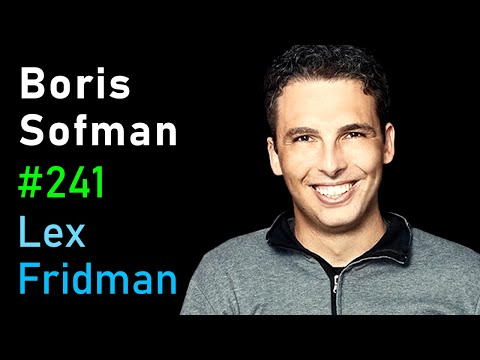
Boris Sofman: Waymo, Cozmo, Self-Driving Cars, and the Future of Robotics | Lex Fridman Podcast #241
Lex Fridman (host), Boris Sofman (guest), Narrator
In this episode of Lex Fridman Podcast, featuring Lex Fridman and Boris Sofman, Boris Sofman: Waymo, Cozmo, Self-Driving Cars, and the Future of Robotics | Lex Fridman Podcast #241 explores from Cozmo To Trucks: Designing Robots People Love And Trust Boris Sofman traces his journey from co-founding Anki and creating the emotionally rich toy robot Cozmo to leading autonomous trucking engineering at Waymo. He explains how Cozmo’s success came from embracing non‑humanoid design, tight cost constraints, and Pixar‑style character development to create real emotional connection in a forgiving, fun domain. Shifting to Waymo, he details the technical, safety, and organizational challenges of Level 4 autonomy, especially for long‑haul trucks, and how simulation, multi‑sensor perception, and a rigorous safety framework underpin deployment. Throughout, he reflects on why robotics startups are so hard, how markets and timing matter as much as technology, and what widespread autonomy and home robots might mean for society, jobs, and daily life.
From Cozmo To Trucks: Designing Robots People Love And Trust
Boris Sofman traces his journey from co-founding Anki and creating the emotionally rich toy robot Cozmo to leading autonomous trucking engineering at Waymo. He explains how Cozmo’s success came from embracing non‑humanoid design, tight cost constraints, and Pixar‑style character development to create real emotional connection in a forgiving, fun domain. Shifting to Waymo, he details the technical, safety, and organizational challenges of Level 4 autonomy, especially for long‑haul trucks, and how simulation, multi‑sensor perception, and a rigorous safety framework underpin deployment. Throughout, he reflects on why robotics startups are so hard, how markets and timing matter as much as technology, and what widespread autonomy and home robots might mean for society, jobs, and daily life.
Key Takeaways
Deliberate constraints can make robots more expressive and lovable.
Cozmo had only four degrees of freedom, a low‑res screen, and no voice, yet conveyed rich emotion by saturating a few channels (eyes, lift, sound) and using Pixar‑style animation principles. ...
Get the full analysis with uListen AI
Character design is as critical as hardware and AI in HRI.
Most robotics efforts over‑invest in mechanics and under‑invest in character, but Sofman argues the ‘three‑legged stool’—hardware, intelligence, and character—must be balanced. ...
Get the full analysis with uListen AI
Robotics startups often die from market and timing, not tech alone.
Anki sold millions of units and built strong tech and reviews, yet the seasonal, hit‑driven, high‑inventory toy business, hardware‑averse capital markets, and brutal cash‑flow swings killed the company. ...
Get the full analysis with uListen AI
Waymo’s edge comes from L4 focus, multi‑sensor design, and real driverless ops.
Unlike L2 driver‑assist programs, Waymo’s hardware, software, and organization are optimized from day one for Level 4, with in‑house lidar, radar, cameras, and fifth‑generation compute. ...
Get the full analysis with uListen AI
Autonomous trucking will start hub‑to‑hub and reshape logistics gradually.
Waymo Via focuses first on freeway‑heavy, long‑haul routes between purpose‑built transfer hubs outside cities, leaving the last urban miles to human drivers initially. ...
Get the full analysis with uListen AI
Machine learning and simulation underpin safety more than raw miles do.
Waymo simulates roughly 1,000 miles for every real mile driven, replaying edge cases, fuzzing scenes, and testing behavior under rare but dangerous scenarios that can’t be sampled purely by driving. ...
Get the full analysis with uListen AI
Humanoid robots are mostly research until there’s a clear application fit.
Sofman is skeptical of chasing human form for its own sake: humans have too many degrees of freedom, are expensive to emulate, and invite unfair comparisons to human capability. ...
Get the full analysis with uListen AI
Notable Quotes
“Perfection is actually not fun. We had to add noise and mistakes into Cozmo’s behavior because that chaos made him feel more alive.”
— Boris Sofman
“Most companies in human‑robot interaction over‑invest in the mechanical side and under‑invest in the character. You don’t win just by adding joints.”
— Boris Sofman
“The hardest problem in autonomous driving is often the evaluation problem, not the autonomy problem. How do you know you’re truly ready for driverless?”
— Boris Sofman
“You can have the greatest idea and team in the world, but the timing and the market can still dominate your outcome.”
— Boris Sofman
“Decades from now we’ll probably look back and say, ‘What was the world even like before autonomous vehicles?’ the same way we do with the internet or smartphones.”
— Boris Sofman
Questions Answered in This Episode
How far can we push character‑driven robots like Cozmo into serious domains such as elder care or education before we need much deeper AI?
Boris Sofman traces his journey from co-founding Anki and creating the emotionally rich toy robot Cozmo to leading autonomous trucking engineering at Waymo. ...
Get the full analysis with uListen AI
What kind of regulatory and societal consensus will be required before cities are comfortable with large numbers of driverless trucks on their roads?
Get the full analysis with uListen AI
Could Tesla’s vision‑only, data‑at‑scale strategy ultimately converge with multi‑sensor approaches, or will these paths diverge into different product categories?
Get the full analysis with uListen AI
How should policymakers and companies jointly handle the short‑term disruption to specific worker groups as automation reshapes logistics and transportation?
Get the full analysis with uListen AI
What would a truly ‘robot‑native’ city or logistics network look like if we designed it from scratch around autonomous vehicles instead of retrofitting today’s infrastructure?
Get the full analysis with uListen AI
Transcript Preview
The following is a conversation with Boris Sofman, who is the senior director of engineering and head of trucking at Waymo, the autonomous vehicle company, formerly the Google self-driving car project. Before that, Boris was the co-founder and CEO of Anki, a robotics company that created Cozmo, which, in my opinion, is one of the most incredible social robots ever built. It's a toy robot, but one with an emotional intelligence that creates a fun and engaging human-robot interaction. It was truly sad for me to see Anki shut down when it did. I had high hopes for those little robots. We talk about this story and the future of autonomous trucks, vehicles, and robotics in general. I spoke with Steve Viscelli recently on episode 237 about the human side of trucking. This episode looks more at the robotic side. This is the Lex Fridman Podcast. To support it, please check out our sponsors in the description, and now here's my conversation with Boris Sofman. Who is your favorite robot in science fiction, books or movies?
WALL-E and R2-D2, where they were able to convey such an incredible degree of intent, emotion, and kinda character attachment without having any language whatsoever, um, and just purely through the emo- richness of em- emotional interaction, so those are fantastic. And then, uh, the Terminator series is just, like, really (laughs) in front of my eye-
(laughs) Okay.
... pretty wide-
Jumped from WALL- (laughs)
... wide range, right? Uh, but, uh, I kinda love this, uh, dynamic where you have this, like, incredible Terminator itself that, that Arnold played, but, uh, and then he was kind of like the inferior, like, previous generation version that was, like, totally outmatched, uh, you know, in terms of kinda specs by the new one, but, you know, still kind of, like, held his own. And so it was kind of interesting where you, you realize how many, how many levels there are on the spectrum from human to kind of potentials in AI and robotics to, uh, futures. And so, yeah, that movie really, uh, as much as it was, like, kind of a dark world in a way, was actually quite fascinating, gets the imagination going.
Well, from an engineering perspective, both the movies you mentioned, uh, WALL-E and, um, Terminator, uh, the first one is probably achievable, you know, humanoid robot, maybe not with, like, the realism in terms of skin and so on, but that humanoid form, we have that humanoid form. It seems like a compelling form. Maybe the challenge is it's super expensive to engine- to, to build, but you can imagine maybe not a machine of war-
Yeah.
... but you can imagine Terminator-type robots walking around.
Yeah.
Uh, and then the same obviously w- with WALL-E. You've basically... So for people who don't know, you, uh, created the company Anki that created, uh, a small robot with a big personality called Cozmo that just... It does exactly what WALL-E does, which is somehow with very few basic visual tools is able to communicate a depth of emotion, and that's fascinating. Uh, but then again, the humanoid form is, uh, super compelling. So, like, C- uh, Cozmo is very distant from a humanoid form-
Install uListen to search the full transcript and get AI-powered insights
Get Full TranscriptGet more from every podcast
AI summaries, searchable transcripts, and fact-checking. Free forever.
Add to Chrome