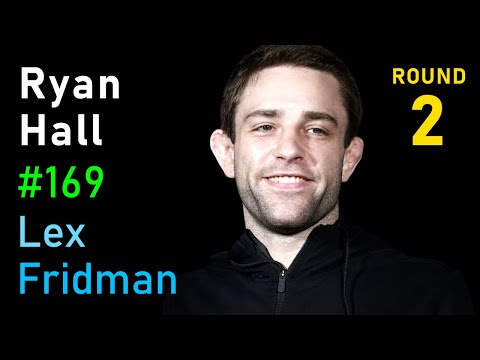
Ryan Hall: Solving Martial Arts from First Principles | Lex Fridman Podcast #169
Lex Fridman (host), Ryan Hall (guest), Narrator, Narrator, Narrator, Narrator, Narrator, Narrator, Narrator, Narrator
In this episode of Lex Fridman Podcast, featuring Lex Fridman and Ryan Hall, Ryan Hall: Solving Martial Arts from First Principles | Lex Fridman Podcast #169 explores ryan Hall Deconstructs Fighting, Free Will, and Human Systems Thinking Ryan Hall and Lex Fridman dive deep into “solving” martial arts from first principles, exploring how systems thinking, game theory, and mechanism design apply to combat sports.
Ryan Hall Deconstructs Fighting, Free Will, and Human Systems Thinking
Ryan Hall and Lex Fridman dive deep into “solving” martial arts from first principles, exploring how systems thinking, game theory, and mechanism design apply to combat sports.
Hall contrasts being an end user of techniques with understanding and rewriting the underlying “source code” of jiu-jitsu, emphasizing continual questioning of foundational assumptions.
They discuss risk, strategy, injury, and career stagnation in MMA, plus broader themes like free will, social media dynamics, power imbalances, and how to live and learn intentionally.
Throughout, Hall ties technical fighting concepts—back control, guard theory, striking without getting hit—to larger philosophical ideas about agency, responsibility, and empathy.
Key Takeaways
Question foundational assumptions in any skill, not just the details.
Hall argues that most innovation in jiu-jitsu tweaks existing tactics (e. ...
Get the full analysis with uListen AI
Strive to understand the “source code” of systems, not just use the interface.
He distinguishes between being an end user (like someone who can operate a phone but not program it) and being able to see how techniques, positions, and strategies interact at a fundamental level so you can redesign the game when needed.
Get the full analysis with uListen AI
Design games where your opponent’s choices are an illusion.
Using rock–paper–scissors and a finger-choosing trick, Hall shows how asking the right sequence of “questions” can funnel an opponent into outcomes that feel like free choices to them but are predetermined by your structure of engagement.
Get the full analysis with uListen AI
Prioritize hitting without getting hit instead of trading damage.
He criticizes the romanticization of “toughness” and wars of attrition in fighting, stressing that great strikers like Stephen Thompson or Mayweather succeed by making asymmetrical trades—landing while largely avoiding being hit.
Get the full analysis with uListen AI
Use time away from competition to ‘mine skills’ instead of chasing wins.
Extended layoffs from injuries and opponent withdrawals were emotionally brutal, but Hall frames them as opportunities to build deep technical and strategic “capital” so future fights can be approached with much better tools.
Get the full analysis with uListen AI
Adopt facilitative beliefs, regardless of whether you can prove them true.
In discussing free will, Hall suggests that believing in agency, discipline, and improvement is more productive than nihilistic determinism, because it better supports effort, responsibility, and constructive action.
Get the full analysis with uListen AI
Lead with empathy and charity in interpretation, especially online.
He criticizes social media’s incentive structures and cultural habit of giving ourselves the most generous interpretation while giving others the harshest; instead, he advocates being a strict judge of oneself and a better lawyer for others.
Get the full analysis with uListen AI
Notable Quotes
“If you understand how things interact on a fundamental level and what type of games exist, then you can transcend a lot of the systems.”
— Ryan Hall
“Most people think they’re doing jiu-jitsu, when in reality they are doing an expression of it.”
— Ryan Hall
“We were so concerned with whether or not we could, we didn’t stop to think whether or not we should.”
— Ryan Hall (paraphrasing Ian Malcolm / Jurassic Park)
“I can’t control whether I win a fight. I can control my effort and my attitude.”
— Ryan Hall
“Everyone is a great lawyer for themselves and a judge for others.”
— Ryan Hall
Questions Answered in This Episode
How can the ‘illusion of choice’ concept be practically built into everyday training and sparring, not just high-level strategy?
Ryan Hall and Lex Fridman dive deep into “solving” martial arts from first principles, exploring how systems thinking, game theory, and mechanism design apply to combat sports.
Get the full analysis with uListen AI
What are some other “sacred” fundamentals in jiu-jitsu that might actually be junk once examined from first principles?
Hall contrasts being an end user of techniques with understanding and rewriting the underlying “source code” of jiu-jitsu, emphasizing continual questioning of foundational assumptions.
Get the full analysis with uListen AI
How should fighters balance the long-term health costs of damage with the short-term pressures to be “exciting” and entertaining?
They discuss risk, strategy, injury, and career stagnation in MMA, plus broader themes like free will, social media dynamics, power imbalances, and how to live and learn intentionally.
Get the full analysis with uListen AI
If social media incentives changed tomorrow, what concrete design tweaks would most improve empathy and quality of discourse?
Throughout, Hall ties technical fighting concepts—back control, guard theory, striking without getting hit—to larger philosophical ideas about agency, responsibility, and empathy.
Get the full analysis with uListen AI
How can non-fighters apply Hall’s systems-thinking approach to solving problems in careers, relationships, or personal growth?
Get the full analysis with uListen AI
Transcript Preview
The following is a conversation with Ryan Hall, his second time on the podcast. He's one of the most innovative scholars of martial arts in the modern era. Quick mention of our sponsors, Indeed hiring website, Audible audiobooks, ExpressVPN, and LMNT electrolyte drink. Click the sponsor links to get a discount and to support this podcast. As a side note, let me say that I've gotten a chance to train with Ryan recently and to both discuss and try out on the mat his ideas about grappling and fighting. What struck me is his unapologetic drive to solve martial arts. It reminds me of the ambitious vision and effort of Google's DeepMind to solve intelligence. In Ryan's case, this isn't some out there martial arts guru talk. This is a style of thinking about the game of human chess, of seeking to define the rules, and to engineer ways from first principles of escaping the constraints of those rules. This style of thinking is rare, but is ultimately the one that leads to the discovery of new revolutionary ideas. If you enjoy this podcast, subscribe to it anywhere or connect with me at Lex Fridman. And now here's my conversation with Ryan Hall. You're known as a systems thinker in martial arts, but you also, I think, are willing to think outside the rules of the game, outside of the system. When you're thinking about strategies of how to, you know, solve the problem, particular problem of an opponent, whether that's jujitsu or in mixed martial arts, what's your process for doing that, for figuring out that puzzle?
I would say, I don't know if I have a specific like A to B to C process for that sort of thing. Um, I try to do my best to, uh, r- appreciate that I think a lot of the thinking, um, or e- maybe not all the thinking, but a lot of great thinking on conflict, on battle, on war, on martial arts has been done already. Um, not that we don't have to do any sort of, uh, background investigation or reassessing of these ideas or axioms that have come down through things like The Book of Five Rings or The Art of War or, you know, e- like von Clausewitz, even anything like that really, but is, uh, eh, we're trying to understand the, the lessons of the past that I think oftentimes we, we don't take with us, um, problem solve. And we pay lip service to them, like, "Oh, yeah, yeah, yeah, uh, you know, uh, a victorious fighter, uh, the great fighter, uh, you know, uh, he knows victory is there then he, then he, then he seeks battle. Everyone else is looking for victory in battle. Yeah, moving on and that's why I'm gonna double jab and throw my left hand." And, uh, I think a lot of times our actions don't reflect our stated belief structure, and I think that oftentimes you can tell what I believe really or what my fundamental operating system is based on my actions, whether I'm aware... I have an operating system internally whether I'm aware of it or not, or certainly whether I'm fully aware of it. So I guess, uh, when it comes to strategy I, I try to think about how things interact, and you mentioned systems thinking and I, and I try to do my best to understand how systems exist, but I think that systems have a fundamental strength and a fundamental weakness. They work how they work and that's great, um, but they're readable. So if you are aware, if I am operating on a system, uh, of which you're, you're not really read into then I, I think oftentimes I can seem like y- s- shockingly effective, particularly if my system preys on certain weaknesses, uh, that, that maybe you are, uh, you're given to. But what happens when you've read the same books that I have? I, I think that a lot of times that makes me deeply predictable. I think about systems in jujitsu, you know, and, uh, a lot of times people think that they're doing jujitsu when in reality they are doing an expression of it. Let's say I'll use... There's the Marcelo Garcia system, there is the, uh, Renzo Gracie current, Renzo Gracie system, there's the old Gracie Barra one, there's, uh, you know, the Gracie Academy, classic Gracie Jujitsu, there's the Art of Jujitsu, um, you know, kind of Atos approach and, you know, there's some crossover between a lot of these. But, uh, oftentimes I think, um, you know, when it comes to understanding how I'm making decisions and how my opponent is making decisions, I have to appreciate whether or not I'm an end user of something and I'll use my, my phone as an example. Um, I was thinking of this the other day, and as an end user of my phone, I can't... I have no idea what it does. You know, like Edward Snowden comes up and goes, "Hey guys, you realize your phones are listening to you?" I'm like, "Really? What?"
Install uListen to search the full transcript and get AI-powered insights
Get Full TranscriptGet more from every podcast
AI summaries, searchable transcripts, and fact-checking. Free forever.
Add to Chrome