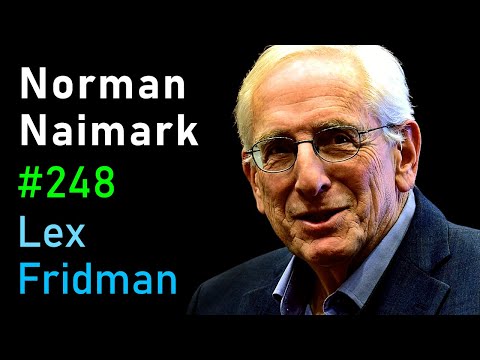
Norman Naimark: Genocide, Stalin, Hitler, Mao, and Absolute Power | Lex Fridman Podcast #248
Lex Fridman (host), Norman Naimark (guest), Lex Fridman (host), Narrator, Narrator
In this episode of Lex Fridman Podcast, featuring Lex Fridman and Norman Naimark, Norman Naimark: Genocide, Stalin, Hitler, Mao, and Absolute Power | Lex Fridman Podcast #248 explores historian dissects Stalin, genocide, and whether human nature can change Lex Fridman and historian Norman Naimark explore the psychology and power of Stalin, arguing he was both deeply competent and deeply delusional, and that his genocidal terror was a political leap, not an inevitable slope from early Bolshevism.
Historian dissects Stalin, genocide, and whether human nature can change
Lex Fridman and historian Norman Naimark explore the psychology and power of Stalin, arguing he was both deeply competent and deeply delusional, and that his genocidal terror was a political leap, not an inevitable slope from early Bolshevism.
They examine the Holodomor in Ukraine and Mao’s Great Leap Forward as manmade famines driven by ideology, paranoia, and the machinery of authoritarian power, contrasting them with communist regimes that did not become mass-murderous.
Naimark explains how genocide is defined, its limits as a legal concept, and why ordinary people so often comply with mass killing, stressing the contingency of history and the difficulty of predicting when atrocities will occur.
Throughout, Lex presses an optimistic view that technology, education, and human love can reduce future genocides, while Naimark remains skeptical but finds hope in younger generations’ values and in individuals choosing integrity in small, high‑stakes moments.
Key Takeaways
Genocide often hinges on a leap by a powerful individual, not a slow inevitability.
Naimark argues Stalin in the 1920s did not obviously appear a future mass murderer; only after consolidating power in the early 1930s did he engineer a radical “Stalin Revolution” that created a system of terror and mass killing.
Get the full analysis with uListen AI
Stalin was both ideologically committed and ruthlessly pragmatic, combining belief and paranoia.
He sincerely believed socialism was humanity’s destiny, yet operated within a paranoid delusional system, constructing vast conspiracies and annihilating groups he imagined threatened his power or the Soviet project.
Get the full analysis with uListen AI
The Holodomor was a targeted use of famine as political punishment and control.
Out of a broader collectivization-induced famine, Stalin singled out Ukraine with harsher grain requisitions, movement bans, and denial of aid to break Ukrainian peasantry and nationalism, fully aware of the mass starvation and cannibalism that followed.
Get the full analysis with uListen AI
Legal definitions of genocide are narrow and politically shaped.
The 1948 UN Genocide Convention focuses on intent to destroy national, ethnic, racial, or religious groups, excluding political and social groups under Soviet pressure, which complicates labeling cases like Indonesia’s anti-communist killings or class-based Soviet terror.
Get the full analysis with uListen AI
Ordinary people’s complicity in genocide stems more from social psychology than direct coercion.
Studies show many perpetrators could have refused to kill without severe punishment, but conformity, group loyalty, fear of ostracism, and bureaucratic obedience made participation in atrocities the default, not the exception.
Get the full analysis with uListen AI
Communist ideology can lower the value of individual life but does not mechanically produce genocide.
Naimark contrasts genocidal regimes like Stalin’s USSR, Mao’s China, and Pol Pot’s Cambodia with communist dictators such as Castro, Ho Chi Minh, or post‑Stalin Soviet leaders, whose systems were repressive but not mass-murderous on the same scale.
Get the full analysis with uListen AI
History is highly contingent, limiting our ability to predict future atrocities.
From Hitler’s improbable rise to Yugoslavia’s unexpected descent into war, Naimark emphasizes that multiple paths are always available; hindsight obscures how uncertain outcomes actually were, which complicates “we saw it coming” narratives and prediction-based prevention.
Get the full analysis with uListen AI
Notable Quotes
“He was an extremely competent man… enormously hardworking, intelligent, with an acute sense of politics… and completely indifferent to the suffering of others.”
— Norman Naimark (on Stalin)
“I don’t like the slippery slope metaphor… It’s a leap. We talk about the Stalin Revolution in ’28–’29.”
— Norman Naimark
“Ukraine turned into what Robert Conquest called a vast Belsen… bodies just lying everywhere, people dead and dying of hunger.”
— Norman Naimark
“Within all of us is the capability of being murderers and mass murderers… It’s not about weird people far away in time and place, it’s about them.”
— Norman Naimark
“To have a chance, we have to imagine that a better future is possible… Optimism is a prerequisite for engineering a better future.”
— Lex Fridman
Questions Answered in This Episode
If ordinary people often comply with atrocity without direct coercion, what concrete practices can individuals and institutions adopt now to increase the odds they will refuse in future crises?
Lex Fridman and historian Norman Naimark explore the psychology and power of Stalin, arguing he was both deeply competent and deeply delusional, and that his genocidal terror was a political leap, not an inevitable slope from early Bolshevism.
Get the full analysis with uListen AI
How far should the legal definition of genocide be expanded before it becomes too broad to be useful for prosecution and prevention?
They examine the Holodomor in Ukraine and Mao’s Great Leap Forward as manmade famines driven by ideology, paranoia, and the machinery of authoritarian power, contrasting them with communist regimes that did not become mass-murderous.
Get the full analysis with uListen AI
Given the Holodomor’s targeted features, what distinguishes a politically induced famine that qualifies as genocide from other catastrophic policy failures?
Naimark explains how genocide is defined, its limits as a legal concept, and why ordinary people so often comply with mass killing, stressing the contingency of history and the difficulty of predicting when atrocities will occur.
Get the full analysis with uListen AI
Can emerging technologies (from social media to cryptocurrencies to AI) realistically constrain authoritarian power, or will they mainly amplify whatever political forces already exist?
Throughout, Lex presses an optimistic view that technology, education, and human love can reduce future genocides, while Naimark remains skeptical but finds hope in younger generations’ values and in individuals choosing integrity in small, high‑stakes moments.
Get the full analysis with uListen AI
If history is deeply contingent and prediction is unreliable, how should policymakers design early-warning and intervention systems for mass atrocities without overreacting or causing greater harm?
Get the full analysis with uListen AI
Transcript Preview
The following is a conversation with Norman Naimark, a historian at Stanford specializing in genocide, war and empire. This is the Lex Fridman Podcast. To support it, please check out our sponsors in the description and now, here's my conversation with Norman Naimark. Did Stalin believe that communism is good, not just for him, but for the people of the Soviet Union and the people of the world?
Oh, absolutely. I mean, Stalin believed that, uh, you know, socialism was the be all and end all of, uh, you know, human existence. He was a true Leninist and in Lenin's tradition, this was, uh, you know, what he believed. I mean, that- that set of beliefs didn't, uh, exclude other kinds of things he believed or thought or did. But, uh, no, the kind- w- what had- the way he defined socialism, the way he thought about socialism, no, he absolutely thought it was in the interest of the Soviet Union and of the world. And in fact, that the world was one day going to go socialist. In other words, I think he believed in the- in eventually in the international revolution.
So given, uh, the genocide in the 1930s that you describe, was Stalin evil, delusional or incompetent?
Uh, evil, delusional or incompetent? Well, you know, evil is one of those words, you know, which has a lot of, uh, kind of religious and moral, uh, connotations. And in that sense, yes, I think he was an evil man. I mean, he, you know, eliminated people absolutely unnecessarily. He, um, tortured people, had people tortured. Uh, he was completely indifferent, uh, to, uh, the suffering of others. He couldn't have cared a whit, you know, that millions, uh, uh, were suffering. And so yes, I- I consider him a- an evil man. I mean, y- you know, historians don't like to-
Use the word evil?
... use the word evil. It's a, you know, it's a word for moral philosophers, but I think it certainly fits, uh, who he is. I think he, uh, was delusional. And there is a wonderful historian, uh, at Princeton, a political scientist actually, named Robert Tucker who said he suffered from a paranoid delusional system. And I will always remember that of- of Tucker's, uh, writing because, uh, what Tucker meant is that he was not just paranoid, meaning, you know, I'm paranoid, I'm worried you're out to get me, right?
Mm-hmm.
But that he constructed a whole, uh, plots of people, uh, whole systems of people who were out to get him. So in other words, his delusions were that there were all of these groups of people out there, um, who were out to, uh, diminish his power and remove him fr- and remove him, uh, from his position and undermine the Soviet Union in his view. So yes, I think he did suffer from, uh, from, uh, delusions. And this had a huge effect because whole groups then, uh, were destroyed, uh, by his, uh, by his activities which he would construct, uh, based on, uh, on these delusions. He was not incompetent. He was an extremely competent man. I mean, I think most of the research that's gone on especially since the, uh, Stalin archive, uh, was opened at the beginning of this century. And I think almost every historian who goes in that archive comes away from it with the feeling of a man who was enormously hardworking, intelligent, uh, you know, with an acute sense of politics, a really excellent sense of, um, you know, political, uh, rhetoric. A fantastic editor, you know, in a kind of agitational sense. I mean, he's a real agitator, right? And, um, of a, um, you know, a really hard worker. I mean, somebody who works from morning 'til night. Uh, a micromanager in some ways. So his competence, I think, was really extreme. Now there were times when that fell down. You know, times in the '30s, times in the '20s, times during the war where he made mistakes. It's not as if he didn't make any mistakes, but I think, you know, you- you look at his stuff, you know, you look at his archives, you look what he did, I mean, this is an enormously competent man who- who in many, many different a- areas of enterprise because he, you know, he had this notion that he should know everything and did know everything. I remember one, uh, archive, dyala it's called, you know, a kind of folder that I looked at where he actually went through the wines that were produced in his native Georgia and- and- and wrote down how much they should make of each of these wines, you know, how m- how many, you know, barrels they should- they should produce of these wines, which grapes were better than the other grapes. Sort of correcting-
Install uListen to search the full transcript and get AI-powered insights
Get Full TranscriptGet more from every podcast
AI summaries, searchable transcripts, and fact-checking. Free forever.
Add to Chrome