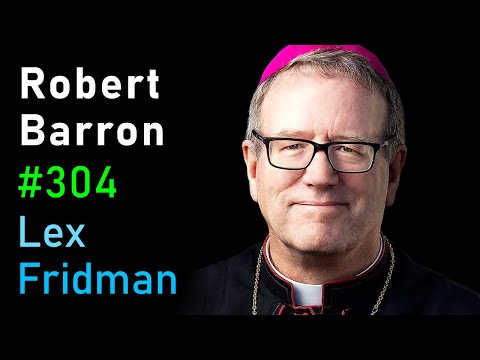
Bishop Robert Barron: Christianity and the Catholic Church | Lex Fridman Podcast #304
Bishop Robert Barron (guest), Lex Fridman (host), Narrator
In this episode of Lex Fridman Podcast, featuring Bishop Robert Barron and Lex Fridman, Bishop Robert Barron: Christianity and the Catholic Church | Lex Fridman Podcast #304 explores bishop Barron and Lex Fridman Explore God, Love, Evil, Freedom, Meaning Lex Fridman and Bishop Robert Barron discuss the philosophical and theological foundations of Christianity and Catholicism, focusing on the nature of God, the Incarnation, the Trinity, and the mission of the Church.
Bishop Barron and Lex Fridman Explore God, Love, Evil, Freedom, Meaning
Lex Fridman and Bishop Robert Barron discuss the philosophical and theological foundations of Christianity and Catholicism, focusing on the nature of God, the Incarnation, the Trinity, and the mission of the Church.
They explore sin, virtue, pride, humility, love, and freedom, connecting classical thinkers like Aquinas, Augustine, and Aristotle to modern issues such as scientism, suffering, abuse scandals, celibacy, gay relationships, abortion, and politics.
Barron repeatedly frames God as the non-competitive source of being itself, and love as willing the good of the other, arguing that Christianity offers the highest form of humanism and a coherent response to evil and meaning.
The conversation closes with practical advice for young people, reflections on death and the afterlife, and a summary of life’s purpose as friendship with God through becoming more fully conformed to divine love.
Key Takeaways
Rethink God as the source of being, not a ‘big being’.
Barron argues, following Aquinas, that God is not one entity among others but the subsistent act of ‘to be’ itself, more like an author to a story than a character within it. ...
Get the full analysis with uListen AI
Use analogical and humble language when speaking about God.
Because nothing in our experience corresponds directly to God’s mode of being, our language is always partial, metaphorical, and analogical (e. ...
Get the full analysis with uListen AI
Understand faith as ‘beyond’ reason, not beneath it.
Faith is not irrational credulity but a supra-rational trust at the horizon where reason reaches its limits. ...
Get the full analysis with uListen AI
Center Christian life on the Incarnation and divinization.
What makes Christianity distinctive, Barron says, is the claim that God became human in Jesus without destroying humanity, in order to divinize creation. ...
Get the full analysis with uListen AI
Combat pride (the ‘black hole’ sin) with humility and love.
Pride, the curving in on oneself, is the root of the other deadly sins and the image of hell as isolation and coldness. ...
Get the full analysis with uListen AI
Measure moral life by love: willing the good of the other as other.
For Barron, following Aquinas, love is an act of the will, not a feeling. ...
Get the full analysis with uListen AI
Face evil and suffering with both philosophical rigor and trust.
Barron calls the problem of evil the strongest argument against God, highlighting Job, Aquinas, and Dostoevsky as its best formulators. ...
Get the full analysis with uListen AI
Notable Quotes
“To be God is to be to be.”
— Bishop Robert Barron
“Authentic faith is the darkness beyond reason and on the far side of reason. It’s supra-rational, not infra-rational.”
— Bishop Robert Barron
“The glory of God is a human being fully alive.”
— Bishop Robert Barron (quoting St. Irenaeus)
“Pride is the in curvatus in se. I’m caved in around myself, like a black hole.”
— Bishop Robert Barron
“Find something you’re good at, because that’s from God—and then dedicate it to love.”
— Bishop Robert Barron
Questions Answered in This Episode
If God is ‘beyond being’ and not a being among beings, how should atheists and believers alike reformulate the God question to avoid category errors?
Lex Fridman and Bishop Robert Barron discuss the philosophical and theological foundations of Christianity and Catholicism, focusing on the nature of God, the Incarnation, the Trinity, and the mission of the Church.
Get the full analysis with uListen AI
How persuasive is Barron’s claim that the Incarnation makes Christianity the ‘greatest humanism imaginable,’ and how does that compare to secular humanist accounts of dignity and purpose?
They explore sin, virtue, pride, humility, love, and freedom, connecting classical thinkers like Aquinas, Augustine, and Aristotle to modern issues such as scientism, suffering, abuse scandals, celibacy, gay relationships, abortion, and politics.
Get the full analysis with uListen AI
Does framing love strictly as ‘willing the good of the other as other’ adequately capture romantic, erotic, and complex modern relationships, including same-sex love?
Barron repeatedly frames God as the non-competitive source of being itself, and love as willing the good of the other, arguing that Christianity offers the highest form of humanism and a coherent response to evil and meaning.
Get the full analysis with uListen AI
Is Barron’s response to the problem of evil—greater goods beyond our understanding and God suffering with us—emotionally and intellectually sufficient in the face of extreme atrocities?
The conversation closes with practical advice for young people, reflections on death and the afterlife, and a summary of life’s purpose as friendship with God through becoming more fully conformed to divine love.
Get the full analysis with uListen AI
To what extent can freedom be redefined from ‘sovereign self-determination’ to ordered desire for the good in a culture that prizes autonomy, and what would that practically require of our education and politics?
Get the full analysis with uListen AI
Transcript Preview
When we're beyond good and evil, you know, and all that's left is the will to power, then why are we surprised that the powerful rise and that they use the power less for their purposes? When we forget ideas like equality and rights, which are grounded in God, why are we surprised that death camps follow?
The following is a conversation with Bishop Robert Barron, founder of Word on Fire and one of the greatest educators in the world on the beauty and wisdom within Catholicism, Christianity, and religious faith in general. This is the Lex Fridman podcast. To support it, please check out our sponsors in the description. And now dear friends, here's Bishop Robert Barron. Let's start with the big question: Who is God-
(laughs)
... according to Christianity, according to Catholicism? Who's God?
I'll give you Thomas Aquinas' definition. Uh, God is ipsum esse subsistens. God is the subsistent act of to be itself. Another way to state that, in Aquinas, is God is that reality, unique, absolutely unique, in which essence and existence coincide. To be God is to be to be. Those are all ways of talking about (laughs) what we mean by God. They are kind of gnomic, and, and that's on purpose. There's almost a Zen koan kind of quality about the way we talk about God. I'm saying something that's substantive, but it's more in like a via negativa mode. It's more like what God is not, because there's nothing in the world that would correspond to those descriptions. So anything in the world would be a being of some type or an event of some type, some particular mode of existence, and God is not an entity in the world. In fact, I would say that's the fundamental mistake that atheists, old and new, make all the time, is they think of God as a big being. When Aquinas says that God is not in any genus, even the genus of being, it's one of the strangest remarks in the whole tradition, but it's really interesting. So you say, "Well, at the very least, God must be a being," right? And Aquinas' answer is, "No, he's not in the genus of being." So we talk about God being beyond being and so on. To say in God essence and existence coincide is to say God's very nature is to be, and that can't be true of any contingent thing in the world. So what I'm doing there is I'm, I'm gesturing the way the tradition does toward God using language that's at the same time philosophically precise and gnomic. (laughs) You know, it's, it's both accurate, it's true. I- in God, essence and existence coincide. What God is is the same as God's, uh, active to be. But now what does that mean? (laughs) I'm not quite sure, because nothing in our ordinary experience corresponds to that. Everything in our experience is, is a being of some type. So it's existence received according to the mode of some essence. That's not true of God, which is why he can't be found in the world. And, and that's, as I say, the fundamental mistake is, uh, oh, I guess theists are those that believe there's this being alongside the other beings in the universe. And then atheists say, "Oh no, there is no such being." Um, and that's precisely wrong. That's just a category error. Uh, Dawkins, I think, cites Bertrand Russell to the effect that proving the non-existence of God is a bit like proving the non-existence of a china teapot orbiting between Earth and Mars. You know, no, that's precisely what (laughs) God is not, some entity that's sort of hidden among the other entities of the universe. God is the reason why there's a contingent realm at all. This is a way to put it. In more theological language, God's the creator of all things.
Install uListen to search the full transcript and get AI-powered insights
Get Full TranscriptGet more from every podcast
AI summaries, searchable transcripts, and fact-checking. Free forever.
Add to Chrome