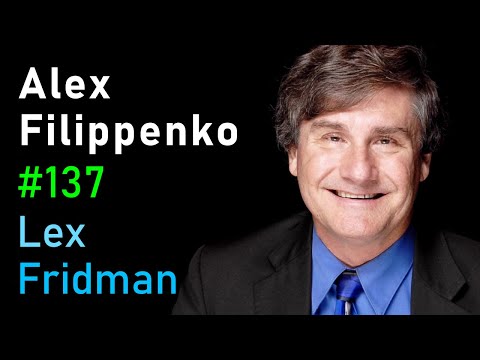
Alex Filippenko: Supernovae, Dark Energy, Aliens & the Expanding Universe | Lex Fridman Podcast #137
Lex Fridman (host), Alex Filippenko (guest)
In this episode of Lex Fridman Podcast, featuring Lex Fridman and Alex Filippenko, Alex Filippenko: Supernovae, Dark Energy, Aliens & the Expanding Universe | Lex Fridman Podcast #137 explores supernovae, dark energy, and our fragile future in a vast cosmos Lex Fridman and astrophysicist Alex Filippenko explore the fate of the universe, the discovery of cosmic acceleration, and the mystery of dark energy and dark matter. Filippenko recounts how Type Ia supernovae revealed that the universe’s expansion is speeding up, and why dark energy might be vacuum energy or an evolving field, while admitting we still lack a fundamental physical explanation. They discuss existential risks from space (asteroids, comets, solar flares, supervolcanoes), the practicality and limits of human and robotic space travel, and the likelihood and detectability of extraterrestrial intelligence. Throughout, Filippenko emphasizes scientific humility, the interplay of data and theory, and the “greatest story ever told”: that we are literal star-stuff, a universe that became conscious enough to study itself.
Supernovae, dark energy, and our fragile future in a vast cosmos
Lex Fridman and astrophysicist Alex Filippenko explore the fate of the universe, the discovery of cosmic acceleration, and the mystery of dark energy and dark matter. Filippenko recounts how Type Ia supernovae revealed that the universe’s expansion is speeding up, and why dark energy might be vacuum energy or an evolving field, while admitting we still lack a fundamental physical explanation. They discuss existential risks from space (asteroids, comets, solar flares, supervolcanoes), the practicality and limits of human and robotic space travel, and the likelihood and detectability of extraterrestrial intelligence. Throughout, Filippenko emphasizes scientific humility, the interplay of data and theory, and the “greatest story ever told”: that we are literal star-stuff, a universe that became conscious enough to study itself.
Key Takeaways
Dark energy drives an accelerating universe, but its nature remains unknown.
Observations of distant Type Ia supernovae show that cosmic expansion has been speeding up for the last ~5 billion years, implying a repulsive component dubbed dark energy, which might be constant vacuum energy or a time-varying field like ‘quintessence’—and current data are not yet precise enough to decide.
Get the full analysis with uListen AI
Type Ia supernovae are powerful cosmological tools only after careful calibration.
These explosions of white dwarfs are not truly identical; their intrinsic brightness correlates with how fast they brighten and fade. ...
Get the full analysis with uListen AI
Space hazards are real but partially manageable with foresight and monitoring.
Kilometer-scale asteroids, long-period comets, extreme solar flares, and rare nearby supernovae or gamma-ray bursts pose civilization-scale risks. ...
Get the full analysis with uListen AI
Human interstellar travel is likely infeasible; machines are more realistic explorers.
At current or plausible rocket speeds, reaching even the nearest stars would take hundreds of thousands of years, demanding impossible multi-generational habitats and energy budgets. ...
Get the full analysis with uListen AI
Intelligent life is probably rare, and our survival may require passing a ‘great filter.’
Given the age and size of the galaxy, if technological civilizations were common and long-lived, some should already have colonized or at least visibly altered the Milky Way, yet we see no clear evidence. ...
Get the full analysis with uListen AI
Most UFO evidence falls far short of scientific standards for extraordinary claims.
While Filippenko doesn’t categorically rule out alien probes, he notes that current UFO reports are mostly anecdotal, ambiguous, or explainable by mundane phenomena, and that truly extraordinary claims (like visiting spacecraft) would need robust, repeatable physical evidence—something like ‘a hunk of kryptonite’—which we do not yet have.
Get the full analysis with uListen AI
Our elements came from stars, giving a cosmic context to human meaning.
Heavy elements such as carbon, oxygen, calcium, and iron are forged in stars and supernovae, then recycled into new stars and planets, eventually enabling life and consciousness. ...
Get the full analysis with uListen AI
Notable Quotes
“Are dark energy and dark matter just our 20th and 21st century Ptolemaic epicycles?”
— Alex Filippenko
“Extraordinary claims require extraordinary evidence.”
— Alex Filippenko (quoting Carl Sagan)
“Humans are by their very nature explorers, pioneers. They want to climb the next mountain and see what’s behind it.”
— Alex Filippenko
“We are a way that the universe found of knowing, of understanding itself.”
— Alex Filippenko
“Even the simplest life is a very, very complex structure… you don’t just stumble across a watch in the Sahara and say a bunch of sand grains randomly came together.”
— Alex Filippenko
Questions Answered in This Episode
If future data show dark energy is not constant, what classes of models would be most scientifically and philosophically disruptive?
Lex Fridman and astrophysicist Alex Filippenko explore the fate of the universe, the discovery of cosmic acceleration, and the mystery of dark energy and dark matter. ...
Get the full analysis with uListen AI
How should humanity prioritize investments between planetary defense (asteroids, solar flares) and Earth-based existential risks like pandemics and climate change?
Get the full analysis with uListen AI
What ethical obligations do we have if our most realistic path to the stars is via self-replicating AI or robotic probes rather than humans?
Get the full analysis with uListen AI
If intelligent life is extremely rare and we may be alone in the Milky Way, how should that change our behavior as a civilization?
Get the full analysis with uListen AI
Where is the line between healthy scientific skepticism and closed-mindedness when evaluating phenomena like UFO reports or multiverse theories?
Get the full analysis with uListen AI
Transcript Preview
The following is a conversation with Alex Filippenko, an astrophysicist and professor of astronomy from Berkeley. He was a member of both the Supernova Cosmology Project and the High-Z Supernova Search Team, which used observations of the extragalactic supernova to discover that the universe is accelerating, and that this implies the existence of dark energy. This discovery resulted in a 2011 Nobel Prize for Physics. Outside of his groundbreaking research, he's a great science communicator and is one of the most widely admired educators in the world. I really enjoyed this conversation and I'm sure Alex will be back again in the future. Quick mention of each sponsor, followed by some thoughts related to the episode. Neuro, the maker of functional sugar-free gum and mints that I use to give my brain a quick caffeine boost. BetterHelp, an online therapy with a licensed professional. MasterClass, online courses that I enjoy from some of the most amazing humans in history. And Cash App, the app I use to send money to friends. Please check out these sponsors in the description to get a discount and to support this podcast. As a side note, let me say that as we talk about in this conversation the objects that populate the universe are both awe-inspiring and terrifying in their capacity to create and to destroy us. Solar flares and asteroids lurking in the darkness of space threaten our humble fragile existence here on Earth. In the chaos, tension, conflict, and social division of 2020, it's easy to forget just how lucky we humans are to be here. And with a bit of hard work, maybe one day we'll venture out towards the stars. If you enjoy this thing, subscribe on YouTube, review it with five stars on Apple Podcast, follow on Spotify, support on Patreon, or connect with me on Twitter @lexfridman. And now, here's my conversation with Alex Filippenko. Let's start by talking about the biggest possible thing, the universe.
Sure.
Will the universe expand forever or collapse on itself?
Well, you know, that's a great question. That's one of the big questions of cosmology. And of course, we have evidence that the matter density is sufficiently low that the universe will expand forever. But not only that, there's this weird repulsive effect, we call it dark energy for want of a better term, and it appears to be accelerating the expansion of the universe. So if that continues, the universe will expand forever, but it need not necessarily continue. It could reverse sign in which case the universe could, in principle, collapse at some point in the far, far future.
So, like, in terms of ad- investment advice, if you were to give me, and then to bet all my money on one or the other, w- where does your intuition currently lie?
Well, right now I would say that it would expand forever, because I think that the dark energy is likely to be just quantum fluctuations of the vacuum. The vacuum zero energy state is not a state of zero energy, that is, the ground state is a, a state of some elevated energy which has a repulsive effect to it. And that will never go away because it's not something that changes with time. So if the universe is accelerating now, it will forever continue to do so.
Install uListen to search the full transcript and get AI-powered insights
Get Full TranscriptGet more from every podcast
AI summaries, searchable transcripts, and fact-checking. Free forever.
Add to Chrome