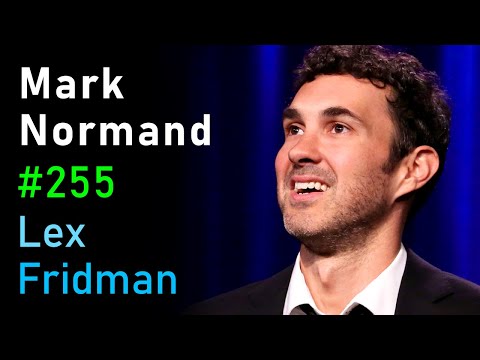
Mark Normand: Comedy! | Lex Fridman Podcast #255
Lex Fridman (host), Mark Normand (guest), Narrator, Narrator
In this episode of Lex Fridman Podcast, featuring Lex Fridman and Mark Normand, Mark Normand: Comedy! | Lex Fridman Podcast #255 explores mark Normand on Pain, Bombing, Love, and the Death Drive Lex Fridman and comedian Mark Normand dig into how childhood bullying, insecurity, and a rough New Orleans upbringing shaped Mark’s dark, rapid-fire comedy and relentless work ethic.
Mark Normand on Pain, Bombing, Love, and the Death Drive
Lex Fridman and comedian Mark Normand dig into how childhood bullying, insecurity, and a rough New Orleans upbringing shaped Mark’s dark, rapid-fire comedy and relentless work ethic.
They explore love and commitment, why marriage feels antiquated yet meaningful, the brutality and necessity of bombing in stand-up, and the changing creative soul of cities like New York and Austin.
The conversation weaves through topics like cancel culture, self-driving cars, robots, Russian literature, and Norm Macdonald, always returning to themes of hardship, self-loathing, and humor as coping mechanisms.
They close on mortality, the fear of an unlived life, the importance of working hard at what you love, and accepting that failure and pain are core ingredients of a meaningful existence.
Key Takeaways
Long-term love requires constant work, not just initial chemistry.
Normand likens relationships to maintaining a good body: everyone starts with potential, but comfort and routine quickly erode passion if you don’t actively invest, communicate, and keep things in shape.
Get the full analysis with uListen AI
Bullying and hardship can build resilience and perspective—if you survive them.
Mark’s experiences as the outnumbered white kid in a tough New Orleans neighborhood—robberies, beatings, humiliation—shaped his insecurity but also his drive, worldview, and comedic edge; Lex frames such moments as pivotal choices for growth rather than permanent victimhood.
Get the full analysis with uListen AI
Bombing is brutal but essential data for becoming a great comedian.
Normand describes bombing as existentially painful validation of your worst doubts, yet insists it’s not failure but feedback: you learn what doesn’t work, refine timing and wording, and develop the thick skin that filters out people who can’t handle the grind.
Get the full analysis with uListen AI
Simplicity and misdirection are at the heart of strong joke writing.
He breaks down jokes as simple setups leading to an unexpected but logical turn, emphasizing ruthless editing (like Ben Franklin’s hat sign story) and the mysterious “fairy dust” of why a word like “PayPal” hits funnier than alternatives.
Get the full analysis with uListen AI
Cities and scenes lose soul when money and corporatization crowd out weirdos.
Mark laments New York’s shift from gritty artistic bootcamp to chain-store corridor, notes comics fleeing to cities like Austin, and argues you still need pockets where immigrants, degenerates, geniuses, and misfits collide to keep art alive.
Get the full analysis with uListen AI
Repression and moralism increase the value and necessity of dark comedy.
With HR culture, online shaming, and constant self-censorship, comedy clubs become rare spaces where people can safely confront taboo thoughts—about sex, violence, race, or tragedy—and experience collective catharsis instead of silent guilt.
Get the full analysis with uListen AI
A meaningful life comes from working hard at what you care about and accepting pain.
Normand urges young people to delay gratification, “eat shit early,” embrace failure as learning, and build something that takes time—whether a career or a relationship—rather than chasing quick dopamine hits and comfort.
Get the full analysis with uListen AI
Notable Quotes
“Bombing fucking hurts because now everybody doesn’t do it. It’s so brutal it keeps a lot of people out of comedy.”
— Mark Normand
“It’s much like a car that gets into a wreck. The door just never closes the same.”
— Mark Normand
“New York is like a place where there’s a billionaire’s house next to a hobo… the city will fuck you in the ass, but it makes you stronger.”
— Mark Normand
“Bombing is not failure, it’s just data.”
— Mark Normand
“I think the key to happiness and satisfaction is working for something… everybody wants Amazon. ‘I got a package,’ feel good for ten seconds, then you’re back in the dumb cycle.”
— Mark Normand
Questions Answered in This Episode
How much hardship is ‘necessary’ to build character, and when does trauma simply become damaging rather than transformative?
Lex Fridman and comedian Mark Normand dig into how childhood bullying, insecurity, and a rough New Orleans upbringing shaped Mark’s dark, rapid-fire comedy and relentless work ethic.
Get the full analysis with uListen AI
In a culture increasingly hostile to offensive or edgy material, how far should comedians go in pushing boundaries, and where—if anywhere—should they draw the line?
They explore love and commitment, why marriage feels antiquated yet meaningful, the brutality and necessity of bombing in stand-up, and the changing creative soul of cities like New York and Austin.
Get the full analysis with uListen AI
If bombing is essential to becoming great at stand-up, what is the equivalent of ‘bombing’ in other careers, and how can people learn to embrace it instead of avoiding it?
The conversation weaves through topics like cancel culture, self-driving cars, robots, Russian literature, and Norm Macdonald, always returning to themes of hardship, self-loathing, and humor as coping mechanisms.
Get the full analysis with uListen AI
As cities like New York and Austin evolve under tech money and corporate influence, what concrete steps could preserve spaces for genuine weirdness and artistic risk?
They close on mortality, the fear of an unlived life, the importance of working hard at what you love, and accepting that failure and pain are core ingredients of a meaningful existence.
Get the full analysis with uListen AI
If our fear of death and insignificance drives so much creativity, would removing that fear—through technology or belief—make us more fulfilled or less motivated?
Get the full analysis with uListen AI
Transcript Preview
The following is a conversation with Marc Normand, a New York comedian who has a way with words that is often both dark and hilarious. Let that be a warning, dear friends, to proceed with caution and to wear protection. You may in fact need it. He has a special on his YouTube called Out to Lunch and a new special on Netflix as part of the Stand Up season three series I recommend you watch. This is the Lex Fridman Podcast. To support it, please check out our sponsors in the description, and now here's my conversation with Marc Normand. I asked Tim Dillon about Bukowski first, so let me continue on that tradition and ask you about something that Charles Bukowski said about love. You know-
Wait, are we rolling?
Yes. This-
Oh, geez. No hello? No nothing.
Nope.
I thought I was robotic.
(laughs) Bukowski said, "Love is a fog that burns away with the first daylight of reality." So, uh, Marc Normand, let me first ask you about love. Uh, what are your thoughts about love? You talk about your relationships quite a bit. Do you think love can last?
I do, but I think it's work. Everybody wants love to be this pre-packaged, perfect, euphoric thing, but it, you gotta... It's like a, a good body, you know? We're all born with a good body, but you gotta keep it in shape, and it's the same with a, with a loving relationship.
I think you, uh-
Nobody wants to do the work. That's the problem.
(laughs) You talked about... I think you told a story about being unfaithful to a previous girlfriend or something like that. I think the story goes that you were like drifting apart. Who were you talking to? Bert Kreischer maybe, or some-
Oh, yeah.
... somebody like that? Drif-
We were high school sweethearts. Dated for like 12 years and then...
I didn't know how to...
So that wasn't love anymore. That was more like a relation- that was like... yeah.
It was comfort. It was routine, and uh, we just slipped into that kind of married life autopilot world, and uh, I tried to break up I think, and it didn't take. It was one of those things. Our lives were just so baked in, and then I think I, uh, cheated and she caught me and it was ugly and then we went to therapy to try to work it out, but it's, it's much like a car that gets into a wreck. The door just never closes the same.
(laughs)
You know what I mean?
Yeah. So...
So...
What are your thoughts about then, um, commitment, like outside of love? Marriage?
I think it's an antiquated idea. I think it's kind of silly and unrealistic, and I think we're coming out of that as we get all polyamorous and non-binary and queefy and all this stuff. I think we're slowly moving away from that, but uh, I think a lot of the ladies more, majority of women, like marriage, like the idea of it. Like I'm in a... I'm f- I'm a fiance now or whatever you call it.
Install uListen to search the full transcript and get AI-powered insights
Get Full TranscriptGet more from every podcast
AI summaries, searchable transcripts, and fact-checking. Free forever.
Add to Chrome