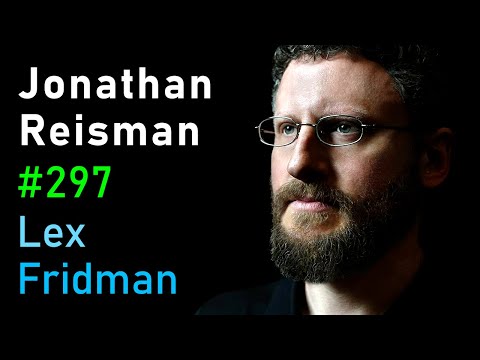
Jonathan Reisman: The Human Body - From Sex & Sperm to Hands & Heart | Lex Fridman Podcast #297
Jonathan Reisman (guest), Lex Fridman (host)
In this episode of Lex Fridman Podcast, featuring Jonathan Reisman and Lex Fridman, Jonathan Reisman: The Human Body - From Sex & Sperm to Hands & Heart | Lex Fridman Podcast #297 explores doctor Explores Human Body’s Genius, Flaws, Sex, Death, And Meaning Lex Fridman interviews physician and writer Jonathan Reisman about the human body as both a brilliantly engineered and deeply flawed system, drawing on his ER work and remote medicine in places like the Arctic, Nepal, and Antarctica.
Doctor Explores Human Body’s Genius, Flaws, Sex, Death, And Meaning
Lex Fridman interviews physician and writer Jonathan Reisman about the human body as both a brilliantly engineered and deeply flawed system, drawing on his ER work and remote medicine in places like the Arctic, Nepal, and Antarctica.
They examine specific organs and systems—the throat, hands, heart, kidneys, liver, genitals, and feces—highlighting clever evolutionary solutions, dangerous design compromises, and the taboos around our most universal bodily functions.
The conversation ranges from evolution’s focus on sex and death, to the narrative written in scars and blood, to how medicine advances through war, error, and humility, and how future technologies like artificial wombs, organ growth, and brain–computer interfaces may reshape health.
Alongside technical anatomy, they discuss travel, trauma, suicide, inequality in global health, and the philosophical questions of mortality and meaning that arise from confronting the body’s limits every day.
Key Takeaways
The body is mostly brilliantly engineered, but key design compromises are dangerous.
Reisman praises structures like the hand and kidneys yet calls the throat a near-fatal flaw: the food tube and airway run millimeters apart, so a single mis-swallow can be lethal, forcing complex compensations like gag, cough, and the ‘mucus elevator’.
Get the full analysis with uListen AI
Sex and death are the core engines of evolution—and likely of alien life too.
Millions of years of reproduction and selective mortality shape which genes persist; Reisman argues any advanced life will likely have some analogue of sex (variation) and death (selection and turnover) to stay adaptable in changing environments.
Get the full analysis with uListen AI
Our most universal bodily acts are the most socially taboo—and that matters medically.
Bathroom and bedroom functions are biologically central but culturally hidden; doctors must cut through shame to ask detailed questions about poop, pee, and sex, because these ‘gross’ details are often crucial diagnostic clues.
Get the full analysis with uListen AI
Every body tells a life story through scars, organs, and blood chemistry.
Cadaver dissection and clinical exams reveal past surgeries, injuries, habits (like smoking), and diseases; even skin scars and internal hardware let doctors reconstruct major chapters of a person’s lived experience.
Get the full analysis with uListen AI
Medical “truths” are fragile; rigorous trials often overturn intuitive treatments.
From bloodletting historically to modern stents and knee arthroscopy, many interventions that “made sense” and seemed to help later proved useless or harmful in placebo-controlled trials, underscoring the need for humility and evidence, not just logic and anecdote.
Get the full analysis with uListen AI
Remote and wartime medicine expose both human darkness and medical innovation.
ER work and war settings reveal addiction, abuse, suicide, and trauma, but they also drive advances in trauma care, transfusion strategies, pain control, and devices that later improve civilian medicine.
Get the full analysis with uListen AI
Future medicine will likely hinge on massive individualized data and bioengineering.
Reisman expects far more personalized care based on genetics and continuous monitoring, along with technologies like artificial wombs, lab-grown organs, and improved mechanical hearts—yet notes today’s doctors still work with shockingly little longitudinal data per patient.
Get the full analysis with uListen AI
Notable Quotes
“Every organ, from moment to moment, keeps us alive and ensures our survival. The genitals are, in a way, the opposite.”
— Jonathan Reisman
“Millions of years of sex and death designed the human body.”
— Jonathan Reisman (via his tweet, discussed in the podcast)
“In the ER you see humanity at its most raw… it’s the all-purpose waste bin for the dregs of society, what people do to themselves and what they do to other people.”
— Jonathan Reisman
“If you look back from far enough into the future, every doctor today will look like a total quack.”
— Jonathan Reisman (via his tweet, discussed in the podcast)
“The idea that some lives matter less is the root of all that is wrong with the world.”
— Paul Farmer (quoted by Lex Fridman at the end)
Questions Answered in This Episode
If you could redesign one dangerous human structure—like the throat or testicles—without evolutionary constraints, what exact architecture would you choose and why?
Lex Fridman interviews physician and writer Jonathan Reisman about the human body as both a brilliantly engineered and deeply flawed system, drawing on his ER work and remote medicine in places like the Arctic, Nepal, and Antarctica.
Get the full analysis with uListen AI
How far should we ethically go with technologies like artificial wombs and lab-grown organs before we’ve fundamentally changed what it means to be human?
They examine specific organs and systems—the throat, hands, heart, kidneys, liver, genitals, and feces—highlighting clever evolutionary solutions, dangerous design compromises, and the taboos around our most universal bodily functions.
Get the full analysis with uListen AI
Given how often later evidence overturns medical ‘common sense,’ how should patients and doctors decide what treatments to trust right now?
The conversation ranges from evolution’s focus on sex and death, to the narrative written in scars and blood, to how medicine advances through war, error, and humility, and how future technologies like artificial wombs, organ growth, and brain–computer interfaces may reshape health.
Get the full analysis with uListen AI
To what extent should future medicine focus on optimizing individual biology versus reshaping the social and economic conditions that drive so much illness and suicide?
Alongside technical anatomy, they discuss travel, trauma, suicide, inequality in global health, and the philosophical questions of mortality and meaning that arise from confronting the body’s limits every day.
Get the full analysis with uListen AI
Is there any non-trivial sense in which understanding the body’s mechanisms—down to sperm counts and neural spikes—actually helps us answer the question of life’s meaning, or are those two realms forever separate?
Get the full analysis with uListen AI
Transcript Preview
We have two tubes that are right next to each other in the throat. One is for food, drink, saliva, mucus, snot, whatever you're gonna swallow. All of that stuff must go down the esophagus, the food tube, and end up in the stomach. And right next to the esophagus, millimeters away, is the windpipe or the trachea, which goes down to the lungs.
Throat, heart, feces, genitals.
Every organ, from moment to moment, keeps us alive and ensures our survival. The genitals are s- in a way, the opposite.
How would you improve the penis and the vagina? The following is a conversation with Jonathan Reisman, a physician and writer of The Unseen Body: A Doctor's Journey Through the Hidden Wonders of Human Anatomy. He has practiced medicine in some of the world's most remote places, including the Alaskan and Russian Arctic, Antarctica, and the Himalayan Mountains of Nepal. This is the Lex Fridman Podcast. To support it, please check out our sponsors in the description, and now, dear friends, here's Jonathan Reisman. You wrote a book called Unseen Body, all about the human body, the messy, the weird, the beautiful, and the fascinating details. So, from an evolutionary perspective, are most parts of the human body a feature or a bug? Is it, like, the optimal solution or just a duct tape solution?
Great question. I think that most of the time, the way the body works is the best solution. Uh, I haven't seen many alternatives, so it's hard to compare. (laughs) But, um, I think, you know, there are some parts of the body that make more sense than others. You know, the way our hands work, for instance. Um, you know, the muscles are up in the forearm and then the tendons kind of come down like, uh, strings on a puppet. And just the dexterity it gives our hands is just really, uh, amazing, and it's hard to imagine a better- a better tool than the human hand to do everything from, you know, hold things, to, um, play piano, and do a million other daily activities that we do. Um, one thing I talk about in the book, there's some other body parts that seem to be lacking that kind of brilliant, um, design, such as the throat. You know, where the, uh, food, drink are swallowed and air is inhaled, and they kind of... those two paths come within millimeters of each other. And you slip up once, you laugh while eating, or you speak while trying to swallow, and you die from choking. So, it seems less than optimal. Though I'm not sure it could be better from th- the way we're kind of formed in the womb, as a... beginning as this tiny little tube. I don't think it could've been done any better or there's any other way to do it, but it is an unfortunate thing that, you know, does lead to some problems.
Install uListen to search the full transcript and get AI-powered insights
Get Full TranscriptGet more from every podcast
AI summaries, searchable transcripts, and fact-checking. Free forever.
Add to Chrome