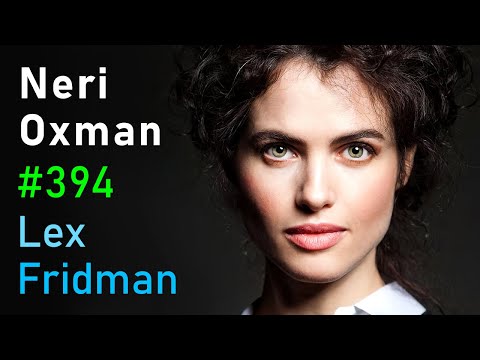
Neri Oxman: Biology, Art, and Science of Design & Engineering with Nature | Lex Fridman Podcast #394
Neri Oxman (guest), Lex Fridman (host), Lex Fridman (host)
In this episode of Lex Fridman Podcast, featuring Neri Oxman and Lex Fridman, Neri Oxman: Biology, Art, and Science of Design & Engineering with Nature | Lex Fridman Podcast #394 explores designing With Nature: Neri Oxman’s Vision of Grown, Not Made Neri Oxman discusses her lifelong project of uniting biology, computation, robotics, and materials science to create products and environments that are grown like nature rather than assembled like machines.
Designing With Nature: Neri Oxman’s Vision of Grown, Not Made
Neri Oxman discusses her lifelong project of uniting biology, computation, robotics, and materials science to create products and environments that are grown like nature rather than assembled like machines.
She introduces her new company, Oxman, which aims to give nature access to computational power—"an iPhone for nature"—so plants, microbes, and ecosystems can self-optimize, heal, and co-design with humans.
Drawing from prior work with silkworms, bees, bacteria, and biopolymers, she explains “material ecology”: designing objects, architectures, and even fragrances as part of ecological systems that reincarnate rather than simply recycle.
Throughout, she weaves in philosophy, art, music, and love—arguing that empowerment, emergence, vulnerability, and wonder are as central to design as technology itself.
Key Takeaways
Design products as parts of ecosystems, not isolated objects.
Oxman advocates ‘material ecology’: every material and product should positively participate in ecological cycles—capable of biodegrading, reincarnating into soil, and even growing new life, rather than ending in landfill.
Get the full analysis with uListen AI
Combine novelty across multiple disciplines to achieve true innovation.
Her project rule is that synthetic biology, robotics, materials science, and computational design all must contribute something genuinely new; stacking multiple forms of novelty makes radically original outcomes far more likely.
Get the full analysis with uListen AI
Use technology to empower nature, not just control it.
Instead of merely templating and steering organisms, she wants to build tools—like ‘large molecule models’ and an ‘iPhone for nature’—that let plants, microbes, and ecosystems access information and make their own optimized decisions.
Get the full analysis with uListen AI
Grow products from CO₂ in closed, regenerative loops.
One flagship effort is a fully biodegradable product that starts from CO₂ or waste carbon, is worn and used by humans, then returns to soil to grow edible plants—demonstrating a complete, circular material life cycle.
Get the full analysis with uListen AI
Exploit environmental templating to co-fabricate with organisms.
By precisely controlling conditions like heat, light, humidity, and pheromones, her teams guide silkworms, bees, and bacteria to create fibers, structures, pigments, and masks—letting biological behavior shape form and function.
Get the full analysis with uListen AI
Embrace controlled loss of control to enable emergence.
Oxman argues the future of design lies in “soft control”: building highly structured frameworks that then allow systems—whether silkworm swarms or microbial ecologies—to self-organize and surprise us.
Get the full analysis with uListen AI
Anchor high-tech design in human values: love, wonder, and meaning.
She insists that presence, gratitude, vulnerability, and a sense of wonder are not extras; they’re core to meaningful work and life, and they should inform how we shape technologies like synthetic biology and AI.
Get the full analysis with uListen AI
Notable Quotes
“If you can combine novelty in synthetic biology with a novelty in robotics, with a novelty in material science, with a novelty in computational design, you are bound to create something novel.”
— Neri Oxman
“What if nature had the bandwidth humans have? What does nature look like now if it could access the world of bits?”
— Neri Oxman
“I called this material ecology: what if all things material would be considered part of the ecology and would have a positive impact on it?”
— Neri Oxman
“To me, beauty is agency. When I solve a problem and the result is not beautiful, I know that I was wrong.”
— Neri Oxman (paraphrasing Buckminster Fuller in part)
“Don’t think of your career. A career is something that is imposed upon you. Think of your calling.”
— Neri Oxman
Questions Answered in This Episode
How realistic is Oxman’s vision of giving plants and microbes a ‘computational interface,’ and what concrete steps are needed to get there?
Neri Oxman discusses her lifelong project of uniting biology, computation, robotics, and materials science to create products and environments that are grown like nature rather than assembled like machines.
Get the full analysis with uListen AI
What ethical framework should govern the empowerment of nature with AI-level tools, especially when modifying microbes or influencing ecosystems?
She introduces her new company, Oxman, which aims to give nature access to computational power—"an iPhone for nature"—so plants, microbes, and ecosystems can self-optimize, heal, and co-design with humans.
Get the full analysis with uListen AI
Where is the line between ‘guiding’ organisms through templating and exploiting them, and how should that line differ for insects, plants, and bacteria?
Drawing from prior work with silkworms, bees, bacteria, and biopolymers, she explains “material ecology”: designing objects, architectures, and even fragrances as part of ecological systems that reincarnate rather than simply recycle.
Get the full analysis with uListen AI
Could Oxman’s concept of material ecology and grown products scale to mass manufacturing without reproducing new forms of ecological harm?
Throughout, she weaves in philosophy, art, music, and love—arguing that empowerment, emergence, vulnerability, and wonder are as central to design as technology itself.
Get the full analysis with uListen AI
How might large language models and Oxman’s proposed ‘large molecule models’ intersect to help us decode and converse with nature’s molecular languages?
Get the full analysis with uListen AI
Transcript Preview
Whenever we start a new project, it has to have these ingredients of simultaneous complexity. It has to be novel in terms of the synthetic biology, material science, robotics, engineering. All of these elements that are discipline-based or rooted must be novel. If you can combine novelty in synthetic biology with a novelty in robotics, with a novelty in material science, with a novelty in computational design, you are bound to create something novel.
The following is a conversation with Neri Oxman, an engineer, scientist, designer, architect, artist, and one of the kindest, most thoughtful and brilliant human beings I've ever gotten to know. For a long time, she led the Mediated Matter group at MIT that did research and built incredible stuff at the intersection of computational design, digital fabrication, material science and synthetic biology, doing so at all scales, from the microscale to the building scale. Now, she's continuing this work at a very new company, for now called Oxman, looking to revolutionize how humans design and build products working with nature, not against it. On a personal note, let me say that Neri has, for a long time, been a friend, and someone who, in my darker moments, has always been there with a note of kindness and support. I am forever grateful to her. She's a brilliant and a beautiful human being. Oh, and she also brought me a present, War and Peace by Tolstoy and Meditations by Marcus Aurelius. It doesn't get better than that. This is the Lex Fridman Podcast. To support it, please check out our sponsors in the description. And now, dear friends, here's Neri Oxman. Let's start with the universe. Do you ever think of the universe as a kind of machine that designs beautiful things at multiple scales?
I- I do. Um... And I think of nature in that way, in general. In the context of design specifically, I think of nature as everything that isn't anthropomass, everything that is not produced by humankind. The birds and the rocks and everything in between. Fungi, elephants, whales.
Do you think there's an intricate ways in which there's a connection between humans and nature?
Yes. And we're looking for it. I think that from... Let's say, from the beginning of mankind, uh, going back 200,000 years, the products that we have designed have separated us from nature. And it's ironic that the things that we designed and produced as humankind, those are exactly the things that separated us. Before that, we were- we were to- totally and complete- completely connected. And I want to return to that world.
But bring the tools of engineering and computation to it.
Yes. Yes. I absolutely believe that there is so much to nature that, that we still have not leveraged, and we still have not understood, and we still haven't... And so much of our work is design, but a lot of it is science, is unveiling and, um, and, and finding new truths about the natural world that we were not aware be- before. Everybody talks about intelligence these days, but I like to think that nature has a kind of wisdom that exists beyond intelligence or above intelligence, um, and it's that wisdom that we're trying to tap into through technology. If you think about humans versus nature, at least in the realm, at least in the context of definition of nature is everything but, um, anthropomass. And I'm using Ron Milo, who is an incredible professor from the Weizmann Institute, who came up with this definition of anthropomass in 2020, uh, when he identified that 2020 was the crossover year when anthropomass exceeded biomass on the planet. So all of the, uh, designed goods that we have created and brought into the world now outweigh all of the biomass, including, of course, all plastics and wearables, building cities, but also asphalt and concrete all outweigh the scale of the biomass. And actually, that was a moment. You know how in life there are moments that...
Install uListen to search the full transcript and get AI-powered insights
Get Full TranscriptGet more from every podcast
AI summaries, searchable transcripts, and fact-checking. Free forever.
Add to Chrome