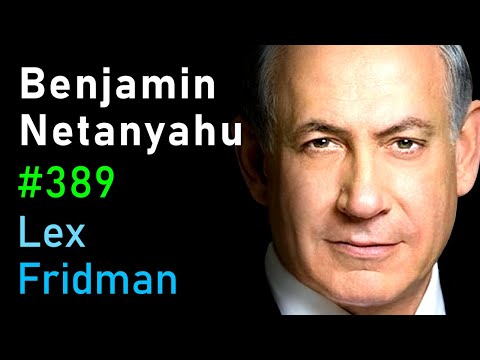
Benjamin Netanyahu: Israel, Palestine, Power, Corruption, Hate, and Peace | Lex Fridman Podcast #389
Benjamin Netanyahu (guest), Lex Fridman (host)
In this episode of Lex Fridman Podcast, featuring Benjamin Netanyahu and Lex Fridman, Benjamin Netanyahu: Israel, Palestine, Power, Corruption, Hate, and Peace | Lex Fridman Podcast #389 explores netanyahu Defends Israel’s Power, Democracy, Settlements, and AI Ambitions Lex Fridman interviews Israeli Prime Minister Benjamin Netanyahu on hate, power, Israel’s democracy, the Palestinian conflict, and emerging technologies like AI. Netanyahu rejects the notion that he is widely hated, framing Israel as a small but indispensable democracy and global benefactor. He defends his controversial judicial reforms as restoring checks and balances, dismisses corruption charges as politically motivated, and outlines his vision for Israel as a major AI and innovation hub. On peace, he blames Palestinian leadership’s refusal to recognize a Jewish state, promotes regional normalization with Arab states first, and insists Israel must retain overarching security control west of the Jordan River.
Netanyahu Defends Israel’s Power, Democracy, Settlements, and AI Ambitions
Lex Fridman interviews Israeli Prime Minister Benjamin Netanyahu on hate, power, Israel’s democracy, the Palestinian conflict, and emerging technologies like AI. Netanyahu rejects the notion that he is widely hated, framing Israel as a small but indispensable democracy and global benefactor. He defends his controversial judicial reforms as restoring checks and balances, dismisses corruption charges as politically motivated, and outlines his vision for Israel as a major AI and innovation hub. On peace, he blames Palestinian leadership’s refusal to recognize a Jewish state, promotes regional normalization with Arab states first, and insists Israel must retain overarching security control west of the Jordan River.
Key Takeaways
Netanyahu frames criticism of Israel and himself as largely rooted in ignorance and media bias.
He argues that much of the animosity comes from misinformation about Israel’s democratic character and its contributions in technology, humanitarian aid, and global rescue efforts, emphasizing that he experiences strong respect in many parts of the world, including segments of the Arab and Iranian public.
Get the full analysis with uListen AI
He presents the judicial reform as a rebalancing of power, not a slide into dictatorship.
Netanyahu claims Israel’s Supreme Court has become the most activist in the world, usurping legislative and executive roles, and says the reforms—especially after dropping a broad override clause—aim to align Israel with other democracies where elected officials have a decisive role in appointing judges.
Get the full analysis with uListen AI
Israel’s tech and AI strategy is central to Netanyahu’s vision of national strength.
He links past market reforms and defense-driven know‑how to Israel’s high GDP per capita and status as an "innovation nation," and argues that Israel must aggressively pursue AI—both for security and economic advantage—expecting it to be a leading global AI power despite open questions about job loss and regulation.
Get the full analysis with uListen AI
He equates modern anti-Zionism with antisemitism and urges early action against genocidal threats.
Drawing on Nazi Germany and Iran, Netanyahu argues that denying Jews the right to a nation-state is inherently antisemitic and that threats of annihilation must be taken literally and preempted before adversaries gain nuclear or other mass-destructive capabilities.
Get the full analysis with uListen AI
Netanyahu rejects conventional two-state frameworks, insisting Israel must control security over all territory.
He contends Palestinian leadership fundamentally seeks Israel’s replacement, not coexistence, citing Gaza and Lebanon as examples where territorial withdrawal led to terror bases, and proposes Palestinians have extensive self-governance but "none of the powers" to threaten Israel—implying limited sovereignty under Israeli security dominance.
Get the full analysis with uListen AI
Regional peace with Arab states is prioritized as a path to eventual Israeli–Palestinian compromise.
He argues that waiting on the Palestinians ("2% of the Arab world") has stalled progress for decades and that normalizing ties with Arab powers through the Abraham Accords—and potentially Saudi Arabia—can undercut Palestinian hopes that wider Arab or Islamic coalitions will one day destroy Israel, making pragmatic compromise more likely.
Get the full analysis with uListen AI
Netanyahu denies being corrupted by power and portrays the corruption cases as a systemic abuse against him.
He says key bribery charges are collapsing in court, describes intrusive investigative tactics as a threat to Israeli democracy, and insists that frequent competitive elections and hostile media prove he is constrained by, not controlling, Israel’s institutions.
Get the full analysis with uListen AI
Notable Quotes
““If somebody threatens to annihilate us, take them seriously, and act to prevent it early on.””
— Benjamin Netanyahu
““Today, antisemitism is anti-Zionism. Those who oppose the Jewish people, oppose the Jewish state.””
— Benjamin Netanyahu
““We want an independent judiciary, but not an all-powerful judiciary.””
— Benjamin Netanyahu
““The Palestinians should have all the powers to govern themselves and none of the powers to threaten Israel.””
— Benjamin Netanyahu
““You have three things you have to study… history, history, and history.””
— Benjamin Netanyahu
Questions Answered in This Episode
How credible is Netanyahu’s claim that judicial reform merely restores balance, given the fears of democratic backsliding among many Israelis and international observers?
Lex Fridman interviews Israeli Prime Minister Benjamin Netanyahu on hate, power, Israel’s democracy, the Palestinian conflict, and emerging technologies like AI. ...
Get the full analysis with uListen AI
To what extent does equating anti-Zionism with antisemitism clarify the debate, and where might it obscure legitimate criticism of Israeli policy?
Get the full analysis with uListen AI
Is Netanyahu’s model of Palestinian "self-governance without full sovereignty" sustainable long-term, or does it risk entrenching a permanent state of unequal rights?
Get the full analysis with uListen AI
Can outside-in normalization with Arab and Muslim states realistically shift Palestinian political incentives, or will it deepen their sense of isolation and resentment?
Get the full analysis with uListen AI
How should democracies regulate AI and tech monopolies when geopolitical competition makes strict regulation a potential strategic disadvantage?
Get the full analysis with uListen AI
Transcript Preview
We should never, and I never set aside and say, "Oh, they're just threatening to destroy us. Uh, they won't do it." If somebody threatens to eliminate you, as Iran is doing today, and as Hitler did then, and people discounted it. Well, if somebody threatens to annihilate us, uh, take them seriously, and act to prevent it early on. Don't let them have the means to do so, because that may be too late.
The following is a conversation with Benjamin Netanyahu, Prime Minister of Israel, currently serving his sixth term in office. He's one of the most influential, powerful, and controversial men in the world, leading a right-wing coalition government at the center of one of the most intense and long-lasting conflicts and crises in human history. As we spoke, and as I speak now, large-scale protests are breaking out all over Israel over this government's proposed judicial reform that seeks to weaken the Supreme Court in a bold accumulation of power. Given the current intense political battles in Israel, our previous intention to speak for three hours was adjusted to one hour for the time being, but we agreed to speak again for much longer in the future. I will also interview people who harshly disagree with the words spoken in this conversation. I will speak with other world leaders, with religious leaders, with historians and activists, and with people who have lived and have suffered through the pain of war, destruction, and loss, that stoke the fires of anger and hate in their heart. For this, I will travel anywhere, no matter how dangerous, if there's any chance it may help add to understanding and love in the world. I believe in the power of conversation, to do just this, to remind us of our common humanity. I know I'm under-qualified and under-skilled for these conversations, so I will often fall short, and I will certainly get attacked, derided, and slandered. But I will always turn the other cheek, and use these attacks to learn, to improve, and no matter what, never give in to cynicism. This life, this world of ours is too beautiful not to keep trying, trying to do some good in whatever way each of us know how. I love you all. This is the Lex Fridman Podcast. To support it, please check out our sponsors in the description, and now, dear friends, here's Benjamin Netanyahu. You're loved by many people here in Israel and in the world, but you're also hated by many.
Mm.
In fact, I think you may be one of the, the most hated men in the world. So if there's a young man or a young woman listening to this right now who have such hate in their heart, what can you say to them to one day turn that hate into love?
I disagree with the premise of your question. Uh, I think I have, uh, I've enjoyed a very broad support around the world. There are certain, uh, corners in which we have, uh, we have this, uh, animosity that you describe, and it sort of permeates in some of the, uh, uh, the newspapers and news organs and so on, in the, in the United States. But certainly doesn't reflect the, uh, the broad support that I have. I just gave a b- uh, uh, uh, an interview on an Iranian channel. 16 million viewers. I gave another one, I just did a, uh, a little video, uh, a few years ago, 25 million viewers, from Iran. Certainly no hate there, I have to tell you. Not from the regime. Okay? And when I go around the world, uh, and I've been around the world, uh, people want to hear what we have to say, what I have to say as a leader of Israel whom they respect increasingly as a rising power in the world. So I, uh, I disagree with that. And the most important, uh, thing that goes against what you said is the respect that we receive from the Arab world, and the fact that we've made four historic peace agreements with Arab countries. They made it with me. They didn't make it with anyone else. Uh, and I respect them and they respect me. And probably more to come. So I think the premise, uh, is wrong. That's all.
Install uListen to search the full transcript and get AI-powered insights
Get Full TranscriptGet more from every podcast
AI summaries, searchable transcripts, and fact-checking. Free forever.
Add to Chrome