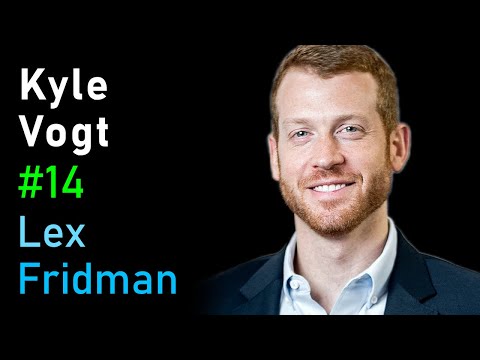
Kyle Vogt: Cruise Automation | Lex Fridman Podcast #14
Lex Fridman (host), Kyle Vogt (guest)
In this episode of Lex Fridman Podcast, featuring Lex Fridman and Kyle Vogt, Kyle Vogt: Cruise Automation | Lex Fridman Podcast #14 explores kyle Vogt on Cruise, startups, and building safe self-driving cars Kyle Vogt traces his path from Kansas robotics and BattleBots through MIT, Justin.tv/Twitch, and finally founding Cruise Automation to tackle autonomous driving. He explains how early curiosities in robotics and programming evolved into a conviction that self‑driving is the most impactful applied AI problem he could work on. A major part of the discussion covers Cruise’s evolution from retrofit highway autopilots to full driverless fleets, and how its acquisition by GM created both cultural friction and huge advantages in manufacturing and scale. Vogt also reflects on startup lessons, the grind of going from prototype to production, and his belief that large autonomous fleets at superhuman safety levels are achievable within a few years.
Kyle Vogt on Cruise, startups, and building safe self-driving cars
Kyle Vogt traces his path from Kansas robotics and BattleBots through MIT, Justin.tv/Twitch, and finally founding Cruise Automation to tackle autonomous driving. He explains how early curiosities in robotics and programming evolved into a conviction that self‑driving is the most impactful applied AI problem he could work on. A major part of the discussion covers Cruise’s evolution from retrofit highway autopilots to full driverless fleets, and how its acquisition by GM created both cultural friction and huge advantages in manufacturing and scale. Vogt also reflects on startup lessons, the grind of going from prototype to production, and his belief that large autonomous fleets at superhuman safety levels are achievable within a few years.
Key Takeaways
Anchor your startup in a problem you can obsess over for a decade.
Vogt chose self-driving only after deciding he was willing to commit 10+ years and that the problem was technically deep, societally impactful, and capable of becoming a very large business.
Get the full analysis with uListen AI
Use simple heuristics to bootstrap, then graduate to deep learning.
He describes how early autonomous driving relied on rule-based vision (e. ...
Get the full analysis with uListen AI
Retrofit autonomy sounds attractive for scale but is a liability minefield.
Cruise’s early retrofit plan ran into safety, validation, liability, and product-fragmentation issues across many car models, ultimately convincing Vogt that deep OEM integration is essential for safety-critical autonomy.
Get the full analysis with uListen AI
Marrying fast-moving software culture with safety-driven manufacturing is hard but powerful.
GM rewards process adherence, predictability, and zero downtime; Cruise rewards experimentation and risk-taking. ...
Get the full analysis with uListen AI
The main challenge is not one ‘hard problem’ but thousands of edge cases.
Cruise has long had the basic behaviors (left turns, lane changes, construction zones); the current work is systematic, continuous improvement to surpass human drivers across countless rare and nuanced scenarios.
Get the full analysis with uListen AI
Autonomous fleets must focus on uptime, longevity, and unit cost to be profitable.
Vogt emphasizes that economics hinge on vehicle build cost, lifetime miles (e. ...
Get the full analysis with uListen AI
Persistence and integrity in your team matter more than avoiding mistakes.
He credits his co-founders’ character and a refusal to quit—despite frequent emotional swings between ‘we’re unstoppable’ and ‘this might die’—as more decisive than any single strategic or technical choice.
Get the full analysis with uListen AI
Notable Quotes
““I basically made this list of requirements for a new company… it had to be hard technology, have a direct positive impact on society, and be a big business.””
— Kyle Vogt
““Self-driving cars are probably the greatest applied AI problem of our generation.””
— Kyle Vogt
““The challenge is not any one scenario… it’s thousands of little things and just grinding on that.””
— Kyle Vogt
““DARPA’s million‑dollar prize was probably one of the most effective uses of taxpayer money I’ve seen.””
— Kyle Vogt
““If you never quit, eventually you’ll end up in a good place.””
— Kyle Vogt (paraphrased and affirmed by Lex Fridman)
Questions Answered in This Episode
How can regulators and cities best support the safe rollout of large autonomous fleets without stifling innovation?
Kyle Vogt traces his path from Kansas robotics and BattleBots through MIT, Justin. ...
Get the full analysis with uListen AI
What kinds of new business models might emerge once you have reliable, superhuman-level autonomous driving available as a platform?
Get the full analysis with uListen AI
How should we handle ethical trade-offs in AV driving style—comfort vs. assertiveness—when individual rider preferences conflict with global safety goals?
Get the full analysis with uListen AI
In hindsight, what technical or strategic bets at Cruise would you change now that you’ve seen how the field has evolved since 2013?
Get the full analysis with uListen AI
What lessons from reconciling GM and Cruise cultures could be applied to modernizing other slow-moving, safety-critical industries like healthcare or aviation?
Get the full analysis with uListen AI
Transcript Preview
The following is a conversation with Kyle Vogt. He's the president and the CTO of Cruise Automation, leading an effort to solve one of the biggest robotics challenges of our time, vehicle automation. He's a co-founder of two successful companies, Twitch and Cruise, that have each sold for a billion dollars, and he's a great example of the innovative spirit that flourishes in Silicon Valley, and now is facing an interesting and exciting challenge of matching that spirit with the mass production and the safety-centric culture of a major automaker, like General Motors. This conversation is part of the MIT Artificial General Intelligence series and the Artificial Intelligence Podcast. If you enjoy it, please subscribe on YouTube, iTunes, or simply connect with me on Twitter at lexfridman, spelled F-R-I-D. And now, here's my conversation with Kyle Vogt. You grew up in Kansas, right?
Yeah. And I just saw that picture you had hidden-
Oh, boy.
... under there, so I'm a little bit- a little bit worried about that now.
Nervous.
Yeah.
So in high school, in Kansas City, you joined Shawnee Mission North High School robotics team.
Yeah.
Now, that wasn't your high school.
That's right. That was- that was, uh, the only high school in the area that had a f- like, a- a teacher who was willing to sponsor our first robotics team.
I was gonna troll you a little bit, jog your memory-
Yep.
... a little bit-
Yep.
... about that kid.
I was trying to look super cool and intense-
You did.
... 'cause, you know, this was BattleBots, this is serious business, so we're standing there with a welded steel frame and looking tough.
So go back there. What is it that drew you to robotics?
Well, I think, I- I've been trying to figure this out for a while, but I've always liked building things with LEGOs, and when I was really, really young, I wanted the- the LEGOs that had motors and other things. And then, you know, LEGO MINDSTORMS came out, and for the first time, you could program LEGO contraptions. And I think, uh, things just sort of snowballed from that. But I remember, um, seeing, you know, the BattleBots TV show on Comedy Central and thinking, "That is the coolest thing in the world. I wanna be a part of that," and, uh, not knowing a whole lot about how to build these 200-pound fighting robots. So I sort of obsessively pored over the, uh, internet forums where all the creators for BattleBots would sort of hang out and talk about, you know, document their build progress and everything. And, uh, I think I read- I must have read like, you know, tens of thousands of forum posts from- from basically everything that was out there on what these people were doing. And eventually, like, sort of triangulated how to- how to put some of these things together, and- and, uh- uh, ended up doing BattleBots, which was, you know, I was like 13 or 14, which was pretty awesome.
Install uListen to search the full transcript and get AI-powered insights
Get Full TranscriptGet more from every podcast
AI summaries, searchable transcripts, and fact-checking. Free forever.
Add to Chrome