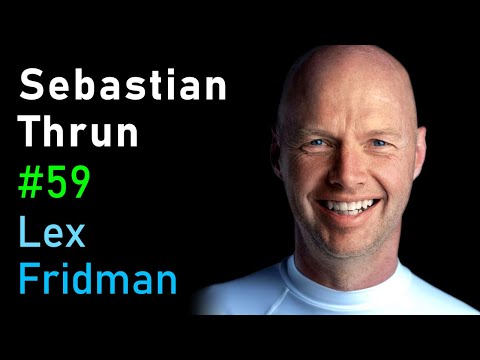
Sebastian Thrun: Flying Cars, Autonomous Vehicles, and Education | Lex Fridman Podcast #59
Lex Fridman (host), Sebastian Thrun (guest)
In this episode of Lex Fridman Podcast, featuring Lex Fridman and Sebastian Thrun, Sebastian Thrun: Flying Cars, Autonomous Vehicles, and Education | Lex Fridman Podcast #59 explores sebastian Thrun on AI, self‑driving cars, flying taxis, and education Sebastian Thrun discusses the evolution of artificial intelligence from rule-based systems to modern machine learning, emphasizing how data-driven methods now match or surpass human experts in domains like driving and medical diagnosis. He reflects on leading the DARPA Grand Challenge and Google’s self-driving car program, explaining both the technical hurdles and the importance of rigorous testing and leadership grounded in empathy. Thrun outlines his vision for electric VTOL ‘flying cars’ as a quiet, safe, autonomous layer of urban transportation that could eliminate traffic and radically speed up commutes. Finally, he talks about Udacity and his broader mission to make cutting-edge, job-relevant education and soft skills globally accessible as AI reshapes work.
Sebastian Thrun on AI, self‑driving cars, flying taxis, and education
Sebastian Thrun discusses the evolution of artificial intelligence from rule-based systems to modern machine learning, emphasizing how data-driven methods now match or surpass human experts in domains like driving and medical diagnosis. He reflects on leading the DARPA Grand Challenge and Google’s self-driving car program, explaining both the technical hurdles and the importance of rigorous testing and leadership grounded in empathy. Thrun outlines his vision for electric VTOL ‘flying cars’ as a quiet, safe, autonomous layer of urban transportation that could eliminate traffic and radically speed up commutes. Finally, he talks about Udacity and his broader mission to make cutting-edge, job-relevant education and soft skills globally accessible as AI reshapes work.
Key Takeaways
Machine learning succeeds where rules fail by capturing tacit human expertise.
Thrun argues that many expert skills (like walking or reading medical images) can’t be fully articulated as rules, but can be learned from data; modern AI systems learn directly from examples and can match or outperform experts in narrow domains.
Get the full analysis with uListen AI
System-level thinking and rigorous testing are critical for real-world robotics.
The Stanford DARPA team froze code a month before the race and built a 160‑page test regimen, systematically attacking the weakest parts of the system—an approach Thrun credits as decisive for winning in a high-stakes, complex environment.
Get the full analysis with uListen AI
Autonomous driving’s last safety percent is vastly harder than the first ninety-nine.
Getting a car to handle most scenarios is relatively quick, but eliminating rare, long-tail failures (e. ...
Get the full analysis with uListen AI
Flying electric VTOL vehicles could radically cut commute times and congestion.
Thrun’s Kitty Hawk envisions quiet, distributed-electric aircraft that are safer than helicopters and fully autonomous, exploiting the three-dimensional, mostly empty sky to make city travel up to ten times faster than cars.
Get the full analysis with uListen AI
AI will transform expert work more by augmentation than by replacement—if we adapt.
Examples like smartphone-based skin cancer detection show AI can give novice practitioners expert-level decision support on day one, but widespread job displacement risks can be mitigated by proactive reskilling through platforms like Udacity.
Get the full analysis with uListen AI
Education should be a universal, lifelong right focused on real problems.
Thrun criticizes academia’s fixation on narrow methods and papers, advocating instead for accessible, systems-focused education that solves problems people actually care about, and that is open to all geographies and ages.
Get the full analysis with uListen AI
Effective technical leadership depends on empathy, not command-and-control.
Drawing from teaching and industry, Thrun stresses empowering people, understanding their intentions, listening, and coaching them on how their actions are perceived—skills he sees as at least as important as technical excellence.
Get the full analysis with uListen AI
Notable Quotes
“To understand, you build.”
— Sebastian Thrun
“We judge ourselves by our intentions, and others by their actions.”
— Sebastian Thrun (citing a friend’s observation)
“If you celebrate your failures really well… then you realize you have no fear. And when your fear goes away, you can move the world.”
— Sebastian Thrun
“The sky is very ample and very empty and very free.”
— Sebastian Thrun
“Education ought to be a basic human right. It cannot be locked up behind ivory tower walls only for the rich people.”
— Sebastian Thrun
Questions Answered in This Episode
How should regulators balance innovation speed and public safety when deploying fully driverless vehicles and urban air mobility systems?
Sebastian Thrun discusses the evolution of artificial intelligence from rule-based systems to modern machine learning, emphasizing how data-driven methods now match or surpass human experts in domains like driving and medical diagnosis. ...
Get the full analysis with uListen AI
In practice, where is the boundary between useful, narrow AI tools and the kind of general intelligence that might challenge human roles more broadly?
Get the full analysis with uListen AI
What concrete steps can traditional universities take to focus more on problem-driven, systems-level education without losing their research depth?
Get the full analysis with uListen AI
How can we design autonomous medical tools so they empower clinicians and patients without eroding trust or over-automating life-and-death decisions?
Get the full analysis with uListen AI
What social and urban changes might follow if quiet, autonomous flying vehicles made commuting ten times faster for large segments of the population?
Get the full analysis with uListen AI
Transcript Preview
The following is a conversation with Sebastian Thrun. He's one of the greatest roboticists, computer scientists, and educators of our time. He led the development of the autonomous vehicles at Stanford that won the 2005 DARPA Grand Challenge and placed second in the 2007 DARPA Urban Challenge. He then led the Google self-driving car program which launched the self-driving car revolution. He taught the popular Stanford course on Artificial Intelligence in 2011, which was one of the first massive open online courses, or MOOCs as they're commonly called. That experience led him to co-found Udacity, an online education platform. If you haven't taken courses on it yet, I highly recommend it. Their self-driving car program, for example, is excellent. He's also the CEO of Kitty Hawk, a company working on building flying cars, or more technically, EVTOLs, which stands for electric vertical takeoff and landing aircraft. He has launched several revolutions and inspired millions of people, but also, as many know, he's just a really nice guy. It was an honor and a pleasure to talk with him. This is the Artificial Intelligence podcast. If you enjoy it, subscribe on YouTube, give it five stars on Apple Podcasts, follow it on Spotify, support it on Patreon, or simply connect with me on Twitter @lexfridman, spelled F-R-I-D-M-A-N. If you leave a review on Apple Podcasts or YouTube or Twitter, consider mentioning ideas, people, topics you find interesting. It helps guide the future of this podcast. But in general, I just love comments with kindness and thoughtfulness in them. This podcast is a side project for me, as many people know, but I still put a lot of effort into it, so the positive words of support from an amazing community, from you, really help. I recently started doing ads at the end of the introduction. I'll do one or two minutes after introducing the episode, and never any ads in the middle that can break the flow of the conversation. I hope that works for you and doesn't hurt the listening experience. I provide timestamps for the start of the conversation that you can skip to, but it helps if you listen to the ad and support this podcast by trying out the product or service being advertised. This show is presented by Cash App, the number one finance app in the App Store. I personally use Cash App to send money to friends, but you can also use it to buy, sell, and deposit Bitcoin in just seconds. Cash App also has a new investing feature. You can buy fractions of a stock, say $1 worth, no matter what the stock price is. Brokerage services are provided by Cash App Investing, a subsidiary of Square and member SIPC. I'm excited to be working with Cash App to support one of my favorite organizations called FIRST, best known for their FIRST robotics and LEGO competitions. They educate and inspire hundreds of thousands of students in over 110 countries and have a perfect rating on Charity Navigator, which means the donated money is used to maximum effectiveness. When you get Cash App from the App Store or Google Play and use code LEXPODCAST, you'll get $10 and Cash App will also donate $10 to FIRST, which, again, is an organization that I've personally seen inspire girls and boys to dream of engineering a better world. And now, here's my conversation with Sebastian Thrun. You've mentioned that The Matrix may be your favorite movie. So let's start with a crazy philosophical question. Do you think we're living in a simulation? And in general, do you find the thought experiment interesting?
Install uListen to search the full transcript and get AI-powered insights
Get Full TranscriptGet more from every podcast
AI summaries, searchable transcripts, and fact-checking. Free forever.
Add to Chrome