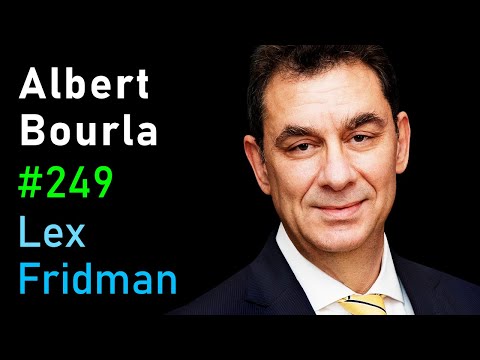
Albert Bourla: Pfizer CEO | Lex Fridman Podcast #249
Lex Fridman (host), Albert Bourla (guest)
In this episode of Lex Fridman Podcast, featuring Lex Fridman and Albert Bourla, Albert Bourla: Pfizer CEO | Lex Fridman Podcast #249 explores pfizer CEO defends vaccines, science, and trust on Lex Fridman Lex Fridman and Pfizer CEO Albert Bourla discuss the rapid development of the Pfizer-BioNTech COVID-19 vaccine, how safety and efficacy were established so quickly, and the massive financial and operational risks Pfizer took. They explore public distrust of big pharma, regulators, and government, including historical misconduct, regulatory capture concerns, and opaque bureaucratic decisions like the FDA’s slow data release. Bourla argues that science-driven innovation in the private sector saved millions of lives during the pandemic and insists regulatory processes and internal culture now strongly protect against bias and corruption. The conversation also covers vaccine mandates, childhood vaccination, Pfizer’s antiviral Paxlovid, the ivermectin controversy, media influence, and broader questions about human nature, fear, and the meaning of life.
Pfizer CEO defends vaccines, science, and trust on Lex Fridman
Lex Fridman and Pfizer CEO Albert Bourla discuss the rapid development of the Pfizer-BioNTech COVID-19 vaccine, how safety and efficacy were established so quickly, and the massive financial and operational risks Pfizer took. They explore public distrust of big pharma, regulators, and government, including historical misconduct, regulatory capture concerns, and opaque bureaucratic decisions like the FDA’s slow data release. Bourla argues that science-driven innovation in the private sector saved millions of lives during the pandemic and insists regulatory processes and internal culture now strongly protect against bias and corruption. The conversation also covers vaccine mandates, childhood vaccination, Pfizer’s antiviral Paxlovid, the ivermectin controversy, media influence, and broader questions about human nature, fear, and the meaning of life.
Key Takeaways
Speed came from financial risk and logistical scale, not skipped safety steps.
Pfizer compressed timelines by spending billions upfront, running large phase 3 trials in parallel, and massively scaling trial sites and manufacturing, while still following standard blinded, regulator-defined safety and efficacy protocols.
Get the full analysis with uListen AI
Focusing on patient impact, not profit, is presented as the core business model.
Bourla argues that if a pharma company chases money directly it will fail; sustained profit only follows from delivering genuine medical breakthroughs that significantly improve patients’ lives.
Get the full analysis with uListen AI
Regulatory systems are portrayed as robust but communication failures erode trust.
He maintains that FDA/EMA processes are transparent, conservative, and scientifically rigorous, yet both he and Lex agree that bureaucratic delays and poor, slow communication fuel suspicion and polarization.
Get the full analysis with uListen AI
Pfizer claims a strong internal compliance culture after past misconduct.
Referencing the 2009 Bextra settlement, Bourla calls early-2000s off-label promotion a serious failure but says the company overhauled processes and has had a “stellar” compliance record since, emphasizing that reputation is rebuilt slowly through daily behavior.
Get the full analysis with uListen AI
Vaccine safety is defended using unprecedented real-world scale and monitoring.
Bourla stresses that hundreds of millions of doses, global electronic medical record surveillance, and continuous signal detection give more safety data on this vaccine than any previous medical product, and he rejects claims that it is unsafe.
Get the full analysis with uListen AI
Mandates are framed as effective but politically and ethically fraught.
At Pfizer, a mandate raised vaccination from about 90% to 96%, but Bourla defers on public-policy mandates, while Lex argues that, especially in the U. ...
Get the full analysis with uListen AI
Paxlovid is positioned as a major tool to keep people out of hospitals.
The oral antiviral, taken for five days after infection, showed roughly a 90% reduction in hospitalizations and deaths in trials, which Bourla contrasts with ivermectin, saying there is no reliable evidence it works against COVID despite popular claims.
Get the full analysis with uListen AI
Notable Quotes
“Reputation is something that you can lose in buckets but you can earn it back in drops.”
— Albert Bourla
“If you focus too much on making money, you will never make. You should focus on what is the real value driver, and the real value driver is to make breakthroughs that change patients’ lives.”
— Albert Bourla
“There is no medical product in the history of humanity that has been tested as much as this vaccine.”
— Albert Bourla
“People aren’t stupid. They see if you’re not respecting them and if you’re not respecting their need to learn because that affects their health, the health of the mother or the kids.”
— Albert Bourla
“This life is short, and to me, without integrity, it is not worth living.”
— Lex Fridman
Questions Answered in This Episode
How could regulatory agencies like the FDA redesign their communication and data-release practices to build trust without sacrificing rigor or privacy?
Lex Fridman and Pfizer CEO Albert Bourla discuss the rapid development of the Pfizer-BioNTech COVID-19 vaccine, how safety and efficacy were established so quickly, and the massive financial and operational risks Pfizer took. ...
Get the full analysis with uListen AI
What independent mechanisms, if any, should exist to audit large pharmaceutical trials and marketing claims beyond current regulatory structures?
Get the full analysis with uListen AI
How should societies balance individual freedom with collective health when considering vaccine mandates, especially in liberal democracies?
Get the full analysis with uListen AI
What concrete evidence would change your mind—either in favor of or against—the safety and effectiveness of COVID vaccines or antivirals like Paxlovid?
Get the full analysis with uListen AI
Given the clear financial incentives on both sides, how can the public better distinguish between legitimate scientific criticism and profit-driven misinformation or sensationalism?
Get the full analysis with uListen AI
Transcript Preview
The following is a conversation with Albert Bourla, CEO of Pfizer. If you would like to skip ahead to our conversation, the timestamps as always are below. But if not, please allow me to say a few words about truth and human nature, specifically about two groups of people throughout history that seek to lay claim to the truth. The first group will tell you that only they possess the truth and that the government will save you, the company will save you, the science, the authorities, the experts, the institutions will save you. The second group too will tell you that only they possess the truth and that the government will hurt you, the company will hurt you, the science, the authorities, the experts, the institutions will hurt you. Both groups have the benevolent and the malevolent, their heroes and their charlatans. And I think the hard truth is that no one in this world can tell you with absolute certainty which is which. You have to use your mind. This is the burden of being human, of being free. Don't blindly follow any leader, neither the emperor nor the martyr who points out that the emperor has no clothes. And then there's the lessons of history. Vaccines have saved hundreds of millions of lives in the past century, and in general, the advance of medicine has saved billions of lives. If you ignore the power of science, you're not being honest with the lessons of history. And if you ignore the corrupting nature of power and money within institutions, including governments and companies that led to the suffering and death of hundreds of millions in the past century, you are once again not being honest with the lessons of history. I announced that I will be having this conversation with Albert Bourla, Pfizer CEO, and a lot of people wrote to me. I would like to say that I was and am and always will be listening and learning with an open mind from everyone. My own opinion, worth little as it is, is that the development of the COVID vaccines is one of the greatest accomplishments of science in recent history. For the rest, from safety and efficacy to policy and economics, I stand humbled before a complicated world full of fear and anger. A small number of malicious people from all walks of life will use that fear and anger to divide us because the division makes them money and gives them power. I took two shots of the Pfizer vaccine. This was my decision. I don't ever want to force this on anyone, and I certainly don't want to dismiss your concerns, or worse, you as a person if you choose not to get vaccinated. I can assure you one thing. In this conversation and in any conversation, the choice of questions I ask and words I say is mine and mine alone. When my words fall short, as they often do, it is only because of the limitations of my mind and of my speaking ability. It is not due to pressure or fear. I'm not afraid of anyone. I cannot be bought by anyone with money, power, or fame. I hope to prove this to you and to myself in the coming years. This life is short, and to me, without integrity, it is not worth living. People sometimes talk down to me, call me naive. Perhaps they are right, but it is who I am. I think this life, this world, this, our human civilization, is beautiful. And as Dostoevsky said, "Beauty will save the world." This is a Lex Fridman podcast, and here's my conversation with Albert Bourla. The development of the COVID-19 vaccine was one of the greatest accomplishments of science in recent history. No matter what, this should give people hope for the future, and yet it is more of a source of division. I hope we can discuss both the inspiring and the difficult ideas in this conversation so that we can do our small part in healing this division.
Install uListen to search the full transcript and get AI-powered insights
Get Full TranscriptGet more from every podcast
AI summaries, searchable transcripts, and fact-checking. Free forever.
Add to Chrome