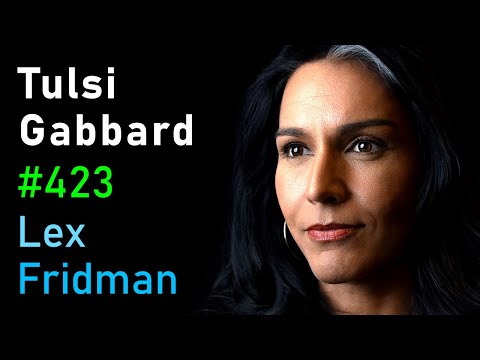
Tulsi Gabbard: War, Politics, and the Military Industrial Complex | Lex Fridman Podcast #423
Tulsi Gabbard (guest), Lex Fridman (host), Lex Fridman (host)
In this episode of Lex Fridman Podcast, featuring Tulsi Gabbard and Lex Fridman, Tulsi Gabbard: War, Politics, and the Military Industrial Complex | Lex Fridman Podcast #423 explores tulsi Gabbard warns of runaway war machine threatening American freedom Tulsi Gabbard speaks with Lex Fridman about how her combat deployments in Iraq and Kuwait opened her eyes to the human and financial costs of war and the entrenched power of the military‑industrial complex. She argues U.S. foreign policy has been captured by war profiteers, leading to regime-change disasters, strengthened terrorist groups, and rising nuclear risk, all while dissenting voices are smeared as traitors or dictator-lovers. Gabbard criticizes both parties—especially today’s Democratic leadership—for civil liberties abuses, censorship, and warmongering, and explains why she left the party to become an independent. Grounding her political positions in her Hindu faith, she calls for courageous leadership, direct diplomacy with adversaries, and a renewed commitment to constitutional freedoms and open debate.
Tulsi Gabbard warns of runaway war machine threatening American freedom
Tulsi Gabbard speaks with Lex Fridman about how her combat deployments in Iraq and Kuwait opened her eyes to the human and financial costs of war and the entrenched power of the military‑industrial complex. She argues U.S. foreign policy has been captured by war profiteers, leading to regime-change disasters, strengthened terrorist groups, and rising nuclear risk, all while dissenting voices are smeared as traitors or dictator-lovers. Gabbard criticizes both parties—especially today’s Democratic leadership—for civil liberties abuses, censorship, and warmongering, and explains why she left the party to become an independent. Grounding her political positions in her Hindu faith, she calls for courageous leadership, direct diplomacy with adversaries, and a renewed commitment to constitutional freedoms and open debate.
Key Takeaways
War’s real cost is borne by soldiers, civilians, and taxpayers, not pundits and politicians.
Gabbard describes tracking daily casualty lists in Iraq, coordinating medical evacuations, and seeing friends killed, alongside witnessing contractors charging tens of dollars per meal while foreign workers earned roughly $500 a month—shaping her opposition to unnecessary wars.
Get the full analysis with uListen AI
The military‑industrial complex operates through a revolving door and policy capture.
She outlines how senior Pentagon officials, defense contractors, members of Congress, and media form an ecosystem where people write policy, then cash out in industry, ensuring endless conflict and massive war profits over genuine national security.
Get the full analysis with uListen AI
Wars should be rare, last‑resort tools, not open‑ended crusades against abstract enemies.
Gabbard supports the narrow, post‑9/11 mission to target al‑Qaeda but condemns its expansion into regime-change projects in Iraq and Afghanistan that lacked clear objectives, strengthened groups like ISIS, and ultimately undermined U. ...
Get the full analysis with uListen AI
Diplomacy with adversaries is essential and should not be stigmatized.
Arguing that leaders must meet enemies as well as allies, she defends her trip to Syria and says presidents should be willing to sit down with figures like Putin and Zelensky to end wars, rather than allow peace talks to be thwarted by hawks or lobbyists.
Get the full analysis with uListen AI
Nuclear war is being dangerously normalized despite its civilization‑ending potential.
She warns that talk of ‘tactical’ nukes as usable tools ignores the near‑automatic escalation dynamics and past near‑misses; the president may have only minutes to decide, so voters should prioritize leaders who can resist warmongering momentum.
Get the full analysis with uListen AI
Civil liberties are eroding under the banner of national security and misinformation control.
From the PATRIOT Act and mass surveillance to the proposed TikTok/RESTRICT-style bill, she argues the executive branch is accumulating power to decide which platforms and voices are allowed, threatening free speech and incentivizing censorship via tech companies.
Get the full analysis with uListen AI
Party power structures punish dissent and prioritize control over principle.
Recounting her DNC resignation to back Bernie and the subsequent smears as a ‘Putin puppet,’ Gabbard says today’s Democratic leadership tolerates little internal debate on war or civil liberties, while some Republicans and figures like Trump are increasingly willing to challenge the establishment consensus.
Get the full analysis with uListen AI
Notable Quotes
“War is ugly and it is messy. It is also an unfortunate reality of the world we live in.”
— Tulsi Gabbard
“They’re not interested in having a substantive conversation about the truth… instead they resort to name-calling that tells voters, ‘You can’t trust this person.’”
— Tulsi Gabbard
“A nuclear war cannot be won and should never be waged. It was true then and it’s true now.”
— Tulsi Gabbard, echoing Ronald Reagan
“The only real power that has the ability to destroy them and stand up against them is a free people living in a free society.”
— Tulsi Gabbard
“I don’t live my life trying to please politicians or people who show up on TV. As long as I am doing my best to be pleasing to God, that is where I draw my happiness and strength.”
— Tulsi Gabbard
Questions Answered in This Episode
Where should the line be drawn between legitimate national security secrecy and the public’s right to know about war, surveillance, and foreign policy decisions?
Tulsi Gabbard speaks with Lex Fridman about how her combat deployments in Iraq and Kuwait opened her eyes to the human and financial costs of war and the entrenched power of the military‑industrial complex. ...
Get the full analysis with uListen AI
How can citizens practically push back against the military‑industrial complex when both parties receive defense industry funding?
Get the full analysis with uListen AI
What would a realistic, step‑by‑step diplomatic roadmap look like to end the war in Ukraine without emboldening further aggression from Russia or NATO?
Get the full analysis with uListen AI
How do we design safeguards—legal or procedural—around nuclear weapons so that one leader’s six‑minute decision window doesn’t risk human civilization?
Get the full analysis with uListen AI
In an age of disinformation and powerful tech platforms, how can societies protect free speech while still mitigating real harms like propaganda, terrorism recruitment, or incitement?
Get the full analysis with uListen AI
Transcript Preview
It's a sad state of affairs when our some of the most influential voices in our country will label someone a, uh, a lover, a supporter of dictators simply because you're saying, "Hey, we shouldn't be going to war. There is another way."
The following is a conversation with Tulsi Gabbard, who was a longtime Democrat, including being the vice chair of the Democratic National Committee. She endorsed Bernie in 2016 and Biden in 2020. She has been both loved and heavily criticized for her independent thinking and bold political stances, especially on topics of war and the military industrial complex. She served in the US military for many years, achieving the rank of lieutenant colonel. And now she's the author of a new book called For Love of Country. This is the Lex Fridman Podcast. To support it, please check out our sponsors in the description. And now, dear friends, here's Tulsi Gabbard. You've served in the US military for many years, achieving rank of lieutenant colonel. You were deployed in Iraq in 2004 and '05, Kuwait in 2008 and '09. What lessons about life and about country have you learned from that experience of war?
So many. Central to those lessons learned w- was having my eyes opened to the very real cost of war. You know, of course, I- I served in a medical unit, uh, during that first deployment to Iraq. It was 2005 during the height of that war. And, uh, unfortunately, we took a lot of casualties, we across the entire US military. Uh, my brigade that I deployed with was from the Hawaii National Guard. We had approximately 3,000 soldiers who were operating in- in four different areas of Iraq. And my first task every day was to go through a list of every injury, combat-related injury that had occurred the day before in the country. And I went through that list name by name, uh, looking to see if any one of our nearly 3,000 soldiers from Hawaii, um, had been hurt in the line of duty. And then if seeing them on the list, tracking them down, where were they, were they getting the care they needed, would they be able to get sufficient care to stay in country and- and return to duty? Did I need to get them evacuated? Usually, it would be to military hospitals that at that time were in Landstuhl and Ramstein in Germany, and then from there, getting them to either, uh, Brooke Army Medical Center, which is here in Texas that specialized in burn-related injuries or to Walter Reed, and tracking them and their care until they were finally, um, home with their families. And it never became a routine task. It never became like, "Okay, cool, check the list," you know, kind of dot the Is, cross the Ts. It- it was that daily confrontation with the reality of the cost of war. Uh, friends of mine were killed in combat. Experiencing firsthand that high human cost of war caused me, you know, 20-something-year-old from Hawaii, I had- had- I'd left my seat in the state legislature to volunteer to deploy with my brothers and sisters in- in my unit to Iraq, and so recognized the cost of war, I think, in two fundamental ways. Number one is the high human cost of war on our troops and on the people in the country where this war was being waged, and also the cost on American taxpayers. Seeing then back, again, 2005 and recognizing KBR Halliburton, one of the biggest defense contracting companies then, and I know that they are still very much in that business now, uh, Dick Cheney being connected with that company at one point or another. But in our camp specifically, which was one of the larger ones in Iraq at that time, there wasn't anything that happened in our camp that didn't have the KBR Halliburton logo imprinted on it. We had a big shack-looking place where we ate our meals. They call it a dining facility, a DFAC in the military. And they served four meals a day. They brought in, and they being KBR Halliburton, they imported workers in from places like Nepal and Sri Lanka and the Philippines to come in and cook food and work at this dining facility. Um, I got curious about how much- how much it cost us as taxpayers. And so I started asking around some of the people, and- and I think at that time, it was like, well, every time a soldier or a service member walks through the door, if I were to go in for breakfast and grab a banana and walk out, that's an automatic $35 per head, per meal, four times a day, thousands and thousands of people. And then we made friends, you know? There- there's a lot, there's a pretty large Filipino community in Hawaii, a lot of Filipino soldiers from Hawaii. We made friends with the Filipino workers who were there. They would often go in, like, the back of the tents and set up their own, like, rice cookers and cook their own meals, um, which is where the real good food was. Uh, but just started talking to them and- and getting to know them and asked like, "Hey, how much do you get paid?" And on average, it was like, "Oh, I get paid like, 500 bucks a month." Five hundred bucks a month to go and do this work of- of either, you know, cleaning out Porta-Potties, um, picking up trash, the dining facility, doing laundry, all of these different tasks because, um, the military wanted soldiers to be out doing things that only soldiers could do. Understandable. But when I started putting, you know, two and two together and knowing that this company, one company alone was making trillions of dollars, trillions of dollars, and yet this...... Filipino mom is making $500 a month, maybe getting one day off a week, maybe, working 12 hours a day otherwise. And so, how, you know, how long, how, how often are you able to go home, uh, to your family? "Well, they let, they'll let us go home a, a couple of weeks every other year." It was, it was an eye-opening experience that growing up in Hawaii, I had, I frankly hadn't given much thought to before. Um, but it's what led me ultimately f- coming back from that first deployment, there was no way that I could go back to the life that I had left behind. And I knew somehow, someway, I needed to find a way to use those experiences to try to make a positive impact, to try to influence those, I mean, frankly, the, the politicians who were making decisions to go, um, and launch these regime change wars, and, and send our men and women in uniform into war, and, and to what end ultimately?
Install uListen to search the full transcript and get AI-powered insights
Get Full TranscriptGet more from every podcast
AI summaries, searchable transcripts, and fact-checking. Free forever.
Add to Chrome