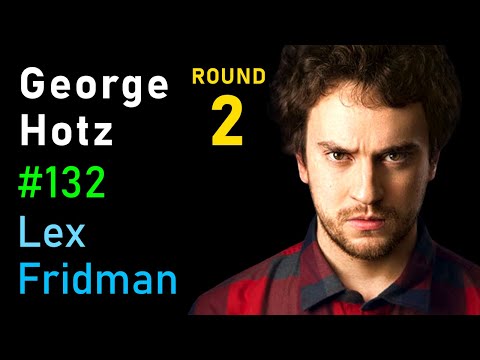
George Hotz: Hacking the Simulation & Learning to Drive with Neural Nets | Lex Fridman Podcast #132
Lex Fridman (host), George Hotz (guest), Narrator, Narrator, Narrator, Narrator
In this episode of Lex Fridman Podcast, featuring Lex Fridman and George Hotz, George Hotz: Hacking the Simulation & Learning to Drive with Neural Nets | Lex Fridman Podcast #132 explores george Hotz on AI, autonomy, and hacking reality’s deepest rule systems George Hotz and Lex Fridman range from simulation theory, alien civilizations, and conspiracy thinking to the concrete engineering of autonomous driving and cryptocurrencies.
George Hotz on AI, autonomy, and hacking reality’s deepest rule systems
George Hotz and Lex Fridman range from simulation theory, alien civilizations, and conspiracy thinking to the concrete engineering of autonomous driving and cryptocurrencies.
Hotz argues that real progress comes from building systems that work in the wild, favoring end‑to‑end machine learning and continuous deployment over large, closed, heavily engineered AV stacks.
He’s bullish on crypto’s core ideas (Nakamoto consensus, smart contracts) and harsh on current AI/compute monopolies and hype‑driven tech cultures, emphasizing that better technology and honesty win in the long run.
Throughout, he ties self‑driving, compression, and programming paradigms to a broader quest for power over nature, possible AGI, and a life mission anchored in actually shipping things rather than theorizing.
Key Takeaways
End-to-end learning is likely the long-term path to true self-driving.
Hotz argues that decomposing driving into hundreds of hand-engineered perception tasks (the “cone guy” / “rook guy” approach) will be outcompeted by end-to-end neural policies trained on massive real-world data, similar to how AlphaZero eclipsed traditional chess engines.
Get the full analysis with uListen AI
Shipping real, paid products forces honesty about progress in autonomy.
Comma. ...
Get the full analysis with uListen AI
Driver monitoring is essential and comparatively easy to do well.
Because the cost of error is lower (you’re training the human, not steering the car directly), feature‑engineered driver attention models plus adaptive policies can greatly improve safety and user behavior, and Hotz expects Tesla to adopt robust monitoring before true Level 5.
Get the full analysis with uListen AI
Data selection and feedback loops are central to scalable ML systems.
He frames the distinction between supervised and reinforcement learning as whether “weights depend on data” or “data depend on weights,” and sees future self-driving as RL on the world: ship a model, observe disengagements as negative rewards, and iterate.
Get the full analysis with uListen AI
Crypto’s real power lies in consensus algorithms and code-as-law.
Beyond speculation, Hotz highlights Nakamoto consensus for decentralized agreement and smart contracts that replace lawyers with deterministic code, envisioning far cheaper, more reliable, and fork‑friendly economic and governance systems.
Get the full analysis with uListen AI
Specialized AI hardware is strategically vital, but platforms must avoid rent-seeking.
He’s wary of dependence on NVIDIA/Google for training compute, criticizes NVIDIA’s pricing and closed strategies, and suggests that companies like Tesla could win big by selling their accelerators broadly instead of locking them inside one product line.
Get the full analysis with uListen AI
Real learning in programming (and life) comes from doing, not consuming advice.
Hotz dismisses self-help style prescriptions; his consistent view is that you learn to program, understand AI, or build companies only by attacking real problems you care about and iterating, not by passively absorbing guides or “how to” content.
Get the full analysis with uListen AI
Notable Quotes
“The technology always wins. The better technology always wins. And lying always loses.”
— George Hotz
“Do you want to be a good programmer? Do it for 20 years.”
— George Hotz
“If you were starting a chess engine company, would you hire a bishop guy?”
— George Hotz
“We’re going to do RL on the world. Every time a car makes a mistake, the user disengages, we train on that and do RL on the world.”
— George Hotz
“I don’t care about self-driving cars. It’s a cool problem to beat people at. The tools we develop will be extremely helpful to solving general intelligence.”
— George Hotz
Questions Answered in This Episode
How far can end-to-end neural networks realistically go in handling rare, long-tail driving edge cases without explicit perception modules?
George Hotz and Lex Fridman range from simulation theory, alien civilizations, and conspiracy thinking to the concrete engineering of autonomous driving and cryptocurrencies.
Get the full analysis with uListen AI
If crypto governance and forking are so powerful, what concrete non-financial systems (law, politics, corporations) should be rebuilt on smart contracts first?
Hotz argues that real progress comes from building systems that work in the wild, favoring end‑to‑end machine learning and continuous deployment over large, closed, heavily engineered AV stacks.
Get the full analysis with uListen AI
What metrics beyond disengagements should we use to compare the safety and progress of different autonomous driving approaches in the real world?
He’s bullish on crypto’s core ideas (Nakamoto consensus, smart contracts) and harsh on current AI/compute monopolies and hype‑driven tech cultures, emphasizing that better technology and honesty win in the long run.
Get the full analysis with uListen AI
How might Hotz’s compression-centric view of intelligence actually shape a roadmap toward AGI, beyond high-level philosophy?
Throughout, he ties self‑driving, compression, and programming paradigms to a broader quest for power over nature, possible AGI, and a life mission anchored in actually shipping things rather than theorizing.
Get the full analysis with uListen AI
What would a truly honest, non-hype-driven communication strategy look like for a company like Waymo or Tesla about their autonomy timelines and limitations?
Get the full analysis with uListen AI
Transcript Preview
The following is a conversation with George Hotz, AKA Geohot. His second time on the podcast. He's the founder of Comma AI, an autonomous and semi-autonomous vehicle technology company that seeks to be to Tesla autopilot what Android is to the iOS. They sell the Comma 2 device for $1,000 that, when installed in many of their supported cars, can keep the vehicle centered in the lane even when there are no lane markings. It includes driver sensing that ensures that the driver's eyes are on the road. As you may know, I'm a big fan of driver sensing. I do believe Tesla autopilot and others should definitely include it in their sensor suite. Also, I'm a fan of Android and a big fan of George for many reasons, including his nonlinear, out-of-the-box brilliance and the fact that he's a superstar programmer of a very different style than myself. Styles make fights, and styles make conversations. So I really enjoyed this chat, and I'm sure we'll talk many more times on this podcast. Quick mention of a sponsor, followed by some thoughts related to the episode. First is Four Sigmatic, the maker of delicious mushroom coffee. Second is Decoding Digital, a podcast on tech and entrepreneurship that I listen to and enjoy. And finally, ExpressVPN, the VPN I've used for many years to protect my privacy on the internet. Please check out the sponsors in the description to get a discount and to support this podcast. As a side note, let me say that my work at MIT on autonomous and semi-autonomous vehicles led me to study the human side of autonomy enough to understand that it's a beautifully complicated and interesting problem space, much richer than what can be studied in the lab. In that sense, the data that Comma AI, Tesla autopilot, and perhaps others like Cadillac super crews are collecting gives us a chance to understand how we can design safe, semi-autonomous vehicles for real human beings in real-world conditions. I think this requires bold innovation and a serious exploration of the first principles of the driving task itself. If you enjoyed this thing, subscribe on YouTube, review it with five stars on Apple Podcast, follow on Spotify, support on Patreon, or connect with me on Twitter @lexfridman. And now, here's my conversation with George Hotz. So last time I started talking about the simulation. This time, let me ask you, do you think there's intelligent life out there in the universe?
I've always maintained my answer to the Fermi paradox. I think there has been intelligent life elsewhere in the universe.
So intelligent civilizations existed, but they've blown themselves up. So your general intuition is that intelligent civilizations quickly... Like, there's that parameter in, in the Drake equation. Your sense is they don't last very long.
Yeah.
How are we doing on that? Like, ha- have we lasted pretty, pretty good?
Oh, no.
Or we do?
Oh, y- yeah. I mean, not quite yet.
Install uListen to search the full transcript and get AI-powered insights
Get Full TranscriptGet more from every podcast
AI summaries, searchable transcripts, and fact-checking. Free forever.
Add to Chrome