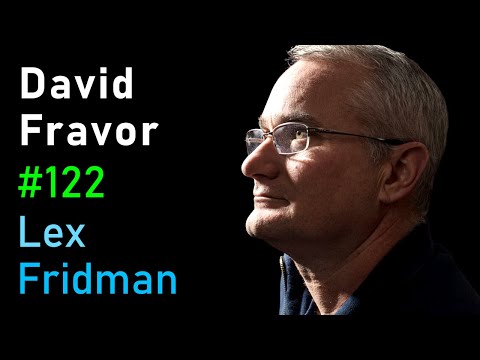
David Fravor: UFOs, Aliens, Fighter Jets, and Aerospace Engineering | Lex Fridman Podcast #122
Lex Fridman (host), David Fravor (guest), Lex Fridman (host), Narrator, Narrator
In this episode of Lex Fridman Podcast, featuring Lex Fridman and David Fravor, David Fravor: UFOs, Aliens, Fighter Jets, and Aerospace Engineering | Lex Fridman Podcast #122 explores top Gun Commander Recalls Tic Tac UFO And Future Of Flight Lex Fridman speaks with former Navy commander and Top Gun graduate David Fravor about his 2004 “Tic Tac” UFO encounter, his 18‑year fighter pilot career, and the realities of high‑performance military aviation.
Top Gun Commander Recalls Tic Tac UFO And Future Of Flight
Lex Fridman speaks with former Navy commander and Top Gun graduate David Fravor about his 2004 “Tic Tac” UFO encounter, his 18‑year fighter pilot career, and the realities of high‑performance military aviation.
Fravor gives a detailed, technical, eyewitness account of the Tic Tac incident, explaining why he believes the object was a real, intelligently controlled craft with capabilities far beyond known human technology.
They discuss how fighter pilots think and train, the limits of current AI and automation in combat aviation, and why paradigm‑shifting technologies are often mishandled or ignored by institutions.
The conversation broadens into space exploration, Elon Musk and SpaceX, secrecy versus openness in breakthrough technologies, and personal reflections on mortality, purpose, and following difficult dreams.
Key Takeaways
Expert eyewitness accounts deserve technical, not dismissive, scrutiny.
Fravor and three other highly trained aviators watched and maneuvered against the Tic Tac for several minutes in perfect visibility; he argues their combined experience, instrumentation, and consistent recollections make simple misidentification or hallucination extremely unlikely.
Get the full analysis with uListen AI
The Tic Tac’s observed performance implies a radical propulsion breakthrough.
The object showed instantaneous acceleration, lack of control surfaces or exhaust, ability to hover in high winds, and rapid transitions from sea level to over 80,000 feet—behaviors Fravor says no known aircraft, black project, or missile can match within current physics and engineering constraints.
Get the full analysis with uListen AI
Advanced human‑made tech is unlikely to be hidden at this scale for decades.
Fravor notes that step‑change capabilities (like the SR‑71 or stealth) still left traces in academia, industry, and test ranges; a technology as far beyond current systems as the Tic Tac would almost certainly have leaked via research, budgets, or operational testing over the 16+ years since.
Get the full analysis with uListen AI
Current AI and automation can’t replace human judgment at the edge of the envelope.
He explains that fighter pilots constantly make 80% “good‑enough” decisions in fractions of a second, sometimes intentionally departing the aircraft from controlled flight or operating in gray areas no deterministic control law or conservative AI would choose.
Get the full analysis with uListen AI
Institutional incentives discourage serious UFO/UAP inquiry, even when safety is involved.
Pilots fear stigma, leadership is busy with immediate operational priorities, and the military–media relationship is fraught; near‑midair events with strange objects have generated hazard reports and NOTAMs, but little apparent high‑level, sustained investigation.
Get the full analysis with uListen AI
Private capital could drive open, global research into breakthrough propulsion.
Fravor suggests that mega‑philanthropists and companies (Bezos, Musk, Gates, etc. ...
Get the full analysis with uListen AI
On a human level, character and relationships matter more than status or money.
Drawing on stories of his grandfather, fallen friends, and his own career, Fravor emphasizes kindness, perseverance against doubters, and being present for family and close friends as the enduring “meaning” beneath high‑performance achievements and brushes with the unknown.
Get the full analysis with uListen AI
Notable Quotes
“If you took a Chinese or Russian flag and painted it on the side of that thing, it would’ve gone high order overnight.”
— David Fravor
“We watched this thing on a crystal clear day with four trained observers. This wasn’t ‘I saw a light in the sky and it was gone.’”
— David Fravor
“There are things a human will do in an airplane that AI won’t. Most AI is logical. Combat often lives in the illogical gray.”
— David Fravor
“You can be anything you want to be. Just don’t let anyone tell you what you can or can’t do.”
— David Fravor
“Somewhere, something incredible is waiting to be known.”
— Carl Sagan (quoted by Lex Fridman at the end)
Questions Answered in This Episode
If the Tic Tac was not human technology, what does that imply about the timeline and nature of other civilizations in our galaxy?
Lex Fridman speaks with former Navy commander and Top Gun graduate David Fravor about his 2004 “Tic Tac” UFO encounter, his 18‑year fighter pilot career, and the realities of high‑performance military aviation.
Get the full analysis with uListen AI
How could the scientific community design a rigorous, stigma‑free program to collect and analyze future UAP incidents in real time?
Fravor gives a detailed, technical, eyewitness account of the Tic Tac incident, explaining why he believes the object was a real, intelligently controlled craft with capabilities far beyond known human technology.
Get the full analysis with uListen AI
What specific propulsion or field‑generation concepts are most consistent with the maneuvers Fravor describes, and how could they be experimentally explored?
They discuss how fighter pilots think and train, the limits of current AI and automation in combat aviation, and why paradigm‑shifting technologies are often mishandled or ignored by institutions.
Get the full analysis with uListen AI
Where is the right balance between necessary national security secrecy and the global benefits of openly sharing potentially revolutionary technologies?
The conversation broadens into space exploration, Elon Musk and SpaceX, secrecy versus openness in breakthrough technologies, and personal reflections on mortality, purpose, and following difficult dreams.
Get the full analysis with uListen AI
On a personal level, how should an individual reorient their life goals if they become convinced that we are being observed by a more advanced intelligence?
Get the full analysis with uListen AI
Transcript Preview
The following is a conversation with Commander David Fravor, who was a Navy pilot for 18 years and commander of the Strike Fighter Squadron 41, also known as the Black Aces, a squadron of 12 airplanes consisting of several hundred people. He's also famously one of the people who, with his own eyes, saw and chased a UFO, an unidentified flying object, in 2004 that is referred to as the Tic Tac and the incident more formally referred to as the USS Nimitz UFO incident. His story, corroborated by several other pilots, from my perspective as a curious scientist and an open-minded human being, is the most credible sighting of a UFO in history, at least that I'm aware of. He's a humble, fascinating, and fun human being to talk to. I put out a call for questions on Reddit and many other places and tried to ask as many of the questions that people posted as I could. And overall, I really enjoyed this conversation, and I'm sure if the world wants us to and if there's more questions to be had, we'll talk on this podcast again. Quick summary of the sponsors: Athletic Greens, ExpressVPN, and BetterHelp. Please check out the sponsors in the description to get a discount and to support this podcast. As a side note, let me say that the world of UFOs and UAPs, unidentified aerial phenomena, and aliens in general is foreign (laughs) to me because of the high ratio of outlandish conspiracy theorists to actual hard evidence. I'm a scientist first and foremost but an open-minded one, often looking and thinking outside the box. I'm often disheartened by the closed-mindedness of the scientific community and, in equal part, I'm disheartened by the lack of rigor and basic scientific inquiry and study on the part of the conspiracy theorists. I believe there's a line somewhere between the two extremes that more inquisitive minds should walk. I think we humans know very little about our world, what's up there among the stars, and the nature of reality and the nature of our very own minds. The path to understanding can only be walked humbly. The very idea that there's a possibility that David witnessed a piece of technology, whether human-made or alien-made, that moved in the way it did should be inspiring to every scientist and engineer on this earth. There may be propulsion and energy systems yet to be discovered that, once understood and mastered, will put distant galaxies within reach of us human beings. Paradigm shifts in science and leaps in understanding can only happen, I think, if we open our eyes and allow ourselves to dream, to think from first principles, and remove the constraints on innovation placed on us by the scientific conventions and assumptions of prior generations. If you enjoy this thing, subscribe on YouTube, review it with five stars on Apple Podcasts, follow on Spotify, support on Patreon, or connect with me on Twitter @lexfridman. As usual, I'll do a few minutes of ads now and no ads in the middle. More and more, I'm trying to make these ad reads unique and interesting and less adsy, more personal, but I give you timestamps so you can skip. But still please do check out the sponsors by clicking the links in the description. It is honestly the best way to support this podcast. This show is brought to you by Athletic Greens, the all-in-one daily drink to support health and performance. I drink it every day to make sure I'm not missing any of the nutrition I need. Now, let me take a hard left turn and talk about fasting. I fast often, sometimes intermittent fasting of 16 hours and then an eight-hour eating period of two meals, sometimes 24 hours, that's one dinner to the next. I've been even considering doing a 48 or 72-hour fast that some people I look up to have done. People who have done it tell me that outside of weight loss and the different health benefits, it's a chance to meditate on the finiteness of life. Not eating somehow is a reminder that we're mortal, that every day is precious. I certainly experienced this with the 24-hour fast, and I think it goes even deeper for the 48, 72, and even week-long fasts. Anyway, I always break my fast with Athletic Greens. It's delicious, refreshing, just makes me feel good. So go to athleticgreens.com/lex to claim a special offer of free vitamin D for a year. Again, go to, uh, athleticgreens.com/lex to get free stuff and to support this podcast. This show is also sponsored by ExpressVPN. Get it at expressvpn.com/lexpod to get a discount. You probably know there's a show called The Office that I fell in love with, first with the British version with Ricky Gervais and then the American version with Steve Carell. ExpressVPN lets you pretend your location is somewhere else, choosing from nearly 100 different countries and then watch one of the nine totally different other versions of The Office in other countries. Also, it protects you when you do shady things on the internet that you shouldn't be doing, like checking the website of this very podcast that, for some reason, was not available in Russia for a long time. I'm not sure if it still is. But if it isn't, you can use ExpressVPN to access it. I think of ExpressVPN like a pirate ship and regular VPN-free life as a boring cruise from one place to another with no excitement in between. Choose wisely, my friends. Again, get it on any device at expressvpn.com/lexpod to get an extra three months free and to support this podcast. This show is sponsored by BetterHelp, spelled H-E-L-P, help, like you would try to spell if you were on a deserted island and trying to get an airplane to notice you.Check it out at betterhelp.com/lex. They figure out what you need and match you with a licensed professional therapist in under 48 hours. You can communicate by text anytime and schedule weekly audio and video sessions. Now, hard left turn, let me talk about desert islands. Whatever you think of it, I love the movie Cast Away with Tom Hanks and the idea of spending time on an island alone with potentially no hope. The natural question is, if I could, what would I bring to this island? The answer's complicated, but let me pick one thing, the first thing (laughs) that popped into my crazy mind, which is the Introduction to Algorithms book, also called CLRS for the first letters of the last name of its four authors. I find algorithms beautiful, like a little toolbox for a simple world inside computers when the real world outside is an impossible, chaotic mess. I would love pondering the puzzles in that book for months, far away from human civilization. Anyway, check out BetterHelp at betterhelp.com/lex to get a discount and to support this podcast. And now, finally, here's my conversation with David Fravor. You're a graduate of the Navy Fighter Weapons School.
Install uListen to search the full transcript and get AI-powered insights
Get Full TranscriptGet more from every podcast
AI summaries, searchable transcripts, and fact-checking. Free forever.
Add to Chrome