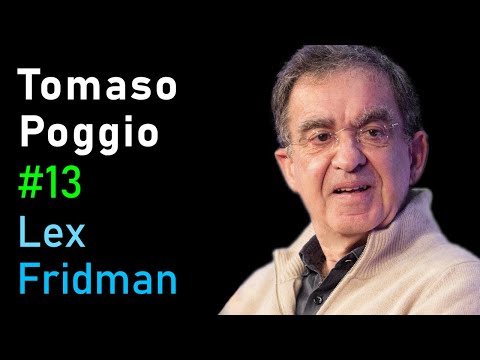
Tomaso Poggio: Brains, Minds, and Machines | Lex Fridman Podcast #13
Lex Fridman (host), Tomaso Poggio (guest), Narrator
In this episode of Lex Fridman Podcast, featuring Lex Fridman and Tomaso Poggio, Tomaso Poggio: Brains, Minds, and Machines | Lex Fridman Podcast #13 explores tomaso Poggio on Intelligence, Brains, and the Limits of AI Lex Fridman and Tomaso Poggio explore the nature of intelligence by connecting modern AI to neuroscience, evolution, and human cognition. Poggio argues that understanding the brain—especially the visual cortex and cortical architecture—is likely essential for the biggest future breakthroughs in AI, even though current deep learning only loosely mimics biology. They discuss compositionality, overparameterized deep networks, and why today’s systems still lack true scene understanding, common sense, and human-like sample efficiency. The conversation ranges into ethics, consciousness, AGI timelines, and what it takes to do great science, emphasizing curiosity, fun, and collaboration.
Tomaso Poggio on Intelligence, Brains, and the Limits of AI
Lex Fridman and Tomaso Poggio explore the nature of intelligence by connecting modern AI to neuroscience, evolution, and human cognition. Poggio argues that understanding the brain—especially the visual cortex and cortical architecture—is likely essential for the biggest future breakthroughs in AI, even though current deep learning only loosely mimics biology. They discuss compositionality, overparameterized deep networks, and why today’s systems still lack true scene understanding, common sense, and human-like sample efficiency. The conversation ranges into ethics, consciousness, AGI timelines, and what it takes to do great science, emphasizing curiosity, fun, and collaboration.
Key Takeaways
Biology has strongly shaped modern AI, and will likely drive key future breakthroughs.
Poggio points out that central techniques like deep learning and reinforcement learning were inspired by neuroscience and behavioral science (Hubel & Wiesel, Pavlov, Minsky). ...
Get the full analysis with uListen AI
Deep networks gain power from compositional structure in the world and in our brains.
When problems can be decomposed into hierarchies of simpler sub-problems (vision, language), deep architectures can avoid the curse of dimensionality that plagues shallow models. ...
Get the full analysis with uListen AI
Overparameterization makes neural networks easier to optimize than classical intuition suggests.
Modern deep nets often have far more parameters than data points, yet train successfully. ...
Get the full analysis with uListen AI
Human learning is built on weak evolutionary priors and powerful bootstrapping, not millions of labels.
Where current AI needs vast labeled datasets, children learn from very few explicit labels. ...
Get the full analysis with uListen AI
The cortex may implement a general learning architecture reused across vision, language, and action.
Despite distinct functions (vision, audition, language), cortical regions share remarkably similar microcircuitry. ...
Get the full analysis with uListen AI
Current AI excels at low‑level perception but is far from genuine understanding.
While vision and speech systems (e. ...
Get the full analysis with uListen AI
Ethics and possibly aspects of consciousness appear to be neuroscientifically grounded and learnable.
Citing fMRI and brain stimulation work (e. ...
Get the full analysis with uListen AI
Notable Quotes
“What about solving a problem whose solution allowed me to solve all the problems?”
— Tomaso Poggio
“I think the problem of human intelligence is, for me, the most interesting problem—it’s really asking who we are.”
— Tomaso Poggio
“The biological world is more n going to one. A child can learn from a very small number of labeled examples.”
— Tomaso Poggio
“There are probably more minima for a typical deep network than atoms in the universe.”
— Tomaso Poggio
“In the brain, the algorithms and the circuits are much more intertwined. That’s why the problem is more difficult than for computers.”
— Tomaso Poggio
Questions Answered in This Episode
If deep architectures are so tightly coupled to compositional structure, how should we design AI systems for domains that appear non‑compositional or entangled?
Lex Fridman and Tomaso Poggio explore the nature of intelligence by connecting modern AI to neuroscience, evolution, and human cognition. ...
Get the full analysis with uListen AI
What concrete biological learning mechanisms might plausibly replace or augment stochastic gradient descent in future neural network designs?
Get the full analysis with uListen AI
How could we systematically encode the kind of weak evolutionary priors and bootstrapping strategies that children use into artificial learning systems?
Get the full analysis with uListen AI
In practice, what would it mean to build AI that truly understands a scene, rather than just labeling objects within it?
Get the full analysis with uListen AI
How might a detailed neuroscience of ethics translate into engineering principles for safe and trustworthy AI behavior?
Get the full analysis with uListen AI
Transcript Preview
The following is a conversation with Tomaso Poggio. He's a professor at MIT, and is a director of the Center for Brains, Minds, and Machines. Cited over 100,000 times, his work has had a profound impact on our understanding of the nature of intelligence in both biological and artificial neural networks. He has been an advisor to many highly impactful researchers and entrepreneurs in AI, including Demis Hassabis of DeepMind, Amnon Shashua of Mobileye, and Christof Koch of the Allen Institute for Brain Science. This conversation is part of the MIT course on artificial general intelligence, and the Artificial Intelligence Podcast. If you enjoy it, subscribe on YouTube, iTunes, or simply connect with me on Twitter, @LexFridman, spelled F-R-I-D. And now, here's my conversation with Tomaso Poggio. You've mentioned that in your childhood, you've developed a fascination with physics, especially the theory of relativity, and that Einstein was also a childhood hero to you. What aspect of Einstein's genius, the nature of his genius, do you think was essential for discovering the theory of relativity?
You know, Einstein was, uh, a hero to me, and I'm sure to many people, because he was able to make, uh, uh, of course, a major, major contribution to physics with, simplifying a bit, just a gedanken experiment, a thought experiment.
Mm-hmm.
You know, imagining, uh, communication with lights between a stationary observer and somebody on a train.
Mm-hmm.
And, uh, I thought that, um, you know, the, the, the, the fact that just with the force of y- of his thought, of his thinking, of his mind, it could get to some- something so deep in term of physical reality, how time depend on space and speed, is, was something absolutely fascinating. It was the power of intelligence, the power of the mind.
Do you think the ability to imagine, to visualize as he did, as a lot of great physicists do, do you think that's in all of us human beings? Or is there something special to that one particular human being?
I think, uh, you know, a- all of us can learn and have, uh, in principle similar b- breakthroughs. Uh, there is lesson to be learned from Einstein. Uh, he was one of five PhD students at ETH, uh, the Eidgenössische Technische Hochschule in, uh, Zurich, in physics, and he was the worst of the five. The only one who d- did not get an academic position when, uh, he, he graduated, when he finished his PhD, and he went to work, as everybody knows, for the patent office. And so it's not so much that he worked for the patent office, but the fact that obviously he was smart, but he was not a top student. O- obviously, he was the anticonformist, he was not thinking in the traditional way that probably his teachers and the other students were doing. So there is a lot to be said about, uh, you know, trying to be... to do the opposite or something quite different from what other people are doing. That's certainly true for the stock market. Never...
Install uListen to search the full transcript and get AI-powered insights
Get Full TranscriptGet more from every podcast
AI summaries, searchable transcripts, and fact-checking. Free forever.
Add to Chrome