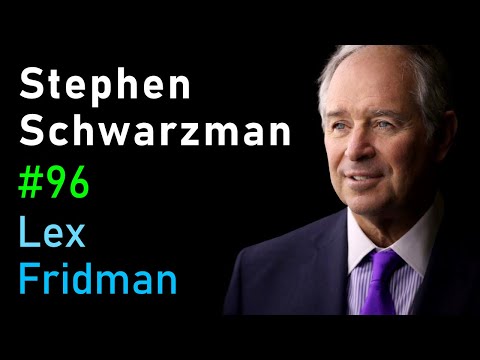
Stephen Schwarzman: Going Big in Business, Investing, and AI | Lex Fridman Podcast #96
Lex Fridman (host), Stephen Schwarzman (guest), Lex Fridman (host)
In this episode of Lex Fridman Podcast, featuring Lex Fridman and Stephen Schwarzman, Stephen Schwarzman: Going Big in Business, Investing, and AI | Lex Fridman Podcast #96 explores stephen Schwarzman on Going Big, Pattern Recognition, and AI’s Future Stephen Schwarzman discusses his philosophy of ‘going big’ in business and life, arguing that large, consequential opportunities create a virtuous cycle of talent, resources, and impact. He explains how pattern recognition, intense listening, and solving other people’s biggest problems underpin his investing, negotiation, and leadership style. The conversation explores his approach to philanthropy, especially his role in launching MIT’s College of Computing, and his concerns about AI ethics, U.S.–China technological competition, and the social consequences of the internet. He also offers candid advice on entrepreneurship, humility, relationships, and sustaining personal values and family life while pursuing ambitious goals.
Stephen Schwarzman on Going Big, Pattern Recognition, and AI’s Future
Stephen Schwarzman discusses his philosophy of ‘going big’ in business and life, arguing that large, consequential opportunities create a virtuous cycle of talent, resources, and impact. He explains how pattern recognition, intense listening, and solving other people’s biggest problems underpin his investing, negotiation, and leadership style. The conversation explores his approach to philanthropy, especially his role in launching MIT’s College of Computing, and his concerns about AI ethics, U.S.–China technological competition, and the social consequences of the internet. He also offers candid advice on entrepreneurship, humility, relationships, and sustaining personal values and family life while pursuing ambitious goals.
Key Takeaways
Target large, consequential opportunities rather than small ones.
Schwarzman argues it’s just as hard to build a small business as a big one, but big opportunities provide more room to pivot if you’re partly wrong and generate enough value to attract top talent and resources.
Get the full analysis with uListen AI
Use pattern recognition to spot ‘lint on the dress’ anomalies.
He focuses on small facts that don’t fit the usual pattern; investigating one or two such ‘discordant notes’ often reveals important shifts or untapped opportunities others ignore.
Get the full analysis with uListen AI
Listen intensely to uncover what people really want and fear.
By observing tone, facial expression, posture, and inconsistencies between words and intent, you can infer people’s true priorities and design solutions they haven’t articulated yet.
Get the full analysis with uListen AI
Create value by solving others’ biggest unresolved problem.
Before meeting someone, he mentally steps into their role, identifies their top unresolved issue, and prepares fresh solution ideas; this service-oriented approach builds trust and long-term influence.
Get the full analysis with uListen AI
Treat philanthropy like building a new business, not writing checks.
He looks for under-addressed, society-wide issues (like AI leadership and ethics), designs new institutions or initiatives around them, mobilizes people and capital, and only then funds the vision.
Get the full analysis with uListen AI
AI progress must be paired with serious ethics and governance work.
After seeing the unintended harms of the internet and social media, he believes repeating that with AI would be “unforgivable” and advocates for universities like MIT to convene researchers, companies, governments, and media around AI ethics.
Get the full analysis with uListen AI
Entrepreneurship is a team sport and emotionally rough; don’t go alone.
Founders should expect constant new problems, frequent setbacks, and psychological strain, and therefore need co-founders, mentors, or peers for both practical guidance and emotional support, while also intentionally protecting their family and love life.
Get the full analysis with uListen AI
Notable Quotes
“If you're gonna do something, do something very consequential.”
— Stephen Schwarzman
“I always see the lint, and I'm fascinated by how did something get someplace it's not supposed to be.”
— Stephen Schwarzman
“Most people give themselves away, no matter how clever they think they are.”
— Stephen Schwarzman
“Using AI to make this kind of mistake twice is unforgivable.”
— Stephen Schwarzman
“People don’t become successful as part-time workers. It doesn’t work that way.”
— Stephen Schwarzman
Questions Answered in This Episode
How can an individual practically train their own ‘pattern recognition’ to notice the small anomalies that signal big opportunities?
Stephen Schwarzman discusses his philosophy of ‘going big’ in business and life, arguing that large, consequential opportunities create a virtuous cycle of talent, resources, and impact. ...
Get the full analysis with uListen AI
What concrete structures or institutions are needed to ensure AI ethics keeps pace with AI capabilities globally?
Get the full analysis with uListen AI
Given China’s plan to teach computer science to every child, what specific policy shifts should the U.S. make to stay competitive in AI and tech?
Get the full analysis with uListen AI
How can entrepreneurs distinguish between healthy, self-critical reflection and destructive self-doubt during inevitable periods of failure?
Get the full analysis with uListen AI
In a highly polarized environment, what realistic steps can business and academic leaders take to restore norms of open discourse and courage in public life?
Get the full analysis with uListen AI
Transcript Preview
The following is a conversation with Stephen Schwarzman, CEO and co-founder of Blackstone, one of the world's leading investment firms, with over $530 billion of assets under management. He's one of the most successful business leaders in history. I recommend his recent book called What It Takes that tells stories and lessons from his personal journey. Stephen is a philanthropist and one of the wealthiest people in the world, recently signing The Giving Pledge, thereby committing to give the majority of his wealth to philanthropic causes. As an example, in 2018, he donated $350 million to MIT to help establish its new College of Computing, the mission of which promotes interdisciplinary big, bold research in artificial intelligence. For those of you who know me know that MIT is near and dear to my heart and always will be. It was and is a place where I believe big, bold, revolutionary ideas have a home, and that is what is needed in artificial intelligence research in the coming decades. Yes, there's institutional challenges, but also there's power in the passion of individual researchers, from undergrad to PhD, from young scientist to senior faculty. I believe the dream to build intelligence systems burns brighter than ever in the halls of MIT. This conversation was recorded recently but before the outbreak of the pandemic. For everyone feeling the burden of this crisis, I'm sending love your way. Stay strong. We're in this together. This is the Artificial Intelligence podcast. If you enjoy it, subscribe on YouTube, review it with five stars on Apple Podcasts, support it on Patreon, or simply connect with me on Twitter @LexFridman, spelled F-R-I-D-M-A-N. As usual, I'll do a few minutes of ads now and never any ads in the middle that can break the flow of the conversation. I hope that works for you and doesn't hurt the listening experience. Quick summary of the ads. Two sponsors: Masterclass and ExpressVPN. Please consider supporting the podcast by signing up to Masterclass at masterclass.com/lex and getting ExpressVPN at expressvpn.com/lexpod. This show is sponsored by Masterclass. Sign up at masterclass.com/lex to get a discount and support this podcast. When I first heard about Masterclass, I thought it was too good to be true. For $180 a year, you get an all-access pass to watch courses from, to list some of my favorites, Chris Hadfield on space exploration; Neil deGrasse Tyson on scientific thinking and communication; Will Wright, creator of SimCity and Sims, on game design; Carlos Santana on guitar; Garry Kasparov on chess; Daniel Negreanu on poker; and many, many more. Chris Hadfield explaining how rockets work and the experience of being launched into space alone is worth the money. By the way, you can watch it on basically any device. Once again, sign up at masterclass.com/lex to get a discount and to support this podcast. This show is sponsored by ExpressVPN. Get it at expressvpn.com/lexpod to get a discount and to support this podcast. I've been using ExpressVPN for many years. I love it. It's easy to use. Press the big power-on button and your privacy is protected. And, if you like, you can make it look like your location is anywhere else in the world. I might be in Boston now, but I can make it look like I'm in New York, London, Paris, or anywhere else in the world. This has a large number of obvious benefits. Certainly, it allows you to access international versions of streaming websites like the Japanese Netflix or the UK Hulu. ExpressVPN works on any device you can imagine. I use it on Linux, shout out to Ubuntu 20.04, Windows, Android, but it's available everywhere else too. Once again, get it at expressvpn.com/lexpod to get a discount and to support this podcast. And now here's my conversation with Stephen Schwarzman. Let's start with a tough question. What idea do you believe, whether grounded in data or in intuition, that many people you respect disagree with you on?
Install uListen to search the full transcript and get AI-powered insights
Get Full TranscriptGet more from every podcast
AI summaries, searchable transcripts, and fact-checking. Free forever.
Add to Chrome