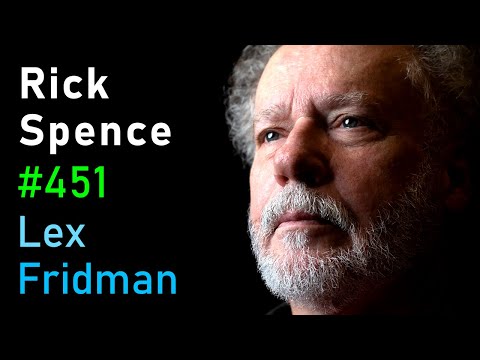
Rick Spence: CIA, KGB, Illuminati, Secret Societies, Cults & Conspiracies | Lex Fridman Podcast #451
Rick Spence (guest), Lex Fridman (host), Lex Fridman (host), Lex Fridman (host), Lex Fridman (host), Lex Fridman (host)
In this episode of Lex Fridman Podcast, featuring Rick Spence and Lex Fridman, Rick Spence: CIA, KGB, Illuminati, Secret Societies, Cults & Conspiracies | Lex Fridman Podcast #451 explores secret Power: Spies, Cults, Killers, and Occult Politics Explained Historian Rick Spence and Lex Fridman trace the hidden history of power, from Russian intelligence and Western agencies to secret societies, cults, and modern conspiracies.
Secret Power: Spies, Cults, Killers, and Occult Politics Explained
Historian Rick Spence and Lex Fridman trace the hidden history of power, from Russian intelligence and Western agencies to secret societies, cults, and modern conspiracies.
They examine how organizations like the Okhrana, KGB, CIA, and FBI operate, especially through infiltration, blackmail, and psychological manipulation, and how these methods echo in scandals like Epstein and programs like MKUltra.
Spence connects esoteric groups (Thule Society, Illuminati, Freemasons, Bohemian Grove) to political movements and ideologies, showing how occult and conspiratorial thinking helped shape Nazism and modern antisemitism.
The conversation closes by probing human nature—our appetite for belonging, ritual, and simple stories—and how those drives make us vulnerable to cults, demagogues, and viral conspiracy narratives.
Key Takeaways
Intelligence agencies thrive on infiltration and controlled chaos, not just information gathering.
From the Okhrana’s deep penetration of revolutionary groups to Soviet moles in Western services, Spence shows that placing agent-provocateurs and turncoats inside target organizations often matters more than pure surveillance.
Get the full analysis with uListen AI
Most spies—and many traitors—are recruited through a mix of money, belief, pressure, and ego (MICE).
Cases like Kim Philby (ego and ideology) and Aldrich Ames (money and resentment) illustrate how overlapping motives are engineered and monitored, often with multiple agents in the same cell to keep each other honest.
Get the full analysis with uListen AI
Borderline-criminal experimentation (e.g., MKUltra) is less a Cold War aberration than a structural temptation.
Once agencies believe mind control or personality-splitting might be possible, they will fund attempts—then push such work into deniable private or academic channels when scrutiny rises and records must be destroyed.
Get the full analysis with uListen AI
Blackmail via sex and kompromat is a timeless tool of power, not a fringe conspiracy trope.
From 1930s occultist Erik Jan Hanussen to Epstein’s filmed encounters and Hoover’s political dossiers, compromising elites for leverage is historically documented—and intelligence services are predisposed to exploit such situations.
Get the full analysis with uListen AI
Secret societies are usually visible but opaque: the secrecy is in actions and aims, not existence.
Groups like the Bohemian Club, Bilderberg, or historical Illuminati are self-selecting, oath-bound networks that cultivate ritual, exclusivity, and ego; they may not literally ‘rule the world’ but do shape who gets heard, vetted, and funded.
Get the full analysis with uListen AI
Occult and ‘magical’ thinking routinely bleed into politics and mass movements, often invisibly.
Spence argues that rituals—from pep rallies to cremation-of-care ceremonies—focus collective will, and that movements like the Thule Society infused early Nazism with mystical nationalism, racial destiny, and esoteric myth-making.
Get the full analysis with uListen AI
Antisemitic mega-narratives like the Protocols endure because they offer simple villains for complex anxieties.
Forged in a milieu of French political scandals, anti-Masonic panic, and Russian right-wing agitation, the Protocols prospered after WWI by providing a ‘turd on a plate’ story many wanted to believe: that a hidden cabal explains all upheaval.
Get the full analysis with uListen AI
Notable Quotes
“Most people, most of the time, are polite, cooperative, and kind, until they're not.”
— Rick Spence
“The basic job of an intelligence agency is to safeguard your secrets and steal the other guy's, and then hide those away.”
— Rick Spence
“Don't become overly bothered trying to figure out whether you actually can bend reality. Become bothered by the fact that there are people who believe that they can and will go to great efforts to do so.”
— Rick Spence
“One of the most important distinctions in life is between what you know and what you believe.”
— Rick Spence
“A turd on a plate is a turd on a plate… and that’s what the Protocols are. They’re just there.”
— Rick Spence
Questions Answered in This Episode
To what extent do you think modern intelligence agencies still cultivate MKUltra-style research indirectly through private or academic fronts, and how could the public ever verify that?
Historian Rick Spence and Lex Fridman trace the hidden history of power, from Russian intelligence and Western agencies to secret societies, cults, and modern conspiracies.
Get the full analysis with uListen AI
Are elite networks like Bohemian Grove and Bilderberg better understood as informal ‘candidate-vetting’ mechanisms rather than literal shadow governments, and what risks does that informal power pose to democratic choice?
They examine how organizations like the Okhrana, KGB, CIA, and FBI operate, especially through infiltration, blackmail, and psychological manipulation, and how these methods echo in scandals like Epstein and programs like MKUltra.
Get the full analysis with uListen AI
How can societies distinguish between legitimate concern about covert power structures and destructive conspiracy thinking that scapegoats entire groups (e.g., Jews, Freemasons) with fabricated narratives?
Spence connects esoteric groups (Thule Society, Illuminati, Freemasons, Bohemian Grove) to political movements and ideologies, showing how occult and conspiratorial thinking helped shape Nazism and modern antisemitism.
Get the full analysis with uListen AI
Given how central ego and belonging are to recruitment in both espionage and cults, what concrete cultural or educational strategies might reduce people’s vulnerability to manipulation by charismatic leaders?
The conversation closes by probing human nature—our appetite for belonging, ritual, and simple stories—and how those drives make us vulnerable to cults, demagogues, and viral conspiracy narratives.
Get the full analysis with uListen AI
Do patterns across cases like Manson, Zodiac, Son of Sam, and the Monster of Florence suggest an organized occult underworld—or are we seeing lone psychopaths retrofitting their crimes to shared myths and media narratives?
Get the full analysis with uListen AI
Transcript Preview
Most people, most of the time, are polite, cooperative, and kind, until they're not.
The following is a conversation with Rick Spence, a historian specializing in history of intelligence agencies, espionage, secret societies, conspiracies, the occult, and military history. This is the Lex Fridman Podcast. To support it, please check out our sponsors in the description. And now, dear friends, here's Rick Spence. You have written and lectured about serial killers, secret societies, cults, and intelligence agencies. So we can basically begin at, uh, any of these fascinating topics. But let's begin with intelligence agencies. Which has been the most powerful intelligence agency in history?
The most powerful intelligence agency in history. I mean, it's an interesting question. I'd say probably in terms of historical longevity and consistency of performance, that the Russian intelligence services, notice I didn't say the KGB specifically, but the Russian intelligence services, going back to the Czarist period, are consistently pretty good. Not infallible. None of them are. Of course, there's a common Western way of looking at anything Russian. Uh, very often, I think this is still the case, Russians are viewed in one of two ways: either they are bumbling idiots, or they are diabolically clever. No sort of middle ground. And you can find both of those examples in this. So what I mean by that is that if you're looking at the modern SVR or FSB, which are just two different organizations that used to be part of the one big KGB, the KGB or its predecessors, the Cheka, you're really going back to the late 19th century and the Imperial Russian intelligence security service, generally known as the Okhrana or Okhranka. It's really the Department of Police, the Special Corps of gendarmes. Their primary job was protecting the Imperial regime and protecting it against Imperial, or rather interior enemies, revolutionaries for the most part. And they got very, very good at that by co-opting people within those movements, infiltrating and recruiting informers, agents provocateurs. In fact, they excelled at the agent provocateur. A person you place inside an organization to cause trouble, usually maneuver them into a position of leadership and they provoke actions that can then allow you to crack down on them. That is, many sort of lure or bring the target organization into an illegal, legal or open status that it can be more effectively suppressed. They were very good at that. So good that by the early 20th century and the years preceding the Russian Revolution in 1917, they had effectively infiltrated every radical party, Bolsheviks, Mensheviks, SRs, great and small, and placed people in positions of influence and leadership, to the point that arguably, that is, you can debate this, but I think on the whole they could largely dictate what those parties did. Nothing was discussed at any central committee meeting of any revolutionary group that the Okhrana wasn't immediately aware of. And they often had people in positions to influence what those decisions were. Of course, that raises an interesting question is that if they were that good and they had infiltrated and effectively controlled most of the opposition, then (laughs) how did the regime get overthrown by revolutionaries? The answer to that is that it wasn't overthrown by revolutionaries. It was overthrown by politicians. That would then take us into a detour into Russian history, but I'll- I'll just leave it with this. If you look at 1917 and you look closely, this is one of the things that I would always tell my students, is that there are two Russian revolutions in 1917. There's the first one in March, or February depending on your calendar, that overthrows Nicholas II. Revolutionaries are really not involved with that. Bolsheviks are nowhere to be seen. Trotsky and Lenin are nowhere to be seen. They have nothing to do with that. That has to do effectively with a political conspiracy within the Russian parliament, the Duma, to unseat an emperor they thought was, you know, bungling the war and was essentially a loser to begin with. And it was a coup d'état, a parliamentary coup d'état. The temporary or provisional government that that revolution put in power was the one overthrown by Lenin eight months later. And that government was essentially one dominated by moderate socialists, it was a government that very quickly sort of turned to the left. You know, the- the guy we associate with that is Alexander Kerensky. Alexander Kerensky was a Russian socialist, a politician. He was the quasi dictator of that regime. He's the person, not the czar, who's overthrown by Lenin. Uh, so the- the revolutionaries, they end- did not prove to be the fatal threat to the Czarist regime. It was the Czarist political system itself that did that. What then transpired was that the Okhrana and its method and many of its agents then immediately segued over into the new Soviet security service. So one of the first things that Lenin did in December of 1917 within a month of seizing power...... since the hold on power was tenuous, at best, was that, well, you were gonna need some kind of organization to infiltrate and suppress those pesky counterrevolutionaries and foreign imperialists and all of the other enemies that we have. And so, the extraordinary commission to combat counterrevolution and sabotage, the Cheka, was formed. You put a veteran Bolshevik, Felix Dzerzhinsky, at the head of that, someone you could politically rely upon. But Dzerzhinsky built his organization essentially out of the Okhrana. I mean, there, you know, there were all of these informers sitting around with nothing, nothing to do, and they were employed. Um, in the early '20s, the kind of rank and file of the Cheka might have been 80 to 90% former Imperial officials. Those were gradually decreased over time. So why would they do that? Well, they were professionals. They also needed to eat, and- and things were somewhat precarious, so if your job is to be an agent provocateur, or if your job is to infiltrate targeted organizations and lead them astray, you do that for whoever pays you. That's part of the professionalism which goes in. And under the Soviets, the Soviet intelligence services are also very good at that. They are very good at infiltrating people into opposing organizations, and I guess the one example I would give to demonstrate that are the Cambridge Five, the British traitors, Soviet standpoint, heroes, who were recruited. You know, most notably Kim Philby, Guy Burgess, Donald Maclean, Anthony Blunt, and there may have been well more than five, but, you know, that wasn't bad out of just Cambridge. Uh, and then placing those people in high positions, the- the ultimate goal, of course, is to get your people into positions of leadership and influence in the opposing intelligence service, and so they did. Of course, it all fell apart and they ended up in, you know, uh, Philby ended up living the last part of his life in exile in Moscow, but they got their money's worth out of him. And you can also find this in KGB infiltration of the CIA, the FBI, the Aldrich Ames, uh, Robert Hansen cases. Of course, we- we were infiltrating, by we I mean the Americans and the West, managed to infiltrate our moles as well. But if it came down, you know, someone could dispute this, but I would think if you, we're gonna come down to a kind of like a- a- a who had the most moles Super Bowl, probably the Soviets would come somewhat ahead of that.
Install uListen to search the full transcript and get AI-powered insights
Get Full TranscriptGet more from every podcast
AI summaries, searchable transcripts, and fact-checking. Free forever.
Add to Chrome