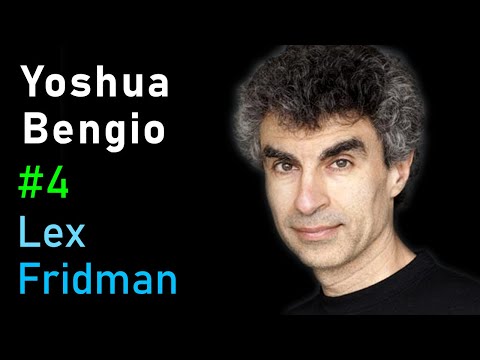
Yoshua Bengio: Deep Learning | Lex Fridman Podcast #4
Lex Fridman (host), Yoshua Bengio (guest)
In this episode of Lex Fridman Podcast, featuring Lex Fridman and Yoshua Bengio, Yoshua Bengio: Deep Learning | Lex Fridman Podcast #4 explores yoshua Bengio on credit assignment, world models, and AI’s future Yoshua Bengio discusses the gaps between biological and artificial neural networks, focusing on long-term credit assignment, memory, and the need for richer world models. He argues that current deep learning is too shallow in abstraction and overly dependent on passive supervised learning, and that progress requires new training frameworks emphasizing causality, active agents, and disentangled high-level representations. Bengio connects these technical issues to broader themes like symbolic vs. neural approaches, generalization to new distributions, and the importance of machine teaching. He also touches on AI safety, societal impacts, bias and ethics, how science actually progresses, and his own motivations and persistence through the AI winter.
Yoshua Bengio on credit assignment, world models, and AI’s future
Yoshua Bengio discusses the gaps between biological and artificial neural networks, focusing on long-term credit assignment, memory, and the need for richer world models. He argues that current deep learning is too shallow in abstraction and overly dependent on passive supervised learning, and that progress requires new training frameworks emphasizing causality, active agents, and disentangled high-level representations. Bengio connects these technical issues to broader themes like symbolic vs. neural approaches, generalization to new distributions, and the importance of machine teaching. He also touches on AI safety, societal impacts, bias and ethics, how science actually progresses, and his own motivations and persistence through the AI winter.
Key Takeaways
Long-term credit assignment is a central missing capability in current neural networks.
Humans can revise decisions based on evidence years later, while RNNs and LSTMs struggle beyond hundreds of time steps; understanding the brain’s mechanisms here could inspire more powerful, biologically inspired learning algorithms.
Get the full analysis with uListen AI
Improving AI will require new training objectives and learning frameworks, not just bigger models or better architectures.
Bengio stresses that scaling depth or parameters alone won’t yield deep understanding; we need objectives that drive causal explanation, active intervention in the world, curiosity-driven exploration, and agent-based learning.
Get the full analysis with uListen AI
Robust intelligence demands joint learning of language and world models, grounded in causality.
Training separately on images/videos and text produces shallow understanding; aligning language with rich, causally structured models of the environment can enable higher-level semantic concepts and better comprehension of sentences about the real world.
Get the full analysis with uListen AI
Disentangling both variables and mechanisms is key to generalization and avoiding catastrophic forgetting.
Neural nets currently encode knowledge in an entangled “blob” of parameters; Bengio argues for representations where causal factors are separated and the relationships between them (rules/mechanisms) are also modular, enabling reuse, compositionality, and more stable learning.
Get the full analysis with uListen AI
True generalization requires capturing stable causal structure that transfers across distributions.
Humans can understand science fiction worlds because underlying physics and social regularities carry over; similarly, AI must learn distribution-robust causal mechanisms, not just patterns tied to a fixed training distribution.
Get the full analysis with uListen AI
Near- and medium-term AI risks (surveillance, weapons, jobs, power concentration, discrimination) are more pressing than speculative existential threats.
Bengio likens long-term existential risk study to researching meteor impacts—worth academic work but not the central public concern—arguing that policy should focus now on regulating misuse, bias, and structural harms from current systems.
Get the full analysis with uListen AI
Machine teaching and human-in-the-loop learning will be critical for future AI systems.
Beyond passive annotation, Bengio envisions teachers (eventually humans) that actively guide agents at the edge of their competence, and calls for more research on optimal teaching strategies to make human–AI interaction more efficient and effective.
Get the full analysis with uListen AI
Notable Quotes
“Current state-of-the-art neural nets have some level of understanding, but it's very basic. It's not nearly as robust and abstract and general as our understanding.”
— Yoshua Bengio
“I don't think that having more depth in the network, in the sense of instead of 100 layers we have 10,000, is going to solve our problem.”
— Yoshua Bengio
“The crucial thing is more the training objectives, the training frameworks… going from passive observation of data to more active agents which learn by intervening in the world.”
— Yoshua Bengio
“There's something really powerful that comes from distributed representations… and it's hard to replicate that kind of power in a symbolic world.”
— Yoshua Bengio
“Listen to your inner voice. Don’t be trying to just please the crowds and the fashion.”
— Yoshua Bengio
Questions Answered in This Episode
How might we realistically implement biologically inspired long-term credit assignment in modern deep learning systems without prohibitive computation?
Yoshua Bengio discusses the gaps between biological and artificial neural networks, focusing on long-term credit assignment, memory, and the need for richer world models. ...
Get the full analysis with uListen AI
What concrete training objectives could drive neural networks to learn explicit causal models rather than just statistical correlations?
Get the full analysis with uListen AI
How can we design architectures or learning schemes that disentangle both high-level variables and the mechanisms (rules) linking them, while retaining the power of distributed representations?
Get the full analysis with uListen AI
What forms of regulation and standardized techniques should be mandated today to meaningfully reduce bias and discrimination in deployed AI systems?
Get the full analysis with uListen AI
In practice, how could machine teaching frameworks be integrated into everyday AI tools so that non-experts can efficiently “teach” systems in the loop?
Get the full analysis with uListen AI
Transcript Preview
What difference between biological neural networks and artificial neural networks is most mysterious, captivating, and profound for you?
First of all, there is so much we don't know about biological neural networks.
Right.
And that's very mysterious and captivating, because maybe it holds the key to improving artificial neural networks. One of the things I studied recently, uh, something that we don't know how biological neural networks do, but would be really useful for artificial ones, is the ability to do credit assignment through very long time spans. There are things that we can, in principle, do with artificial neural nets, but it's not very convenient, and it's not biologically plausible. And this mismatch, I think, this kind of mismatch may be an interesting thing to study to, A, understand better how brains might do these things, 'cause we don't have good corresponding theories with artificial neural nets, and B, maybe provide new ideas that we could explore about, um, things that brain do differently, and that we could incorporate in artificial neural nets.
So, let's break credit assignment up a little bit.
Yes.
So, what ... It's a beautifully technical term, but it can incorporate so many things. So, is it more on the RNN memory side, that, thinking like that? Or is it something about knowledge, building up common sense knowledge over time? Or is it, uh, more in the reinforcement learning sense, that you're picking up rewards over time for a particular, uh, to achieve a certain kind of goal?
So, I was thinking more about the first two meanings, whereby we store all kinds of memories, um, episodic memories in our brain, which we can access later in order to help us both infer causes of things that we are observing now, and assign credit to decisions or interpretations we came up with a while ago when, you know, those memories were stored. And then we can change the way we would have, uh, reacted or interpreted things in the past, and now that's credit assignment used for learning.
So, in which way do you think artificial neural networks, the current LSTM, the current architectures are not able to capture the ... Presumably, you're, you're, you're thinking of very long term.
Yes. So, current, recurrent nets are doing a fairly good jobs for sequences with dozens, or say, hundreds of time stamps, and then it gets sort of harder and harder, and depending on what you have to remember and so on, as you consider longer durations. Whereas humans seem to be able to do credit assignment through essentially arbitrary times. Like, I, I could remember something I did last year, and then now, because I see some new evidence, I'm gonna change my mind about, uh, the way I was thinking last year, and hopefully not do the same mistake again.
I think a big part of that is probably forgetting. You're only remembering the really important things, so it's very efficient forgetting. Um-
Install uListen to search the full transcript and get AI-powered insights
Get Full TranscriptGet more from every podcast
AI summaries, searchable transcripts, and fact-checking. Free forever.
Add to Chrome