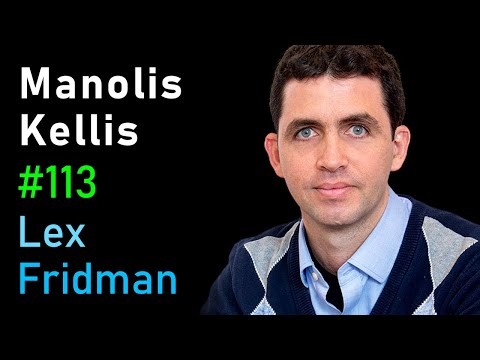
Manolis Kellis: Human Genome and Evolutionary Dynamics | Lex Fridman Podcast #113
Lex Fridman (host), Manolis Kellis (guest), Lex Fridman (host)
In this episode of Lex Fridman Podcast, featuring Lex Fridman and Manolis Kellis, Manolis Kellis: Human Genome and Evolutionary Dynamics | Lex Fridman Podcast #113 explores digital Life, Human Genome, and Evolution’s Messy, Beautiful Intelligence Unveiled Lex Fridman and Manolis Kellis explore the human genome as a digital code underlying life, emphasizing how discrete genetic inheritance and massive variation shape both our individuality and shared humanity.
Digital Life, Human Genome, and Evolution’s Messy, Beautiful Intelligence Unveiled
Lex Fridman and Manolis Kellis explore the human genome as a digital code underlying life, emphasizing how discrete genetic inheritance and massive variation shape both our individuality and shared humanity.
They contrast vertical genetic inheritance with horizontal cultural inheritance, arguing that education, the internet, and language create a second, rapidly evolving 'genome' of ideas.
Kellis explains evolutionary dynamics in detail—from human height and immune genes to yeast and coronaviruses—using them to argue that evolution is brutally simple, messily implemented, but astonishingly powerful and robust.
They close by reflecting on AI, brain–computer interfaces, language, and parenting, with Kellis suggesting that the very quest for meaning—and passing knowledge and love to others—may itself be the meaning of life.
Key Takeaways
Life is fundamentally digital, but its expression is analog and complex.
Genomes store information in discrete units (nucleotides and genes), which allows high-fidelity inheritance, yet traits emerge as continuous spectra because thousands of tiny genetic contributions and environmental effects blend together.
Get the full analysis with uListen AI
Humans are both almost identical and unimaginably unique, which has ethical implications.
Any two people share about 99. ...
Get the full analysis with uListen AI
Human evolution is shaped by both genes and a powerful second system: cultural inheritance.
Unlike most animals, humans spend years in a malleable 'neotenous' state where brains can be rewired by education, culture, and now the internet—creating a horizontal flow of ideas that evolves far faster than DNA.
Get the full analysis with uListen AI
Comparative genomics and evolutionary signatures let us infer function from patterns of change.
By aligning genomes across many species and examining how regions mutate, scientists can distinguish protein-coding genes from regulatory elements, discover hidden genes, and understand which viral mutations (like in SARS‑CoV‑2 spike) confer adaptive advantages.
Get the full analysis with uListen AI
Evolution is not 'smart' in intent, but selection produces designs that look intelligent.
Random mutation plus ruthless natural selection yields elegant solutions (like coronavirus gene organization), yet these solutions arise without foresight; recognizing this helps avoid anthropomorphizing viruses or genes while still respecting their sophistication.
Get the full analysis with uListen AI
Biology prioritizes robustness and adaptability—an approach engineering can learn from.
Genomes tolerate vast amounts of mutation and use redundancy, duplication, and messy recombination to discover new functions, suggesting that engineered systems and AI might benefit from similar tolerance for failure and exploration beyond rigid modular design.
Get the full analysis with uListen AI
Health, immunity, and even response to pandemics are deeply tied to lifestyle and evolution.
Exercise, diet, microbiome composition, prior infections, and vaccination history all shape our immune response, while past selective events (e. ...
Get the full analysis with uListen AI
Notable Quotes
“We are not the inventors of the first digital computer; we are the descendants of the first digital computer.”
— Manolis Kellis
“Any two people on the planet are 99.9% identical. How can you fight with someone who is 99.9% identical to you?”
— Manolis Kellis
“Evolution has two components: random, blind and stupid mutation, and super smart, ruthless selection.”
— Manolis Kellis
“If engineers had designed evolution, we would still be perfectly replicating bacteria.”
— Manolis Kellis
“The very symposium was illustrating the quest for meaning, which might itself be the meaning of life.”
— Manolis Kellis
Questions Answered in This Episode
How does recognizing the digital nature of the genome change how we think about identity, responsibility, and free will?
Lex Fridman and Manolis Kellis explore the human genome as a digital code underlying life, emphasizing how discrete genetic inheritance and massive variation shape both our individuality and shared humanity.
Get the full analysis with uListen AI
In what concrete ways could software engineering and AI design adopt evolutionary principles of robustness and 'productive messiness'?
They contrast vertical genetic inheritance with horizontal cultural inheritance, arguing that education, the internet, and language create a second, rapidly evolving 'genome' of ideas.
Get the full analysis with uListen AI
Given the power of horizontal information transfer online, how should education systems change to teach epistemology and source evaluation rather than just facts?
Kellis explains evolutionary dynamics in detail—from human height and immune genes to yeast and coronaviruses—using them to argue that evolution is brutally simple, messily implemented, but astonishingly powerful and robust.
Get the full analysis with uListen AI
What ethical obligations arise from knowing that traits like obesity risk, immunity, and even some psychological tendencies are partly genetically encoded?
They close by reflecting on AI, brain–computer interfaces, language, and parenting, with Kellis suggesting that the very quest for meaning—and passing knowledge and love to others—may itself be the meaning of life.
Get the full analysis with uListen AI
How might a deeper understanding of language evolution and translation inform the development of more human-like natural language processing systems?
Get the full analysis with uListen AI
Transcript Preview
The following is a conversation with Manolis Kellis. He's a professor at MIT and head of the MIT Computational Biology Group. He's interested in understanding the human genome from a computational, evolutionary, biological, and other cross-disciplinary perspectives. He has more big impactful papers and awards than I can list. But most importantly, he's a kind, curious, brilliant human being, and just someone I really enjoy talking to. His passion for science and life in general is contagious. The hours honestly flew by, and I'm sure we'll talk again on this podcast soon. Quick summary of the ads. Three sponsors, Blinkist, Eight Sleep, and MasterClass. Please consider supporting this podcast by going to blinkist.com/lex, eightsleep.com/lex and signing up at masterclass.com/lex. Click the links, buy the stuff, get the discount. It's the best way to support this podcast. If you enjoy this thing, subscribe on YouTube, review it with five stars on Apple Podcasts, support it on Patreon, or connect with me on Twitter @LexFridman. As usual, I'll do a few minutes of ads now and never any ads in the middle that can break the flow of the conversation. This episode is supported by Blinkist, my favorite app for learning new things. Get it at blinkist.com/lex for a seven-day free trial and 25% off afterwards. Blinkist takes the key ideas from thousands of non-fiction books and condenses them down into just 15 minutes that you can read or listen to. I'm a big believer in reading at least an hour every day. As part of that, I use Blinkist every day to try out a book I may otherwise never have a chance to read. And in general, it's a great way to broaden your view of the idea landscape out there and find books that you may want to read more deeply. With Blinkist, you get unlimited access to read or listen to a massive library of condensed non-fiction books. Go to blinkist.com/lex to try it free for seven days and save 25% off your new subscription. That's blinkist.com/lex. Blinkist, spelled B-L-I-N-K-I-S-T. This show is also sponsored by Eight Sleep and its Pod Pro mattress that you can check out at eightsleep.com/lex to get $200 off. It controls temperature with an app and can cool down to as low as 55 degrees on each side of the bed separately. Research shows that temperature has a big impact on the quality of our sleep. Anecdotally, that's been true for me. It's truly been a game changer. I love it. The Pod Pro is packed with sensors that track heart rate, heart rate variability, and respiratory rate, showing it all in their app. The app's health metrics are amazing, but the cooling alone is honestly worth the money. Check it out at eightsleep.com/lex to get $200 off. This show is also sponsored by MasterClass. Sign up at masterclass.com/lex to get a discount and to support this podcast. When I first heard about MasterClass, I thought it was too good to be true. For 180 bucks a year, you get an all-access pass to watch courses from, to list some of my favorites, Chris Hadfield on space exploration, Neil deGrasse Tyson on scientific thinking and communication, Will Wright, one of my favorite game designers, Carlos Santana, one of my favorite guitar players, Garry Kasparov, of course, the greatest chess player of all time, I'm not biased, Daniel Negreanu on poker, and many more. Chris Hadfield explaining how rockets work and the experience of being launched into space alone is worth the money. By the way, you can watch it on basically any device. Once again, sign up at masterclass.com/lex to get a discount and to support this podcast. And now, here's my conversation with Manolis Kellis. What to you is the most beautiful aspect of the human genome?
Install uListen to search the full transcript and get AI-powered insights
Get Full TranscriptGet more from every podcast
AI summaries, searchable transcripts, and fact-checking. Free forever.
Add to Chrome