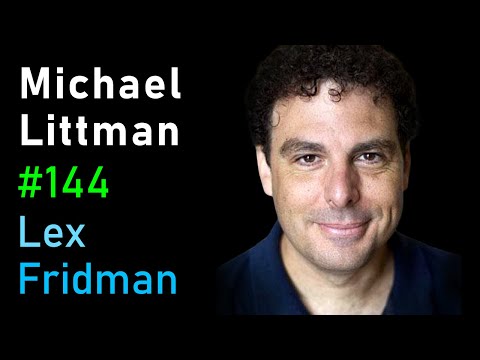
Michael Littman: Reinforcement Learning and the Future of AI | Lex Fridman Podcast #144
Lex Fridman (host), Michael Littman (guest)
In this episode of Lex Fridman Podcast, featuring Lex Fridman and Michael Littman, Michael Littman: Reinforcement Learning and the Future of AI | Lex Fridman Podcast #144 explores reinforcement Learning, AGI Fears, and Human Quirkiness with Michael Littman Lex Fridman and Michael Littman discuss the history and promise of reinforcement learning, from early temporal-difference methods and TD-Gammon to AlphaGo and modern self-play systems. They explore fears around AGI and existential risk, with Littman arguing that true superintelligence requires long, human-guided development rather than a sudden, uncontrollable leap. The conversation widens into the societal impact of AI and social media, the role of interaction in language and intelligence, and the limits of scale-alone approaches like GPT-3. Interwoven throughout are personal stories about teaching, music, commercials, parody songs, self-driving cars, and the meaning of life as a balancing act.
Reinforcement Learning, AGI Fears, and Human Quirkiness with Michael Littman
Lex Fridman and Michael Littman discuss the history and promise of reinforcement learning, from early temporal-difference methods and TD-Gammon to AlphaGo and modern self-play systems. They explore fears around AGI and existential risk, with Littman arguing that true superintelligence requires long, human-guided development rather than a sudden, uncontrollable leap. The conversation widens into the societal impact of AI and social media, the role of interaction in language and intelligence, and the limits of scale-alone approaches like GPT-3. Interwoven throughout are personal stories about teaching, music, commercials, parody songs, self-driving cars, and the meaning of life as a balancing act.
Key Takeaways
Reinforcement learning’s power lies in learning behavior over time, not just mappings from inputs to outputs.
Littman emphasizes that RL grew from an interest in behavior and temporal prediction (TD-learning), distinguishing it from classical supervised learning and making it a natural framework for studying intelligence as adaptive action.
Get the full analysis with uListen AI
Breakthroughs like TD-Gammon and AlphaGo depended as much on human craftsmanship as on algorithms.
He argues that systems such as TD-Gammon worked because of “neural net whisperers” like Gerry Tesauro and heavy engineering effort, cautioning against attributing progress solely to generic algorithms rather than human insight and tuning.
Get the full analysis with uListen AI
AlphaGo was a bigger conceptual leap than AlphaGo Zero, which mostly removed a crutch.
For Littman, the first success—combining deep learning, search, and RL to beat top Go players—was the real watershed; once that machinery worked, taking away human game records (AlphaGo Zero) was impressive but unsurprising refinement.
Get the full analysis with uListen AI
AGI “fast takeoff” fears overlook how much we’ll learn while building powerful systems.
Littman is skeptical that a superintelligence will suddenly appear and destroy us; he expects that creating genuinely capable, world-acting systems will force us to deeply understand and shape them long before they pose existential threats.
Get the full analysis with uListen AI
Language models need interactive feedback, not just more text, to approach real understanding.
He views GPT-style systems as extraordinarily good imitators of surface statistics, but fundamentally limited without live interaction where humans push back, correct, and force the system to grapple with nuance and consequence.
Get the full analysis with uListen AI
Driving is as much a social inference problem as a control problem.
Teaching his kids to drive revealed to Littman how heavily humans rely on signaling and theory of mind—predicting what other drivers and pedestrians think and intend—highlighting a major unsolved challenge for autonomous vehicles.
Get the full analysis with uListen AI
Relying purely on compute scaling (the ‘bitter lesson’) is inherently limited.
He points out that Moore’s Law and related trends will hit economic and physical constraints, so betting everything on simple, massively-scaled methods is risky; deeper algorithmic and structural insights will still be necessary.
Get the full analysis with uListen AI
Notable Quotes
“One of the things we're learning from AI is where we are smart and where we are not smart.”
— Michael Littman
“I am not particularly moved by the idea that if we're not careful, we will accidentally create a superintelligence that will destroy human life.”
— Michael Littman
“It doesn’t mean computers are smarter than we realize; it partly means people are dumber than we realize.”
— Michael Littman
“Computers couldn’t have done it without people, but people couldn’t have done it without computers.”
— Michael Littman
“For me, the meaning of life in one word is balance.”
— Michael Littman
Questions Answered in This Episode
If self-play and scale can produce superhuman performance in games, what additional ingredients are required to transfer that success to messy, open-ended real-world domains?
Lex Fridman and Michael Littman discuss the history and promise of reinforcement learning, from early temporal-difference methods and TD-Gammon to AlphaGo and modern self-play systems. ...
Get the full analysis with uListen AI
How can we design AI systems and training processes that incorporate meaningful interactive feedback from humans without being limited by the slow, expensive nature of human attention?
Get the full analysis with uListen AI
In practical terms, what would it look like to build AI that respects and supports the inherently social nature of tasks like driving, rather than treating them as purely geometric or optimization problems?
Get the full analysis with uListen AI
Given the ‘bitter lesson’ and looming limits of Moore’s Law, where should research invest most heavily: in algorithmic innovation, better compute, or richer human–AI collaboration paradigms?
Get the full analysis with uListen AI
How can society encourage broader “programming literacy” so more people can shape and question the software systems that increasingly govern their lives?
Get the full analysis with uListen AI
Transcript Preview
The following is a conversation with Michael Littman, a computer science professor at Brown University, doing research on and teaching machine learning, reinforcement learning, and artificial intelligence. He enjoys being silly and light-hearted in conversation, so this was definitely a fun one. Quick mention of each sponsor, followed by some thoughts related to the episode. Thank you to SimpliSafe, a home security company I use to monitor and protect my apartment; ExpressVPN, the VPN I've used for many years to protect my privacy on the internet; Masterclass, online courses that I enjoy from some of the most amazing humans in history; and BetterHelp, online therapy with a licensed professional. Please check out these sponsors in the description to get a discount and to support this podcast. As a side note, let me say that I may experiment with doing some solo episodes in the coming month or two. The three ideas I have floating in my head currently is to use, one, a particular moment in history; two, a particular movie; or three, a book, to, uh, drive a conversation about a set of, uh, related concepts. For example, I could use 2001: A Space Odyssey or Ex Machina to talk about AGI for one, two, three hours. Or I could do an episode on the, uh, yes, rise and fall of Hitler and Stalin each in a separate episode, using relevant books and historical moments for reference. I find the format of a solo episode very uncomfortable and challenging, but that just tells me that it's something I definitely need to do and learn from the experience. Of course, I hope you come along for the ride. Also, since we have all this momentum built up on announcements, I'm giving a few lectures on machine learning at MIT this January. In general, if you have ideas for the episodes, for the lectures, or for just short videos on YouTube, let me know in the comments that I still definitely read despite my better judgment and the wise sage advice of the great Joe Rogan. If you enjoy this thing, subscribe on YouTube, review it with five stars on Apple Podcast, follow on Spotify, support on Patreon, or connect with me on Twitter @lexfridman. And now, here's my conversation with Michael Littman. I saw a video of you talking to Charles Isbell about Westworld, the TV series. You guys were doing the kind of thing where you're watching new things together. But let's rewind back. Is there a sci-fi movie or book or shows that you. That was profound, that had an impact on you philosophically or just, like, specifically something you enjoyed nerding out about?
(laughs) Yeah, interesting. I think a lot of us have been inspired by robots in movies. The one that I really like is, uh, there's a movie called Robot and Frank, which I think is really interesting 'cause it's very near-term future, where, uh, robots are being deployed as, uh, helpers in people's homes.
Install uListen to search the full transcript and get AI-powered insights
Get Full TranscriptGet more from every podcast
AI summaries, searchable transcripts, and fact-checking. Free forever.
Add to Chrome