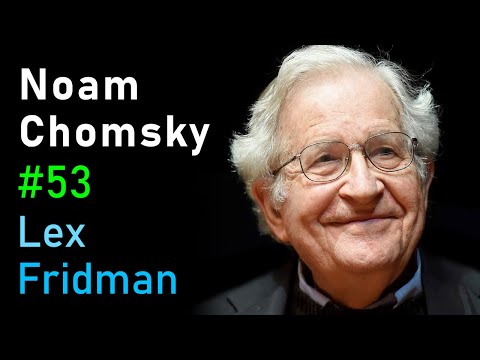
Noam Chomsky: Language, Cognition, and Deep Learning | Lex Fridman Podcast #53
Lex Fridman (host), Noam Chomsky (guest), Lex Fridman (host)
In this episode of Lex Fridman Podcast, featuring Lex Fridman and Noam Chomsky, Noam Chomsky: Language, Cognition, and Deep Learning | Lex Fridman Podcast #53 explores noam Chomsky on Language, Human Limits, and AI’s Blind Spots Lex Fridman interviews Noam Chomsky about the nature of language, cognition, and the limits of human and machine intelligence. Chomsky explains language as an internal mental faculty that underlies thought, with external speech being a secondary use, and argues that language is central to human reasoning and creativity. He contends that biological systems, including our cognitive capacities, have built‑in scope and limits, illustrated historically by physics’ acceptance of unintelligible phenomena. Chomsky is skeptical that deep learning reveals much about human language or mind, seeing it as useful engineering but weak science, and closes with reflections on human nature, institutions, mortality, and life’s self-created meaning.
Noam Chomsky on Language, Human Limits, and AI’s Blind Spots
Lex Fridman interviews Noam Chomsky about the nature of language, cognition, and the limits of human and machine intelligence. Chomsky explains language as an internal mental faculty that underlies thought, with external speech being a secondary use, and argues that language is central to human reasoning and creativity. He contends that biological systems, including our cognitive capacities, have built‑in scope and limits, illustrated historically by physics’ acceptance of unintelligible phenomena. Chomsky is skeptical that deep learning reveals much about human language or mind, seeing it as useful engineering but weak science, and closes with reflections on human nature, institutions, mortality, and life’s self-created meaning.
Key Takeaways
Language is primarily an internal system that underlies thought.
Chomsky argues that what we call language is chiefly a mental faculty localized in the brain, which generates structured thoughts; speech and writing are secondary ‘externalizations’ of this inner system.
Get the full analysis with uListen AI
Language and arithmetic-like structure may be universal enough for alien communication.
Referencing Marvin Minsky’s work with simple Turing machines, Chomsky suggests that any sufficiently intelligent species would likely have arithmetic, and that human language’s core operations approximate arithmetic, offering a possible shared basis for communication.
Get the full analysis with uListen AI
Human cognition has both rich scope and hard biological limits.
Just as our genes allow complex mammalian vision but preclude insect eyes or wings, our cognitive endowment enables powerful reasoning but likely blocks certain forms of understanding, challenging the assumption that humans can in principle comprehend everything.
Get the full analysis with uListen AI
A key property of language is structure dependence, not simple word order.
Interpretation often relies on hierarchical structure rather than linear proximity (e. ...
Get the full analysis with uListen AI
Deep learning is useful engineering but currently weak cognitive science.
Chomsky sees systems like Google Translate as valuable tools that find patterns in huge corpora, but notes they are optimized for coverage of random ‘experiments’ (sentences), not for testing theoretical questions, and they can perform just as well on languages that violate known principles of human grammar.
Get the full analysis with uListen AI
Technological extensions, including brain–machine interfaces, expand access, not basic capacity.
Like books, brain–computer interfaces can increase bandwidth and external memory, but Chomsky doubts they can fundamentally transcend our native biological cognitive limits, only re-present information in forms we can already handle.
Get the full analysis with uListen AI
Meaning and significance of life are created by our own actions.
For Chomsky, there is no external, universal “meaning” to human existence; the significance of a life is determined by what individuals do, value, and build—relationships, inquiry, creativity, and struggles against illegitimate authority.
Get the full analysis with uListen AI
Notable Quotes
“Most of your use of language is thought, internal thought.”
— Noam Chomsky
“There may be limits to understanding. We understand the theories, but the world that they describe doesn’t make any sense.”
— Noam Chomsky
“Science tries to find critical experiments… It doesn’t care about coverage of millions of experiments.”
— Noam Chomsky
“A book expands your cognitive capacity. This [brain–machine interface] could expand it too. But it’s not a fundamental expansion.”
— Noam Chomsky
“The significance of your life is something you create.”
— Noam Chomsky
Questions Answered in This Episode
If human cognition has hard biological limits, how should that change the goals and methods of scientific research and AI development?
Lex Fridman interviews Noam Chomsky about the nature of language, cognition, and the limits of human and machine intelligence. ...
Get the full analysis with uListen AI
What kind of experiments or evidence would convince Chomsky that deep learning can illuminate the structure of human language, not just engineer useful tools?
Get the full analysis with uListen AI
How might understanding structure dependence and other universal properties of language influence the design of future natural language processing systems?
Get the full analysis with uListen AI
In what concrete ways can individuals and societies reshape institutions so they reflect an “instinct for freedom” rather than domination?
Get the full analysis with uListen AI
If the meaning of life is created by our actions, what kinds of projects, relationships, or pursuits best embody that in Chomsky’s own view?
Get the full analysis with uListen AI
Transcript Preview
The following is a conversation with Noam Chomsky. He's truly one of the great minds of our time and is one of the most cited scholars in the history of our civilization. He has spent over 60 years at MIT and recently also joined the University of Arizona where we met for this conversation. But it was at MIT about four and a half years ago when I first met Noam. My first few days there I remember getting into an elevator at Stata Center, pressing the button for whatever floor, looking up and realizing it was just me and Noam Chomsky riding the elevator. Just me and one of the seminal figures of linguistics, cognitive science, philosophy and political thought in the past century, if not ever. I tell that silly story because I think life is made up of funny little defining moments that you never forget for reasons they may be too poetic to try and explain. That was one of mine. Noam has been an inspiration to me and millions of others. It was truly an honor for me to sit down with him in Arizona. I traveled there just for this conversation, and in a rare heartbreaking moment after everything was set up and tested the camera was moved and accidentally the recording button was pressed stopping the recording. So I have good audio of both of us but no video of Noam, just the video of me and my sleep-deprived but excited face that I get to keep as a reminder of my failures. Most people just listen to this audio version for the podcast as opposed to watching it on YouTube, but still it's heartbreaking for me. I hope you understand and still enjoy this conversation as much as I did. The depth of intellect that Noam showed and his willingness to truly listen to me, a silly-looking Russian in a suit, it was humbling and something I'm deeply grateful for. As some of you know, this podcast is a side project for me, where my main journey and dream is to build AI systems that do some good for the world. This latter effort takes up most of my time, but for the moment has been mostly private. But the former, the podcast, is something I put my heart and soul into and I hope you feel that even when I screw things up. I recently started doing ads at the end of the introduction. I'll do one or two minutes after introducing the episode and never any ads in the middle that break the flow of the conversation. I hope that works for you and doesn't hurt the listening experience. This is the Artificial Intelligence Podcast. If you enjoy it, subscribe on YouTube, give it five stars on Apple Podcasts, support it on Patreon, or simply connect with me on Twitter @lexfridman, spelled F-R-I-D-M-A-N. This show is presented by Cash App, the number one finance app in the App Store. I personally use Cash App to send money to friends, but you can also use it to buy, sell, and deposit bitcoin in just seconds. Cash App also has a new investing feature. You can buy fractions of a stock, say $1 worth, no matter what the stock price is. Broker services are provided by Cash App Investing, a subsidiary of Square and member SIPC. I'm excited to be working with Cash App to support one of my favorite organizations called FIRST, best known for their FIRST Robotics and Lego competitions. They educate and inspire hundreds of thousands of students in over 110 countries and have a perfect rating on Charity Navigator which means the donated money is used to maximum effectiveness. When you get Cash App from the App Store or Google Play and use code LEXPODCAST you'll get $10 and Cash App will also donate $10 to FIRST, which again is an organization that I've personally seen inspire girls and boys to dream of engineering a better world. And now here's my conversation with Noam Chomsky. I apologize for the absurd philosophical question-
Install uListen to search the full transcript and get AI-powered insights
Get Full TranscriptGet more from every podcast
AI summaries, searchable transcripts, and fact-checking. Free forever.
Add to Chrome