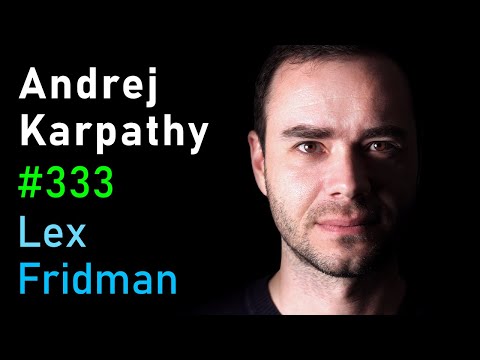
Andrej Karpathy: Tesla AI, Self-Driving, Optimus, Aliens, and AGI | Lex Fridman Podcast #333
Andrej Karpathy (guest), Lex Fridman (host), Narrator, Narrator
In this episode of Lex Fridman Podcast, featuring Andrej Karpathy and Lex Fridman, Andrej Karpathy: Tesla AI, Self-Driving, Optimus, Aliens, and AGI | Lex Fridman Podcast #333 explores andrej Karpathy on AI, AGI, aliens, and humanity’s explosive future Lex Fridman and Andrej Karpathy range across technical and philosophical territory: how modern neural networks work, the transformer’s importance, Software 2.0, large-scale data engines, and Tesla’s vision-based self-driving and humanoid robots.
Andrej Karpathy on AI, AGI, aliens, and humanity’s explosive future
Lex Fridman and Andrej Karpathy range across technical and philosophical territory: how modern neural networks work, the transformer’s importance, Software 2.0, large-scale data engines, and Tesla’s vision-based self-driving and humanoid robots.
Karpathy argues that current AI systems already exhibit nontrivial understanding and reasoning, and that scaling data, models, and multimodal inputs will likely lead to AGI, possibly without physical embodiment.
They explore the origins and prevalence of life in the universe, the Fermi paradox, whether our universe is a simulation with possible “exploits,” and how future synthetic intelligences might solve the universe’s “puzzle.”
The conversation closes on ethics, safety, human meaning, longevity, and what a world of ubiquitous AI agents, humanoid robots, and virtual realities might look like, with Karpathy cautiously optimistic yet acutely aware of existential risks.
Key Takeaways
Transformers act as a general-purpose differentiable computer and underpin modern AI progress.
Karpathy views the transformer as a powerful, relatively simple architecture that is expressive in the forward pass, trainable with backpropagation, and highly parallelizable on GPUs—making it the de facto backbone for language, vision, and multimodal models.
Get the full analysis with uListen AI
Data, not hand-coded logic, is the new center of software—“Software 2.0.”
Instead of writing rules, engineers design architectures and, crucially, build large, diverse, accurate datasets plus loss functions; optimization “fills in the blanks” in the weights, so the real programming happens via data curation and iteration loops (data engines).
Get the full analysis with uListen AI
Vision-only self-driving is both necessary and, Karpathy argues, sufficient.
He claims cameras provide the richest, cheapest constraints on the world and match the human sensor stack that roads are designed for; additional sensors like radar or lidar add organizational and data complexity, so they must deliver large gains to justify their cost—and often don’t.
Get the full analysis with uListen AI
Large language models already exhibit a form of understanding and reasoning.
Trained on next-token prediction, GPT-like systems must implicitly learn physics, chemistry, human behavior, and many tasks embedded in text; their ability to solve novel problems via prompting indicates genuine generalization rather than simple pattern lookup.
Get the full analysis with uListen AI
Embodiment (e.g., humanoid robots) is a powerful but not strictly necessary path to AGI.
Karpathy thinks AGI may emerge from scaled multimodal internet models alone, but sees Optimus-style humanoid robots as a high-certainty hedge: if AGI requires acting in and learning from the physical world, a large fleet of human-form robots will eventually discover the needed algorithms.
Get the full analysis with uListen AI
Interstellar travel and alien detection are likely far harder than life’s emergence.
After reading origin-of-life work (e. ...
Get the full analysis with uListen AI
AGI and nuclear weapons share a key property: tiny perturbations can flip outcomes from good to catastrophic.
He worries that beneficial AGI applications will be developed first, but many failure modes might be only a “minus sign away” in objective functions or deployment choices—creating a razor-thin safety margin similar to that around nuclear arsenals.
Get the full analysis with uListen AI
Notable Quotes
“We’re not writing the algorithm anymore; we’re writing the dataset.”
— Andrej Karpathy
“A transformer is basically a general-purpose differentiable computer that happens to run extremely well on our hardware.”
— Andrej Karpathy
“Vision is both necessary and sufficient for driving. Roads are built for human eyes.”
— Andrej Karpathy
“I kind of think of neural nets as a very complicated alien artifact.”
— Andrej Karpathy
“I suspect the universe is some kind of a puzzle, and synthetic AIs will uncover that puzzle and solve it.”
— Andrej Karpathy
Questions Answered in This Episode
If transformers are such a strong default, what kind of architectural change—if any—could realistically surpass them?
Lex Fridman and Andrej Karpathy range across technical and philosophical territory: how modern neural networks work, the transformer’s importance, Software 2. ...
Get the full analysis with uListen AI
How far can text-only or internet-only training go before embodiment or real-world interaction becomes a hard requirement for AGI?
Karpathy argues that current AI systems already exhibit nontrivial understanding and reasoning, and that scaling data, models, and multimodal inputs will likely lead to AGI, possibly without physical embodiment.
Get the full analysis with uListen AI
What concrete mechanisms or institutions could meaningfully reduce AGI catastrophic risk, given how small the gap is between helpful and harmful capabilities?
They explore the origins and prevalence of life in the universe, the Fermi paradox, whether our universe is a simulation with possible “exploits,” and how future synthetic intelligences might solve the universe’s “puzzle.”
Get the full analysis with uListen AI
How should society handle proof-of-personhood and identity when sophisticated AI agents can convincingly imitate humans at scale?
The conversation closes on ethics, safety, human meaning, longevity, and what a world of ubiquitous AI agents, humanoid robots, and virtual realities might look like, with Karpathy cautiously optimistic yet acutely aware of existential risks.
Get the full analysis with uListen AI
In a world with humanoid robots and immersive virtual realities, what aspects of human life and meaning do you expect to remain fundamentally unchanged?
Get the full analysis with uListen AI
Transcript Preview
... think it's possible that physics has exploits and we should be trying to find them, uh, arranging some kind of a crazy quantum mechanical system that somehow gives you buffer overflow, uh, somehow gives you a rounding error in the floating point. Synthetic intelligences are kind of like the next stage of development. And I don't know where it leads to. Like, at some point, I suspect the universe is some kind of a puzzle. These synthetic AIs will uncover that puzzle and solve it.
The following is a conversation with Andrej Karpathy, previously the director of AI at Tesla, and before that, at OpenAI and Stanford. He is one of the greatest scientist-engineers and educators in the history of artificial intelligence. This is the Lex Fridman podcast. To support it, please check out our sponsors. And now, dear friends, here's Andrej Karpathy. What is a neural network and why does it seem to, uh, do s- such a surprisingly good job of learning?
What is a neural network? It's a mathematical abstraction of the brain. I would say that's how it was originally developed. At the end of the day, it's a mathematical expression and it's a fairly simple mathematical expression when you get down to it. It's basically a sequence of, uh, matrix multiplies, which are really dot products mathematically and, uh, some non-linearities thrown in. And so it's a very simple mathematical expression and it's got knobs in it.
Many knobs.
Many knobs. And these knobs are loosely related to basically the synapses in your brain. They're trainable, they're modifiable. And so the idea is, like, we need to find the setting of the knobs that makes the neural net, uh, do whatever you want it to do, like classify images and so on. And so there's not too much mystery I would say in it. Like, um, you might think that basically don't want to endow it with too much meaning with respect to the brain and, uh, how it works. Uh, it's really just a complicated mathematical expression with knobs and those knobs need a proper setting, uh, for it to do something, uh, desirable.
Yeah, but poetry is just a collection of letters with spaces-
(laughs) .
... but it can make us feel a certain way.
Yeah.
And in that same way when you get a large number of knobs together, whe- whether it's in a, inside the brain or inside a computer, they seem to, they seem to surprise us with the, with their power.
Yeah. I think that's fair. So basically, uh, I'm underselling it by a lot because-
Yes (laughs) .
... you definitely do get very surprising emergent behaviors out of these neural nets when they're large enough and trained on complicated enough problems. Like say, for example, the next, uh, word prediction in a massive data set from the internet. And, uh, then these neural nets take on, uh, pretty surprising magical properties. Yeah, I think it's kind of interesting how much you can get out of even very simple mathematical formalism.
Install uListen to search the full transcript and get AI-powered insights
Get Full TranscriptGet more from every podcast
AI summaries, searchable transcripts, and fact-checking. Free forever.
Add to Chrome