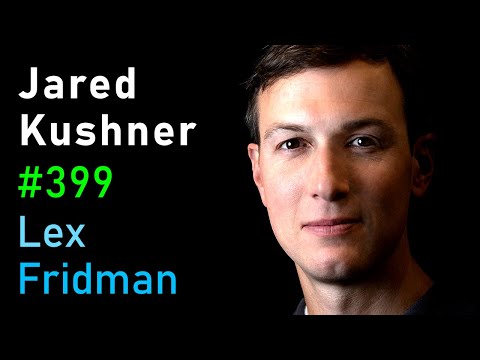
Jared Kushner: Israel, Palestine, Hamas, Gaza, Iran, and the Middle East | Lex Fridman Podcast #399
Lex Fridman (host), Jared Kushner (guest)
In this episode of Lex Fridman Podcast, featuring Lex Fridman and Jared Kushner, Jared Kushner: Israel, Palestine, Hamas, Gaza, Iran, and the Middle East | Lex Fridman Podcast #399 explores jared Kushner dissects Hamas attack, Middle East peace, and power Jared Kushner joins Lex Fridman to react to the October 7 Hamas attack and to lay out his view of Hamas, Gaza, Iran’s role, and Israel’s likely objectives in the ensuing war. He argues that Hamas is both a terrorist proxy of Iran and the primary obstacle to Palestinian prosperity, framing Gazans as hostages of Hamas rather than beneficiaries.
Jared Kushner dissects Hamas attack, Middle East peace, and power
Jared Kushner joins Lex Fridman to react to the October 7 Hamas attack and to lay out his view of Hamas, Gaza, Iran’s role, and Israel’s likely objectives in the ensuing war. He argues that Hamas is both a terrorist proxy of Iran and the primary obstacle to Palestinian prosperity, framing Gazans as hostages of Hamas rather than beneficiaries.
Kushner contrasts the Trump and Biden administrations’ approaches to the Middle East, claiming Trump-era maximum pressure on Iran and the Abraham Accords created a uniquely stable region, and that subsequent policy reversals empowered Iran and its proxies. He details the logic and mechanics behind the Abraham Accords, his economic plan for Palestinians, and his broader philosophy of negotiation: trust, first‑principles thinking, and re‑engineering incentives.
The conversation widens into U.S. domestic politics, criminal justice reform, Russia–Ukraine, China, Saudi Arabia and MBS, and Kushner’s personal experiences with public scandal, his father’s imprisonment, and working quietly behind the scenes. Throughout, he stresses strength, economic opportunity, and interpersonal trust as the only durable bases for peace.
Kushner closes with a cautiously optimistic view of the Middle East and humanity’s future, arguing that if leaders prioritize security plus economic flourishing—and if individuals choose dialogue over hatred—transformative progress remains possible even after severe setbacks.
Key Takeaways
Hamas’s strategy makes Palestinian suffering structurally inevitable under its rule.
Kushner argues that Hamas diverts materials and funds from civilian projects into tunnels and weapons, uses civilians as shields, and rejects economic planning—meaning outside aid without governance reform cannot translate into better lives for Gazans.
Get the full analysis with uListen AI
Iran’s proxy model is central to understanding the current conflict dynamics.
He frames Hamas, Hezbollah, and the Houthis as Iranian proxies used to fight indirectly, destabilize the region, and block U. ...
Get the full analysis with uListen AI
Changing incentive structures is more important than repeating diplomatic formulas.
Kushner criticizes decades of peace processing where Israeli settlements and Palestinian cash both grew after every failure, and says he tried to flip this by producing a concrete, map‑based plan tied to economic investment that would reward compromise, not stalemate.
Get the full analysis with uListen AI
Arab–Israeli normalization can proceed independently of the Palestinian track—and may ultimately help it.
The Abraham Accords, he says, broke the long‑standing linkage that no Arab state would normalize with Israel before Palestinian statehood, creating people‑to‑people ties, religious access, and economic corridors that could later benefit Palestinians if governance changes.
Get the full analysis with uListen AI
Strong, sometimes unpredictable U.S. power can deter war and unlock deals.
Kushner contends that Trump’s willingness to impose tariffs, strike adversaries, and depart from conventional wisdom (e. ...
Get the full analysis with uListen AI
Trust, direct communication, and listening are Kushner’s core tools in negotiation.
He emphasizes operating off‑camera, asking leaders what they would do in his position, using back channels (e. ...
Get the full analysis with uListen AI
Personal adversity shaped a results‑driven, stoic approach to politics.
Experiences like his father’s imprisonment and the Russia‑collusion investigations led Kushner to focus only on controllable factors, avoid public grandstanding, and judge political work by concrete outcomes (peace deals, legislation) rather than media narratives.
Get the full analysis with uListen AI
Notable Quotes
“There cannot be peace in Israel and in the Middle East while there is a terror group, funded by Iran, that is allowed to flourish and plan operations aiming to kill innocent civilians.”
— Jared Kushner
“In Gaza you have basically 2.2 million people being held hostage by 30,000 Hamas terrorists.”
— Jared Kushner
“The end of a political problem set is always the beginning of a new paradigm.”
— Jared Kushner
“Most political prognosticators are wrong. Outcomes in the world are usually driven by the decisions of humans.”
— Jared Kushner
“If President Trump was in office, this never would have happened.”
— Jared Kushner
Questions Answered in This Episode
To what extent is Kushner’s characterization of Hamas and Palestinian governance complete, and what crucial perspectives from Palestinians themselves are missing?
Jared Kushner joins Lex Fridman to react to the October 7 Hamas attack and to lay out his view of Hamas, Gaza, Iran’s role, and Israel’s likely objectives in the ensuing war. ...
Get the full analysis with uListen AI
How plausible is his claim that the Abraham Accords and maximum pressure on Iran made the October 7 attack “completely avoidable,” and what alternative causal stories exist?
Kushner contrasts the Trump and Biden administrations’ approaches to the Middle East, claiming Trump-era maximum pressure on Iran and the Abraham Accords created a uniquely stable region, and that subsequent policy reversals empowered Iran and its proxies. ...
Get the full analysis with uListen AI
Can Arab–Israeli normalization truly advance Palestinian self‑determination, or does it risk further sidelining their political agency in favor of state‑to‑state interests?
The conversation widens into U. ...
Get the full analysis with uListen AI
What are the ethical and strategic limits of using economic leverage (sanctions, investment, conditional aid) as a primary tool in conflict resolution?
Kushner closes with a cautiously optimistic view of the Middle East and humanity’s future, arguing that if leaders prioritize security plus economic flourishing—and if individuals choose dialogue over hatred—transformative progress remains possible even after severe setbacks.
Get the full analysis with uListen AI
How should we evaluate Kushner’s and Trump’s foreign‑policy record given both the peace deals he cites and the longer‑term trajectories we see now in Gaza, Ukraine, and great‑power competition with China?
Get the full analysis with uListen AI
Transcript Preview
The following is a conversation with Jared Kushner, former senior advisor to the president during the Donald Trump administration, and author of Breaking History: A White House Memoir. He's one of the most influential and effective presidential advisors in modern history, helping conduct negotiations with some of the most powerful leaders in the world, and deliver results on trade, criminal justice reform, and historic progress towards peace in the Middle East. On Thursday, October 5th, we recorded a conversation on topics of war and peace, history and power in the Middle East and beyond. This was about a day and a half before the Hamas attack on Israel. And then we felt we must sit down again on Monday, October 9th, and have a discussion on the current situation. We open the podcast with this second newly recorded part. My heart goes out to everyone who has and is suffering in this war. I pray for your strength, and for the long term peace and flourishing of the Israeli and Palestinian people. I love you all. This is the Lex Fridman Podcast. And now, dear friends, here's Jared Kushner. We did a lot of this conversation before the Hamas attack on Israel, and we decided to sit down again, and finish the discussion to address the current situation, which is still developing. If I may, allow me to summarize the situation as it stands today. It's morning, Monday, October 9th. On Saturday, October 7th at 6:30 AM Israel time, Hamas fired thousands of rockets into Southern Israel. The rocket attacks served as cover for a multi-pronged infiltration of Israel territory by over 1,000 Hamas militants. This is shortly after, at 7:40 AM. The Hamas militants went door to door in border towns, killing civilians and taking captives, including women and children. In response to this, Israeli Air Force began carrying out strikes in Gaza, also fighting on the ground in Israel to clear out Hamas militants from Israel territory, and preparing to mobilize Israeli troops for potential ground attack on Hamas in Gaza. Now, of course, this is what it appears to be right now, and this, along with other things, might change, because the, the situation is still developing. The IDF is ordering civilian residents of Gaza to evacuate their homes for their safety. Benjamin Netanyahu declared war in several statements, and warned Israelis to brace themselves for a long and difficult war. Just today, Israeli ministers ordered a, quote, "complete siege of Gaza, interrupting supplies of electricity, food, water and fuel from Israel to Gaza." As of now, October 9th, the death toll is over 1,200 people and over 130 hostages taken to Gaza by Hamas. Uh, so as I said, the events are rapidly unfolding, so these numbers will sadly increase. Uh, but hopefully our words here can at least, in part, speak to the, the timeless underlying currents of, uh, the history, and, uh, as you write about, the power dynamics of the region. So for people who don't know, Gaza is a 25 miles long, 6 miles wide strip of territory along the Mediterranean Sea. It borders Israel on the east and north, and Egypt on the southwest. It's densely populated, about 2.3 million people. And there's been a blockade of Gaza by Israel and Egypt since 2007 when Hamas took power. I could just summarize that Hamas is a Palestinian militant group which rules the Gaza Strip. It originated in 1988, and it came to power in Gaza in 2006. As part of its charter, it's sworn to the destruction of Israel, and it is designated by the United States, European Union, UK, and of course, Israel as a terrorist group. So given that context, what are your feelings as a human being, uh, and what is your analysis as the former senior advisor to the president under the Trump administration of the current situation in Israel and Gaza?
Install uListen to search the full transcript and get AI-powered insights
Get Full TranscriptGet more from every podcast
AI summaries, searchable transcripts, and fact-checking. Free forever.
Add to Chrome